MEMETERIA

Icon

Arts writing by Thomas May

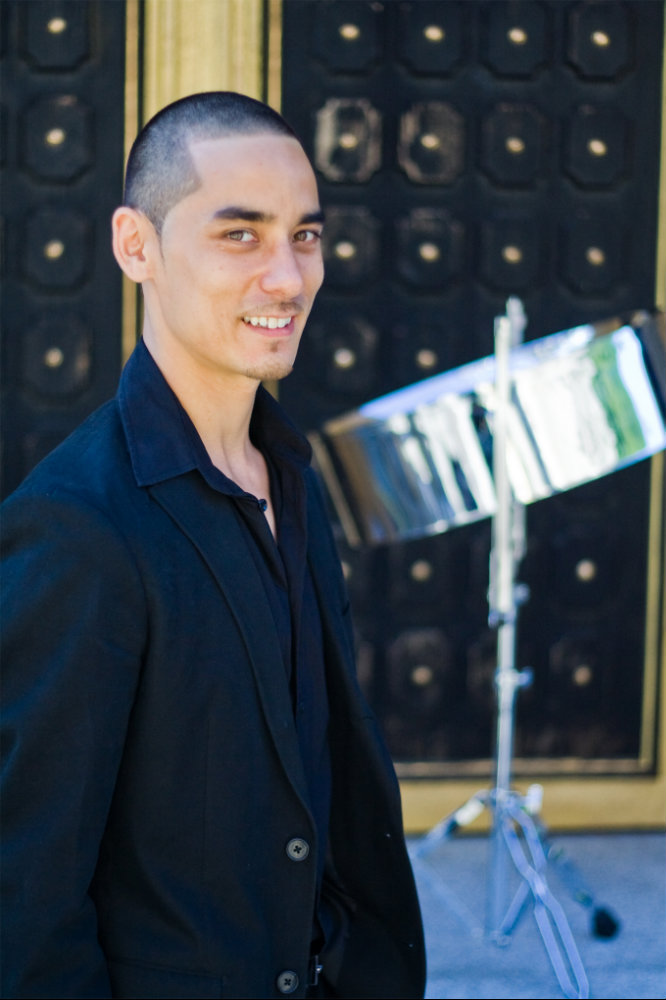
Beneath Lighted Coffers

Andy Akiho; photo by Aestheticize Media

Andy Akiho; photo by Aestheticize Media

The National Symphony Orchestra’s program this weekend, conducted by Manuel López-Gómez, is titled Rhythms of the Americas. It will include the world premiere of a new Concerto for Steelpan by the composer and percussionist Andy Akiho, who was recently named winner of the The Lili Boulanger Memorial Fund.

Here’s a taste of what to expect from Andy’s new concerto. Inspired by the Pantheon in Rome, he has given the piece an evocative title: Beneath Lighted Coffers:

When the National Symphony undertook its first international concert tour under Music Director Christoph Eschenbach’s leadership in June 2012-playing at venues across the Americas-the Republic of Trinidad and Tobago was among its destinations. The NSO performed a concert in honor of the 50th anniversary of the Republic’s independence from the United Kingdom, and the following day Music Director Christoph Eschenbach was presented with a steelpan by the Prime Minister in gratitude. A tuned percussion instrument made of sheet metal that was invented in Trinidad and Tobago in the 20th century, the steelpan is a fitting symbol for the Republic’s independence from colonial domination. At that occasion Maestro Eschenbach announced that the NSO would commission a concerto for this marvelously versatile instrument.

continue reading

Filed under: National Symphony, new music, percussion, program notes

New Music from Bryce Dessner

Getting commissioned to write a percussion piece to be paired with your mentor David Lang’s the so-called laws of nature is a pretty impressive vote of confidence. And the result was Bryce Dessner‘s enchanting Music for Woods and Strings  (2013), commissioned by Carnegie Hall.

This piece has just been released on Sō Percussion’s new album. Dessner, also known as the guitarist for The National, describes the “chord stick” process he devised for the work: “Using sticks or violin bows, the players can sound either of two harmonies, or play individual strings, melodies, and drone tremolos.” This “hybrid dulcimer” sound, which he likens to “chord hockets,” shows the inspiration of American folk song tradition in its warmly layered rhythmic counterpoint.

The Los Angeles Philharmonic will premiere Dessner’s latest piece, Quilting, as part of the Next on Grand Festival of contemporary American composers, which has just gotten under way (with John Adams to lead a program on Tuesday.

A couple years ago, Dessner compiled a list of his own favorite contemporary works for BoingBoing, including both Adams’s Shaker Loops and John Luther Adams’s For Lou Harrison. I approve the man’s taste.

Filed under: American music, Bryce Dessner, David Lang, John Adams, John Luther Adams, Los Angeles Philharmonic, new music

The Horror! The Horror!

Daniel Cilli; © Steve di Bartolomeo

Daniel Cilli; © Steve di Bartolomeo

I wish I’d been able to see the American premiere of Tarik O’Regan’s opera based on Joseph Conrad’s Heart of Darkness. It was given by San Francisco’s Opera Parallèle in an all-too-brief production.

The intrepid Lisa Hirsch reports:

All things considered, it’s something of a surprise that Tarik O’Regan’s opera Heart of Darkness took four years to reach the United States after its 2011 premiere at the Royal Opera’s Linbury Studio Theatre. Its brevity and eloquence, as well as the small forces it requires, make it a natural for adventurous opera companies everywhere.

Leave it to the ever-alert Opera Parallèle, champion of contemporary and 20th-century opera, to remedy the situation. Its production, strongly cast and beautifully played, scores another success for the company and makes a strong case for the opera.”

Here’s Joshua Kosman’s assessment:

The immersive qualities of the opera have two sources. One is the kaleidoscopic inventiveness of O’Regan’s score, which uses a chamber ensemble and vivid vocal writing to conjure up the moral miasma of the African interior as Marlow encounters it, and to delineate the few nuggets of action that move the plot forward.”

And over at Bachtrack, Jamie Robles writes:

Opera Parallèle’s production visuals enhance the move from scene to scene, adding to the music’s flow. A large screen fills the back of the stage, and across it projections splash colorful images of Ohio-based illustrator Matt Kish, taken from his book interpreting The Heart of Darkness, which offers one illustration for each page of the novella. Kish’s work is similar to that of many graphic novel artists: highly stylized with geometric and simplified forms; the colors are bright and primary with heavy black outlines. The imagery has the simplicity of cartoons, and also their instantaneous impact. Interestingly, the artwork was similar to Phillips’ graphic reworkings of the pages in The Humument.

Filed under: new music, Tarik O'Regan

Penderecki’s Concerto Grosso for Three Cellos

Krzysztof_Penderecki

I’m looking forward to Christoph Eschenbach’s concert with the National Symphony Orchestra tonight. Here’s one of the notes I wrote for the program — on the Concerto Grosso for Three Cellos by Krzysztof Penderecki:

The remarkably lengthy and productive career of Krzysztof Penderecki might be regarded as a kind of microcosm of some of the (seemingly) contradictory tendencies in contemporary music. Penderecki first came to international attention as an avant-garde artist who pushed his experiments with texture to bold extremes, at times bordering on “noise,” in such pieces as Threnos (also known as Threnody to the Victims of Hiroshima (1960)-a piece initially titled 8’37” in tribute to John Cage, whose chance aesthetics and other revolutionary attitudes made Cage a profoundly influential figure for several important composers of the Polish Renaissance (as the postwar flowering of new music in that country has been called).

continue reading

Filed under: Eschenbach, National Symphony Orchestra, new music

Salonen’s Nyx

Here’s a recent program essay I wrote on Esa-Pekka Salonen’s Nyx. The composer himself is conducting the San Francisco Symphony this week in a program that includes The Firebird and Ravel’s Mother Goose.

To music lovers, the mention of Finland seems to conjure the ghost of Sibelius. For the gifted Finnish composers of Esa-Pekka Salonen’s generation in particular, Sibelius is a commanding presence. And yet such “anxiety of influence” can indeed generate creative innovation. Over the past several decades there has emerged an extraordinary generation of creative thinkers staking out new territory, and the once-marginalized Finland has turned into a progenitor of some of today’s most interesting composers.

continue reading

Filed under: new music, Salonen

Trimpin the Light Fantastic

Trimpin's Gurs Zyklus; photo courtesy Nic Dahlquist, Stanford Lively Arts

Trimpin’s Gurs Zyklus; photo courtesy Nic Dahlquist, Stanford Lively Arts

I’m unable to attend this week’s world premiere of Trimpin’s latest project, Above, Below, and In Between, a commission from the Seattle Symphony and Ludovic Morlot.

But to mark the occasion, here’s a feature I wrote a few years ago in conjunction with the Seattle premiere of Trimpin’s Gurs Zyklus at On the Boards:

Contemporary composers are so routinely described as “crossing barriers” and “defying genres” that these tags have become meaningless clichés. But Trimpin genuinely resists categorization.

The familiar labels aren’t much help in trying to define his unusual career. Based in Seattle for over three decades, the German-born Trimpin follows a path that zigzags wildly, unbound by conventional parameters. He’s a kinetic sculptor working with sound, an installation artist, an inventor, an instrument builder who combines the insatiable curiosity of artist and scientist alike with the old-fashioned know-how of a craftsman.

Trimpin’s work can be encountered in museums (the tornado of guitars at EMP), in natural environments, and even in venues like Terminal A in Sea-Tac Airport, where travelers unwittingly activate his 80-foot-long kinetic sculpture of gadgets and instruments as they pass alongside on a rolling walkway. But his latest big project breaks new ground even for Trimpin. Receiving its Seattle premiere this Thursday through Sunday at On the Boards, The Gurs Zyklus is as unclassifiable as the MacArthur “genius” award-winning artist himself.

The Gurs Zyklus places his vision as a composer, inventor, and builder within the context of music theater. Originally commissioned by Stanford University’s Lively Arts program and given its world premiere there last May, the work has been reconfigured as a site-specific work for On the Boards. “It’s being presented as a three-sided staging and will feel very intimate in our main stage theater space,” says artistic director Lane Czaplinski. “You feel you’re inside the work, as in a sculpture, as opposed to on the outside watching.”

The production marks the first time since the early 1990s that On the Boards has hosted the work of Trimpin and of Obie Award-winning director Rinde Eckert, who is collaborating on the theatrical conception of The Gurs Zyklus. It’s an especially good fit, Czaplinski adds, since it represents “that in-between category which is the future of opera and music theater. People don’t yet know quite how to talk about it, but this is what we do at On the Boards.”

The creative process underlying the work, Trimpin explains, was fueled by a desire to transform the inert facts of history and information into “other forms of expression: notation, music, sound sculpture design, and performance.” It also represents the artist’s attempt to come to terms with memories that have haunted him since his childhood in a small town in southwestern Germany, where Gerhard Trimpin was born in 1951. (Long ago he officially lopped off his first name.) He recalls chancing upon an overgrown Jewish cemetery as a youngster and becoming intrigued by the Hebrew inscriptions on the headstones,” which he thought resembled “mysterious hieroglyphs.”

But the fate of the Jewish population was a taboo topic in those early postwar years. Eventually Trimpin learned that in October 1940 the Nazis had rounded up all of the town’s Jews and sent them by train to the internment camp of Gurs. Located to the southwest, in the French Pyrenees close to the Spanish border, Gurs was run by the collaborative Vichy government but had been operating since the 1930s, when the French first used it to control the influx of refugees from Franco’s forces in the Spanish Civil War.

A profile of Trimpin by Jean Strouse called “Perpetual Motion” in the New Yorker in May 2006 caught the attention of Victor Rosenberg. His mother had come from the same hometown (Efringen-Kirchen ) and his uncle was interned at Gurs. Rosenberg contacted Trimpin, offering to let him access to a shoebox full of letters mailed from the camp to his father. This became the trigger for The Gurs Zyklus, which, says Trimpin, “is about the challenge of learning, deciphering, investigating, wanting to know more about what is happening.”

Other remarkable connections from Trimpin’s own experience began to illuminate the past. In the late 1980s he had become friends with fellow maverick composer Conlon Nancarrow, for example, but only later learned that Nancarrow himself had spent time as a prisoner at Gurs in its earlier phase, after fighting with the Abraham Lincoln Brigade against Franco’s Fascists. Trimpin decided to retrace the journey from his hometown to Gurs, recording the sounds of the train and the announcements at each stop. And as he was developing The Gurs Zyklus during a year-long residency at Stanford, by chance he encountered a local resident who had been sent to Gurs as a young boy.

All of these links to Gurs became strands of the work, which blends aspects of opera, oratorio, staged installation, and memory play. Its musical and symbolic elements range widely. Clicking castanets mimic a message being sent in Morse code as Spanish Fascists order the assassination of Federico García Lorca. This reference to the struggle in which Nancarrow took part — the score also incorporates his music — ominously foreshadows the darkness descending over Europe. Trimpin’s script and sequence of visual imagery draws from the Rosenberg letters. Along with their despairing reports of everyday conditions, the letters express a poignant hope for release from the camp.

The raw material gathered from his own trip to Gurs — the sounds of the train trip, the innocuous-sounding roll call of place names — provides the “information” that becomes transformed into a powerfully resonant narrative. Even the patterns on tree bark samples taken from Gurs are translated into musical notation, giving voice at last to these silent “witnesses” of what took place. Trimpin also uses instruments he has invented for other pieces, such as the “Fire Organ” — a contraption of glass tubes and Bunsen burners that emits sounds with a texture uncannily similar to the human voice. While interacting with his students at Stanford, Trimpin designed other mechanical elements specifically for The Gurs Zyklus, constructing the most intricate components in his three-storey studio in Madrona.

All of Trimpin’s projects share this one-of-a-kind aura. Yet while much of his work evokes a sense of delighted whimsy with the sheer bravura of its invention — a “Dr. Seuss,” as Czaplinski puts it —The Gurs Zyklus explores a dark past, pushing beyond the expressive limits of conventional instruments and easily digested narrative chronology. The essence of its dramaturgy lies in the metaphorical combinations of sound and visual images, of isolated memories that turn out to be interconnected. Site-specific acoustical perceptions are also integral to the piece. “These are events that don’t make sense at first,” Trimpin remarks. How to decipher them “is then up to the individual. The audience’s understanding comes from their own interpretation of what they have just experienced.”

(c) 2015 Thomas May. All rights reserved.

Filed under: American music, new music, Seattle Symphony

Zabur

Mohammed Fairouz; photo by Samantha West

Mohammed Fairouz; photo by Samantha West

A notable premiere by composer Mohammed Fairouz is being given tonight by the Indianapolis Symphony: Zabur, to a libretto by Najla Said.

From Scott Shoger’s interview with the composer about this contemporary war requiem:

Fairouz:

Zabur is the most persistently and overwhelmingly dark pieces that I’ve ever written, although it doesn’t end in that darkness. It ends in a wonderful image of children in the sunlight like the end of Mahler’s Kindertotenlieder. Sometimes as an artist, part of the job description is to go into psychological and emotional places that the rest of the world would avoid.

[…]

Zabur begins with a great outcry and destruction that proves to be a flash-forward or premonition of what will happen — that everyone in the shelter will be destroyed. I was debating with myself how to end the piece, but I decided to bring back the children’s choir to sing, “The children of your servants will live on forever.” It’s an absolutely heartbreaking ending, but with the sound of the children, you have this group of 100-some children in Indianapolis connecting artistically, in some way, to their brothers and sisters half a world away in Syria who are suffering. There’s something very moving about that.

Filed under: American music, new music

Music for Easter Weekend

Kings_college_cambridge_ceiling

For this Easter weekend, you can stream the Good Friday performance of Scottish composer James MacMillan’s St. Luke Passion from King’s College, Cambridge (the compose conducts).

In a recent interview with Boosey & Hawkes, MacMillan speaks about the work:

I’ve always enjoyed a fruitful fascination with the Passion story, and there are deep reasons through history why artists and composers have been attracted to it, right up to our own times. The story is compelling and the images are powerful, prompting a variety of responses. Each time I return to it I try and find different perspectives. Some works are purely instrumental reflections following Haydn’s example, such as my Fourteen Little Pictures for piano trio, or the Triduum of orchestral works written in the mid-90s. Others follow more familiar formats with choir, such as the Seven Last Words from the Cross or the St John Passion.

As to why he chose the narrative found in Luke’s gospel:

My setting of the St John Passion took a particular approach, examining the human drama, and was almost operatic in impact. So returning after a five-year interval I wanted to take an alternative direction. St John stands apart from the other three so-called synoptic Gospel writers who share structure and common material and, of those three, St Luke has a special appeal for me. As well as relating Christ’s life and teachings, Luke is concerned with the idea of the Kingdom of God which points forward to the same author’s Acts of the Apostles. This started me thinking about a more spiritual, inward, and pared-back approach to create a focused work about an hour long.

Meanwhile, here is the incomparable Jordi Savall conducting Bach’s St. Matthew Passion (featuring Le Concert des Nations at the Palau de la Música Catalana, Barcelona).

Not to be missed, even if not specifically Holy Week-related: Bach’s Mass in B minor from Sir John Eliot Gardiner’s recent tour with the English Baroque Soloists and Monteverdi Choir (which included a stop at the Lucerne Easter Festival; this performance is from the Paris Philharmonie.

For good measure, here’s Johann’s son Carl Philipp Emanuel Bach’s cantata on the Resurrection and Ascension of Jesus, Wq240:

The culmination of Mahler’s Symphony No. 2 (“Resurrection”), a composition tailor-made for Leonard Bernstein:

Finally, from John Adams’s The Gospel According to the Other Mary (Act 2, scene 5 (“Burial/Spring – Mary Awakens on the Third Morning”):

Filed under: Bach, Easter, John Adams, new music, spirituality

Sounds of Water, Rituals of Rebirth: Tan Dun’s Water Passion

water-passion

My essay on Tan Dun’s Water Passion, which is being performed next weekend by Grant Gershon and the LA Master Chorale, is now live:

In 2013 the peripatetic Tan Dun traveled to the Thomaskirche in Leipzig to conduct his Water Passion in the very space in which J.S. Bach had introduced the St. Matthew Passion nearly three centuries ago (most likely in 1727). The gesture underlined the kind of cross-cultural counterpoint that lies at the heart of the Chinese composer’s oratorio.

The full title reads Water Passion after St. Matthew, yet Tan also models his work on his reading of Bach’s monumental precedent. It might even be titled Water Passion after St. Matthew after Bach — the second “after” being taken in its double sense of “according to” and “postdating” (for a contemporary world).

continue reading

Filed under: choral music, essay, Los Angeles Master Chorale, new music

Orpheus Ascending: Mohammed Fairouz’s New CD

follow-poet

Mohammed Fairouz’s Follow, Poet is among the most inspiring CDs I’ve encountered in quite a while. For one thing, it documents two recent works by a composer who brings to the new-music scene not just a fresh voice but a powerful intellect and — most significantly — an unclouded vision of art’s potential for our jaded age. A vision that is ambitious without being naive.

Fairouz, still just south of 30, has already channeled his imagination into an astonishing gamut of genres, from intimate chamber works to concertos and major-scale symphonies (four to date!), choral pieces, and opera and other theater works. And with Follow, Poet, he is the youngest composer in the history of Deutsche Grammophon to have an entire album devoted to his works.

Such ample gifts could easily run aground with compromised or even downright hackwork production just to fulfill the commissions that seem to be piling up from all sides. (Alas, not an uncommon phenomenon.) But start listening to the song cycle Audenesque, one of the gems featured on Follow, Poet, and you find yourself in the hands of an artist who crafts the musical equivalent of a page-turner: the first song sets the stage for W.H. Auden’s masterful elegy In Memory of W.B. Yeats with a gripping blend of musical images, a mix of restless churning and numb melancholy.

In place of mere accompaniment or wallpaper “illustration” of Auden’s own images, Fairouz builds a sound world that vividly engages with the elegy’s aesthetic agenda, which is organized into three stages as three separate but interlinked songs. First is the despairing indifference of the “real world” in response to the artist’s death, followed by a reflection on the actual difference poetry can make. The elegy culminates in the moving breakthrough of renewal in the third song, with its promise of “the healing fountain.”

Fairouz’s music beautifully amplifies the oracular-in-the-ordinary tone characteristic of Auden. An additional layer enriches the cycle by bridging Auden’s elegy with the present era as Fairouz appends a fourth song, his setting of the late Irish poet Seamus Heaney’s Audensque.

Auden paid homage to Yeats as the exemplary poet, and Heaney’s poem feelingly, and with humor, eulogizes fellow poet Joseph Brodsky (who died in 1996 — on the same date on which Yeats had died). The music forges still another link in this chain of connection, becoming the composer’s elegy for Heaney (the poet had befriended Fairouz near the end of his life).

In a short booklet essay, the conductor/musicologist Leon Botstein provides an eloquent appraisal of Fairouz’s musical pedigree and approach. You can hear the sensibility he shares with Samuel Barber (the unforced lyricism, with its elegiac undertow), Kurt Weill (the accessibility that nevertheless forces you to listen actively, without the crutch of easy sentiment), and Gustav Mahler (the narrative punch, along with the pointed details of Fairouz’s chamber orchestration); an arresting harmonic pattern at the climax of the Auden poem meanwhile casts its Philip Glass-like spell. Yet the perspective Fairouz brings to his influences is strongly individual, never sounding eclectic.

The other musical work is Sadat, a chamber ballet being released here ahead of its stage premiere (to be given in late May 2015 by the Mimesis Ensemble at Carnegie Hall). Cast in five brief but representative scenes, Sadat distills a portrait of the slain Egyptian leader Anwar Sadat.

Like Audenesque, the wordless ballet score manifests the theatrical and narrative instincts that figure so prominently in Fairouz’s compositions. Whether the scene is of public mourning or an intimate encounter between the young army officer and his fiancée, a minimum of musical gestures is needed to establish the atmosphere.

Sadat‘s chamber orchestration centers around a characterful array of tuned and untuned percussion (including highly colorful writing for xylophone). Fairouz’s use of these instruments alludes more directly to the Middle Eastern sound world that contributes important elements to the Arab-American composer’s palette — he even calls for the sound of a shofar — though similar gestures are subtly present in his scoring of Audenesque as well.

The performances are sympathetic, alluring, dramatically crisp. Evan Rogister leads the Ensemble LPR, a group of 14 musicians associated with New York’s admired “alternative” performance venue, Le Poisson Rouge. With its warmth, variety of colors, and flexibility, Kate Lindsey’s mezzo is ideally suited to Fairouz’s vocal writing. His lines trace their own musical sense while remaining alert to the sounds and rhythmic life of the words.

Follow, Poet is also the inaugural release in an innovative series — Return to Language — that Elizabeth Sobol, the president of Universal Music Classics, has launched to explore the synergy between music and words.

To that end, the album includes separate tracks of the Pulitzer Prize-winning poet Paul Muldoon reciting the poems set to music by Fairouz, along with a couple of brief excerpts from speeches by President John F. Kennedy extolling the power of poetry.

“I believe in cultivating a respect and love for depth of language and reflection and expression, even in the age of Twitter and YouTube, when some of that seems in danger of being eroded,” says Sobol. “And it has always been the interrelatedness of literature and music that has touched me most deeply in art — the exponential power of storytelling when you join words and music.”

It’s a highly laudable effort that deserves to have a widespread audience — and the choice of music by Mohammed Fairouz to kick it off shows that UMC is on the right track.

–(c)2015 Thomas May. All rights reserved.

Filed under: CD reviews, Mohammed Fairouz, new music, poetry, programming, review

Archive

Enter your email address to follow this blog and receive notifications of new posts by email.