I’m in a bit of shock realizing today marks the official debut of my professional career writing about music. Exactly 20 years ago, I published my first review as a freelance critic for the Washington Post (link below).
It wouldn’t have happened without the incredibly generous mentoring of Tim Page, who agreed to give a complete unknown this chance.
Tim remains one of my dearest friends. It all started with his encouragement.
Meanwhile, I hope I’ve made at least a modicum of progress in my writing since then.
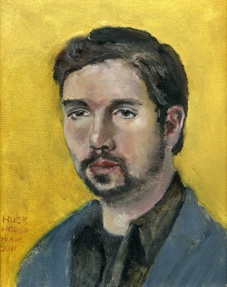
Huck Hodge, portrait by Mark Rabinowitz for the American Academy in Rome
Pairing Beethoven with a world premiere: that’s my kind of program, and it’s what the Daedalus Quartet unpacked for their recital Friday night at Meany Hall under the auspices of the University of Washington’s World Series (soon to be rebranded as “Meany Center for the Performing Arts”).
The Daedalus Quartet consists of Min-Young Kim and Matilda Kaul, violins; Jessica Thompson, viola; and Thomas Kraines, cello. This adventurous young ensemble, which has been quartet-in-residence at the University of Pennsylvania since 2006 while also maintaining a busy touring schedule, is a proud champion of an impressive range of contemporary music: George Perle, Ligeti, Carter, Kurtág, Joan Tower, and Fred Lerdahl are all part of the group’s rep.
On Friday Daedalus gave the world premiere of The Topography of Desire by Huck Hodge. Currently an associate professor on UW’s School of Music Faculty, the 39-year-old Hodge studied with Lerdahl and Tristan Murail and spent time in Stuttgart and as a fellow of the American Academy in Rome — all the while evidently developing a heady mix of philosophical, psychological and poetic interests that are embedded in his bold musical investigations.
His output includes compositions that draw on such material for inspiration as the pre-Socratic philosophers, the Gestalt theory of perceptual illusions, stellar parallax, seascapes at night, the poetry of Jorge Luis Borges.
The program note for his new piece observes that Hodge is also inspired by “uniquely northwestern American light patterns … ‘the way that a piercing slant of light, breaking through a dreary cloudscape, casts an intense, otherworldly chiaroscuro on the landscape,’ the ethereal yellowness of the light in bas-relief against the yawning darkness of the sky.”
Hodge himself took to the stage to introduce The Topography of Desire — a substantial work for string quartet cast in a single movement, which shared the program with two Beethoven quartets. The central question he sets out to explore in this music is nothing less than the insatiability of desire itself: the unbridgeable “gap between our needs and the way we come to represent them in the mind.”
While the composer’s printed note frames the issue of desire and non-fulfillment in terms familiar from French post-structuralist theory, Hodge’s comments onstage yielded a more-straightforward description of the two basic musical techniques he used to construct the piece. First is “detuning” of the inner voices (second violin and viola) vis-a-vis the “normal” tuning of the other instruments by a fractional tone, so as to build in harmonic friction. Such dissonance becomes an audible symbol of the “gap” and the itch for unison harmony.
The second technique involves Hodge’s use of a “phantom theme” — the ever-present melodic source content that derives from the overtone series, appearing in spread-out or super-speeded-up incarnations such that we never hear it clearly spelt out. That strategy reminded me, conceptually, a bit of the “enigma theme” in Elgar’s famous Variations.
The result of these techniques of “deferring unity” is to generate what Hodge aptly calls a “poetics of the near miss.” Presented in this context, Topography initially brought to mind the way we often encounter a contemporary art installation, via explanatory placards that help guide the view and point the way toward interesting things to look for — and I mean that in a good way, because the concert music scene has much to learn, in my view, from the presentation of new visual art.
Of course the ineluctable difference is that, once the music starts, you can’t scurry back and forth between the wall text and “the piece.” (If you do dip back into the program notes, you’re already losing the music however long your distraction lasts.) Hodge’s Topography was genuinely immersive, continually revealing surprises and new, unexpected corners as it unfolded.
The Daedalus Quartet played with the conviction and focus necessary to thread listeners through this musical labyrinth. The key idea of desire, for example, is emphatically not something to be “gotten” as soon as your ears have acclimated to the weird tuning. That’s simply a given, part of the foundation Hodge uses to then design an astonishingly varied edifice. Sometimes the fractional pitch differences (at times played with a sort of vibrato effect by the same instrument) sounded more conventionally “dissonant,” yet Hodge creates pockets — through shifting tempo, register, and counterpoint — in which the effect suddenly turns curiously peaceful and serene.
The composer referred to his experiences in Indonesia last summer studying Balinese gamelan music and the shimmering, vibrant quality of multiple tunings. Hodge manages to replicate this sensation with his scoring for four Western string instruments: Goethe’s famous metaphor of the Classical quartet as “a conversation among four reasonable people” is supplanted by a music alternately evoking confusion and prayer. At times it touches on the otherworldly spaces that Ligeti weaves with his micropolyphony.
Hodge’s intrepid ambition doesn’t stop at sharing a program with two Beethoven quartets (including what is arguably among the top five ultimate masterpieces in the genre, Op. 132). He also invites comparison with Richard Wagner, whom he mentioned in his remarks as the “grand master of the poetics of the near miss,” referring to the chromatic frustrations and delayed resolutions in Tristan und Isolde.
If you invoke Wagner/Tristan, you raise the issue of “the art of transition” — of mediating between strongly contrasting material through musically sensible and sensitive connections. Here I found myself less convinced by the structure of Topography — which is comparable in length to Schoenberg’s Verklärte Nacht (if not longer — I was unintentionally without watch). But the score is too richly layered to possibly grasp in one hearing, and I hope to have the opportunity for future encounters.
Heading outside at intermission after Topography, I was struck by how fitting the last glints of setting sun appeared as a commentary on the music — to the point of speculating how Hodge’s new work might sound as a site-specific, environment-based experience in the manner of John Luther Adams….
The Daedalus Quartet opened the program with the Quartet in D major from Beethoven’s inaugural Op. 18 set (replacing the originally announced Quartet in F major). Though no. 3 in the Op. 18 sequence, the D major is actually the first Beethoven completed.
Some indecisive intonation and tentative phrasing gave the impression that they hadn’t quite settled on an interpretation. Thematically, in any case, the yearning two notes of the opening phrase suggested an interesting Classical starting point for the music of desire that would follow in Topography.
They brought a more identifiable point of view to the ineffable Quartet in A minor, Op. 132, which filled out the program’s second half. Overall, the Daedalus steer clear of obvious dramatics. Their style is ultra-refined, elegant, even understated. There’s no playing to the gallery. This approach enhanced the mysterious melancholy of the first movement, which almost hinted at a dark undercurrent of repression.
Daedalus underscored the “normalcy”of the movements framing Beethoven’s “holy song of thanksgiving.” Even the theatrics of the recitative were restrained — too demure for my taste — and they kept the anxious passion of the finale from rising to a proper boil. Here, their subtlety of approach felt excessive, just when the reins should be loosened.
The centerpiece of Op. 132, the beyond-the-battle Heiliger Dankgesang, got an intriguing approach that was not without risk. They exaggerated the vibrato-less purity of the “Lydian” theme, which enhanced not only its archaic quality but the contrast with the “modern,” vibrato-colored Andante theme in this loose set of double variations.
Upon each variation of the opening section, they introduced more and more vibrato, converging on a richly resonant sonority in the final section. Initially the movement sounded too weightless, but the strategy proved to offer emotional satisfactions I wasn’t expecting.
Dutilleux City: Thanks to the vision and musicianship of Ludovic Morlot and Seattle Symphony, the Emerald City can legitimately claim to have become one of the globe’s top spots to hear authoritative performances of the French master.
This weekend’s program includes a not-to-be-missed chance to enjoy Dutilleux’s Timbres, espace, mouvement, which is being recordedfor release as part of the third volume in the SSO’s ongoing survey of his orchestral music on the house label. (Vol. 2, featuring soloist Augustin Hadelich, garnered the orchestra a Grammy in February.)
But nothing compares with the experience of this music in live performance. By now it’s a built-in expectation that Morlot and the SSO will sustain an almost superhuman focus when bringing a Dutilleux score to life — with the result that, to borrow Schoenberg’s famous encomium (re his student Anton Webern’s music): “every glance is a poem, every sigh a novel.”
It’s been fascinating to watch Morlot, over his now half-decade with the ensemble, inspiring the players to the level of poetic accuracy, of fluent command of an incalculably subtle idiom, such as was on display in last night’s performance. Even by Dutilleux’s standards, Timbres, espace, mouvement, ou “La nuit etoilée” (from 1978, with a section added in 1991) pushes the bar still higher.
Morlot gave a brief intro to the piece, accompanied by relevant visuals to contextualize some of the composer’s extra-musical inspirations: the constellations, a gorgeous interstellar nebula, and van Gogh’s famous painting cited in Dutilleux’s alternate title (“Starry Night”).
The music director explained that the last-named is reflected in the unusual scoring for a large orchestra, which however omits violins and violas: their lack focuses the registral weight at a lower band to evoke the nocturnal mystery especially at the bottom portion of van Gogh’s canvas.
The early Romantics had their “blue flower.” Dutilleux has his “blue flame,” as Morlot memorably characterizes the composer’s sound world, contrasting its unique incandescence with the more obvious brilliance of a yellow flame: “music that evaporates” before our ears, but not before kindling an extraordinary intensity.
None of this is “program music” in the old-fashioned sense — a soundtrack to the Big Bang, or an attempt to “illustrate” van Gogh’s painting. (Why would a masterpiece painting need to be illustrated anyway?)
A better way to think of the piece — which was certainly encouraged by this performance — is in terms of what the first part of the title itself indicates: timbres that move about in musical space, the mystery of sonorities as they begin to coalesce and cluster across the orchestral field.
A critical element here is the timing — not just what’s written in the score, but the unquantitatable rightness of overall pacing, of relation of part to whole, of the transition between ideas that should emerge in performance. Morlot tapped into and sustained the necessary sense of cosmic awe and mystery: source of our very capacity to experience beauty.
Especially captivating were the echoings of the long, sinuous melody that shoots across the orchestral canvas, as juxtaposed so effectively with Dutilleux’s watchmaker-precision scoring for his percussion section. (Terrific work from the woodwinds in particular, with a key role for Mary Lynch’s superb stylings on oboe.)
The piece’s spare but powerful climaxes aren’t narrative “events” or outcomes but announce sudden shifts of perspective, a kind of turning of the cosmic wheel. I also admired how Morlot countered the receding horizon of Dutilleux’s most amorphous gestures with a sense of finality in the score’s massive unisons.
How this composer achieved such rending beauty remains one of the mysteries of contemporary music — not the sort of beauty that washes lazily over a passive listener, but a co-creative beauty of imagination, requiring incarnation in sound…
The ensuing Beethoven — the Fourth Piano Concerto — marked a continuation of the SSO’s ongoing two-year cycle devoted to Herr Ludwig van. As usual with these strong contrasts, I couldn’t help but hear a few “foretastes” of those mesmerizing sinuosities from the Dutilleux in a few of Beethoven’s woodwind phrasings in the first movement, though I’m willing to concede that this might have resulted from some sort of psychoacoustic aftereffect.
Unfortunately, I have to report my deep disappointment in the contributions of the soloist, Imogen Cooper. The British pianist commands a formidable reputation on the international circuit — in particular for this repertoire — which is why I was all the more baffled by this experience.
Cooper’s point of attack and phrasing of the all-important opening solo immediately signaled the basic problem that, to this taste, bedeviled her account throughout. It was clear, clean … and bereft of poetry, personality, or point of view.
Despite Morlot’s efforts to tease out character from the orchestra’s interactions, the whole first movement came across as flaccid, too relaxed — mostly because the points of tension needed to anchor Beethoven’s serenely lyrical writing kept going slack in Cooper’s performance. Even that initial cleanness was offset at several points by notably strong left-hand attacks; but rather than suggest a particular reading, they simply made for an eccentric (and, frankly, off-putting) mannerism.
The middle movement accentuated the problem even more. Morlot whipped up the drama with sternly accentuated string recitative — the “wild beasts” to be tamed by Orpheus/the pianist, in the popular reading of this movement (which also anticipates the strategy of the Ninth’s finale.) Of this Andante Tchaikovsky wrote: “I know of no greater work of genius … and I always pale and chill when I hear it.”
But Cooper’s timid phrasings hardly initiated a dialectic, adhering instead to the same over-relaxed sonority at each entrance. Problems with coordination between Cooper and the ensemble recurred in the outer movements.
Morlot closed the program with the rarely heard final symphony by Prokofiev, the Seventh. Written near the very end of the Russian composer’s life, this is an enigmatic symphonic swan song: the big, sweeping, “Socialist Realist” rhetoric of Romeo and Juliet comes face to face with sonic images of innocence and childhood, of clocks winding down. It’s immensely accessible — and emotionally attractive, in the SSO’s rich-bodied but finely detailed performance — yet somehow riddling all the same.
Morlot played up the perplexing shifts in direction that accentuate the piece — especially in the curious second movement and in the final pages of the finale — as if to underscore the question marks that remain beneath the surface of such “simple” music.
Last night’s Seattle Symphony concert featured two guest artists of genuine distinction: Jesús López-Cobos, Conductor Emeritus of the Cincinnati Symphony Orchestra and former music director of Madrid’s Teatro Real, and the violinist Augustin Hadelich.
The latter is especially familiar to Seattle audiences as a longtime regular at the Seattle Chamber Music Festival. This time he returned with a fresh crowning of laurels from last month’s Grammy Awards: he won Best Classical Instrumental Soloist for his recording of L’Arbre des Songes, a violin concerto by Henri Dutilleux. (So fresh, in fact, that, as Hadelich later mentioned, he still hasn’t received the gold-plated trophy he accepted in absentia.)
Hadelich recorded the Dutilleux with the Seattle Symphony and Ludovic Morlot on their new in-house label, and the SSO and audience welcomed him back with obvious warmth, cheering before he’d played a note. (A couple days before, Hadelich had recorded a shorter Dutilleux piece for violin and orchestra — Sur le même accord — which is due for future release on the SSO label.)
But from the moment he did start playing — the vehicle was Tchaikovsky’s Violin Concerto — Hadelich cast an absolutely irresistible spell. I kept trying to dissect his secret. There’s no shortage of flawlessly virtuosic young violinists, and being able to showcase your technique on the KiesewetterStrad from 1723 doesn’t hurt.
Still, what made his performance unique was its authenticity. I mean that not in the sense of HIP, of period instrument ideology, but quite simply as a matter of musical and emotional honesty. Too often technique and sincerity (“playing from the heart”) are set up as opposite poles; operating from a stance of modesty, Hadelich grounds his technique — and it’s jaw-dropping fabulous, above all his masterful intonation and dynamics — with sheer love of the musical message.
In the process Hadelich succeeded in dusting away the clichés, phony sentimentality, and sense of routine that frequently accompany the Tchaik. He kept his distance from the lapel-grabbing emotional sensationalism performers know guarantees excitement, but by the same token there was nothing cool or unduly “objective” here.
Overall Hadelich seemed to have in mind Tchaikovsky’s abiding affection for Mozart — always a tempering influence on his own tendencies toward excess. The violinist shaped the first movement’s main theme with a tasteful classicism. When deep pathos emerged, in the minor-key Canzonetta, it resonated powerfully.
Hadelich’s interactions with the players underscored his intense engagement in this music as a present-tense affair. I’d forgotten how beguiling Tchaikovsky’s woodwind lines are here. The clarinet — featuring the expressive work of guest player Gabriel Campos-Zamora — becomes virtually a second protagonist.
Throughout, López-Cobos was interpretively in sync with Hadelich, encouraging clarity of shape and timbre from the players. He set a leisurely pace in the first movement but was able almost imperceptibly to quicken and then moderate it again, in accord with Hadelich’s phrasing choices. The finale was thrillingly breakneck, a rousing conclusion to a work in which Tchaikovsky seems to regain purpose and joie de vivre.
Hadelich returned for an encore: the Andante from J.S. Bach’s Second Solo Sonata in A minor. It was the epitome of this artist’s gift for fusing marvelous technique with incandescent expression: an early-21st-century version of what used to be called “the sublime.”
There was likewise a great deal to admire in Jesús López-Cobos’ work from the podium in this all-Russian program. It seemed to be connected by a “travel” theme (remember that Tchaikovsky wrote his Violin Concerto soon after his disastrous attempt at marriage while he was sojourning in Western Europe). As an opener, the Spanish conductor led a charming account of Glinka’s Summer Night in Madrid, rhythmically vivid and awash in cheerful colors.
It turned out to be a pretty accurate trailer for the characteristics he brought to Rimsky-Korsakov’s Scheherazade in the second half. Particularly in the wake of John Adams’s new masterpiece, Scheherazade.2, last week — I admit to approaching another encounter with Rimsky’s crafty Sultana with some skepticism. It bored me the last time I heard the SSO play this score (three years ago).
This time, I couldn’t get enough of it. López-Cobos coaxed a uniformly high-quality performance from the SSO. Magisterial and majestic, he crafted a beautifully proportionate interpretation of Rimsky’s score, giving just the right amount of time and emphasis to its components.
So rewarding were the musical allurements that he tempted the audience to forget about the half-hearted Arabian Nights program, for which the composer in any case expressed ambivalence. The narrative that mattered was how one texture and melodic idea gave way to the next. Threading this story together was the impressively phrased, gorgeous playing from Elisa Barston, the evening’s concertmaster.
John Adams with the Seattle Symphony (photo credit: Chris Bennion)
Here’s my Seattle Times review of last night’s Seattle Symphony concert with John Adams at the podium:
The chance to hear a great living composer conducting his own music is rarity enough. But the new work John Adams has brought with him is rarer still: a composition created in the here-and-now that shows every sign of becoming part of the canon.
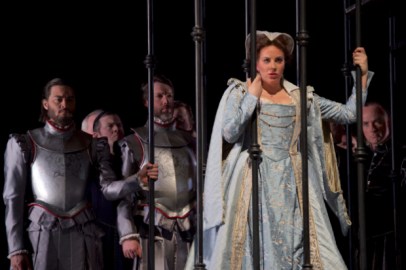
Joyce El-Khoury in the title role of Maria Stuarda; image credit: Jacob Lucas
My review of Maria Stuarda at Seattle Opera — where soprano Joyce El-Khoury has made a spectacular company debut — is now posted on Bachtrack:
Tudormania continues its invasion of America. Later this month at the Met, Sondra Radvanovsky will have added the third and final jewel to her Donizetti crown when she sings Elizabeth in Roberto Devereux. And across the continent, Seattle Opera has been presenting its company debut of Maria Stuarda (1835).
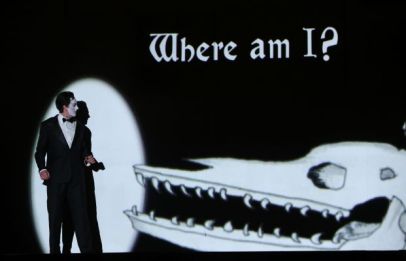
Musical America has posted my review of the Barrie Kosky/Suzanne Andrade-directed Magic Flute (behind a paywall):
LOS ANGELES— Singspiel meets silent film in this genuinely innovative production of The Magic Flute directed by Barrie Kosky and Suzanne Andrade. Initially created in 2012 for the Komische Oper Berlin …
My review of this weekend’s Mahler 3 by Gustavo Dudamel and the Los Angeles Philharmonic is now posted on Bachtrack:
No work is more emblematic of Mahler‘s symphonic philosophy than the Third. Or at least that version of his philosophy filtered by Sibelius, who recollected Mahler’s words decades after their meeting in 1907, long after his colleague’s death: ‘The symphony must be like the world. It must embrace everything’.
But it was another Mahlerian statement that Gustavo Dudamel’s interpretation with the Los Angeles Philharmonic brought to mind – a statement reported by his confidante Natalie Bauer-Lechner referring specifically to the Third Symphony when it was still a work in progress: ‘To me, “symphony” means constructing a world with all the technical means at one’s disposal’.
New York, NY – Feb. 24, 2016 — The Mariinsky Orchestra, lead by conductor Valery Gergiev, performs Prokofiev’s Piano Concerto No. 3: Daniil Trifonov soloist, at BAM’s Howard Gilman Opera House. (credit: Robert Altman)
The Mariinsky Theater and its director Valery Gergiev launched their recent five-day residency at BAM February 24 with an ambitious orchestral program comprising the five piano concertos of Prokofiev. Trading the windswept rain … »Read
When was the last time you had a chance to see La Calisto, an opera from the early Baroque by Francesco Cavalli/aka Francesco Caletti-Bruni (1602-1676)?
Leave it to Stephen Stubbs and colleagues to make us realize how much we’ve been missing.
The Seattle-based conductor, lutenist, and early music expert was asked by Juilliard to lead their recent production of La Calisto, which just concluded a brief run of three performances in the school’s intimate Rosemary and Meredith Willson Theater (seating for a maximum of 100).
The result was far more than musical archeology. It also went beyond presenting a platform for talented young Juilliard artists. This was a fully engaging theatrical and musical experience, one that proved — vividly and gracefully — the undiminished appeal of this material.
La Calisto dates from a fascinating period in early opera, when the newish art form was migrating from private courts into the public theaters of Venice in the mid-17th century. The surprise at Juilliard was how fresh and resonant the work can be when experienced in such a smart, tasteful production. The version of La Calisto presented had been adapted and arranged by Stubbs and director and choreographer Zack Winokur, featuring members of Juilliard Opera and Dance.
Cavalli’s opera of 1651, to a libretto by Giovanni Faustini, repurposes one of the mythic stories of love gone astray from Ovid’s Metamorphoses, fusing it with the (normally unrelated) legend of the handsome shepherd Endymion (Endimione).
What’s most remarkable about the conflation of sources here is the mingling of comic, even ribald, elements with pathos — and this is exactly what Winokur negotiated so effectively and with such winning imagination.
Well before Mozart and da Ponte would hit upon a similarly ambiguous admixture of seria and buffa tonalities in Don Giovanni, Cavalli and Faustini dramatize scenes of lofty emotion and longing side-by-side with the grotesque and sometimes crudely humorous spectacle of gods and demigods crazed by uncontrollable lust.
The latter isn’t limited to the randy half-goat Pan and his merry band of satyrs but extends to Jove himself. We encounter the chief of the gods overcome by desire at first sight of the virgin archer Calisto [one “el” in the Italian, rather than the English “Callisto”].
A follower of the moon goddess and huntress Diana and hence pledged to chastity, Calisto rejects his advances — the libretto includes a witty aside about the pesky side-effects of the free will that Jove has granted his creations — so the god resorts to a transgender disguise as Diana to con his way. There’s a subtler layer of humor as well, as the hypocrisy of the gods is put on full display.
The opera is framed by a narrative of cosmic happenings, beginning — as if the day after Götterdämmerung — with a visit by Jove, accompanied by Mercury, to check up on an earth devastated by Apollo’s son Phaeton (who, having lost control of the reins of papa’s sun-chariot, had accidentally set the planet on fire).
At the end of the opera, Calisto undergoes an apotheosis into one of the constellations in the heavens. (In Ted Hughes’ rendering of Ovid’s Latin, Calisto — from the Greek for “most beautiful” — is “the Arcadian beauty.”)
But within that framework the opera explores the maddening effects of Eros on humans, demigods, and immortals alike. Jove’s frankly sexual passion for the innocent titular heroine sets in motion the main narrative.
Along with a subplot about Diana’s own weakness for the male counterpart of Calisto — the beautiful shepherd Endimione — it involves a comedy of mistaken identities, confused longing, sexual aggression and rejection — and of course the inevitable blowback from jilted lovers who channel their passion into a lust for vengeance.
At the opera’s midpoint, for example, Jove’s official spouse Juno descends from Olympus to discover hubby’s latest infidelity. Enraged — though Calisto has been the unwitting object of Jove’s desires — Juno cruelly transforms her rival into a bear; physically, though, Calisto retains her human awareness. (“Her lament/Was the roar of a bear – but her grief was human,” in Ted Hughes’s version of Ovid.) Calisto’s second transformation into a heavenly body is Jove’s way of repairing the damage he has caused.
“It seems to me that [librettist Faustini] set out to fashion a show that a modern promoter might describe as ‘a sexy romp’ — with all the tools that he and Cavalli had developed in their previous works. Sexuality and sensuality pervade every corner of the libretto,” notes Stephen Stubbs.
This was Stubbs’s first collaboration with Juilliard students, working a magic similar to what he has achieved in his stagings with University of Washington students (as in Handel’s Semeleand Mozart’s The Magic Flute).
Indeed, Winokur’s staging and pacing underscored the playful erotics — with an arch nod to contemporary sexual politics, but avoiding predictable camp. This was the polar opposite of “stand and sing” opera, of absurdly monumental gestures.
Stage movement was brisk and varied, at times wittily stylized into dance — and in marvelous sync with the lively tempi Stubbs elicited.
The conductor led mostly from the harpsichord, working with a small but colorful and dynamic ensemble comprising a pair of violins and a continuo mixture (lutes, bowed basses, etc.), plus a touch of percussion. The players were members of Juilliard415, the school’s period-instrument ensemble.
La Calisto unfolds place amid a pastoral scene that has just begun to be restored. The setting was elegantly visualized by the design team of Adam Charlap Hyman and Andre Herrero, with landscape painting by Pilar Almon and suggestive lighting by Marcus Doshi.
The energetic cast had been well prepared in the musical rhetoric of Cavalli’s idiom, which quickly (almost unnoticeably) morphs from recitative to arioso to aria or duet — the score features a wealth of duets — with terrific economy. Modest gestures were telling and made their mark.
Particularly outstanding were the Polish countertenor Jakub Józef Orliński as Endimione in the subplot of Diana’s own naughty dalliance. He did justice to what is probably the score’s single most gorgeous piece of music: his praise of Diana in “Lucidissima face.” (Endimione and Diana are the opera’s only couple to enjoy a case of requited love.)
Samantha Hankey amazed with a commanding stage presence and with her ability to persuasively differentiate Diana as lover from the severe Diana who is horrified by Calisto’s confession of love. As Calisto, Angela Vallone sang with unaffected beauty, suggesting the awakening of sensual awareness when her innocent character is duped by Jove in disguise.
Julia Wolcott used her large voice to imposing, regal effect as Juno, hinting at a mesmerizing fusion of an angry Donna Anna with the Queen of the Night. Her appearance — accompanied by a retinue of Furies — inspired the most memorable of Austin Scarlett’s delightful costumes, her towering dress an object of awe in itself.
Excellent contributions were made as well by Xiaomeng Zhang as the sex-starved Giove, while spot-on comic timing was provided by Michael St. Peter as his sidekick Mercurio, who eggs him on to pursue his desires. Don Giovanni once again came to mind, with Giove as a precursor to the amoral seducer, the procuring messenger god his Leporello.
Shades of A Midsummer Night’s Dream likewise were evoked, though La Calisto concludes not with a smoothing out of the erotic misalliances, but rather with a sublime ensemble ode to the transformed heroine.



 John Adams with the Seattle Symphony (photo credit: Chris Bennion)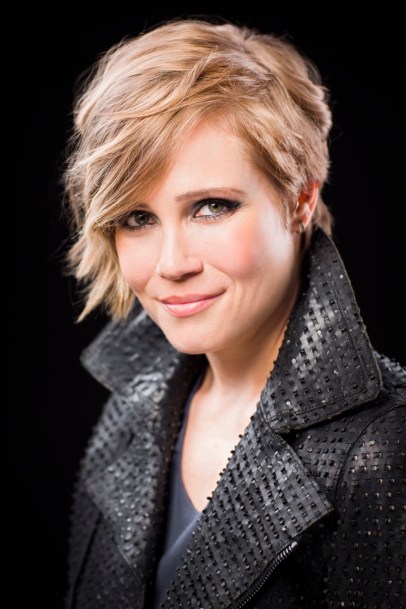
 My
My 
 Adam Charlap Hyman’s scenic design for Calisto

