MEMETERIA

Icon

Arts writing by Thomas May

Seattle Symphony Is Making Music Matter

mbb_patoc_selects_0023-1500x500

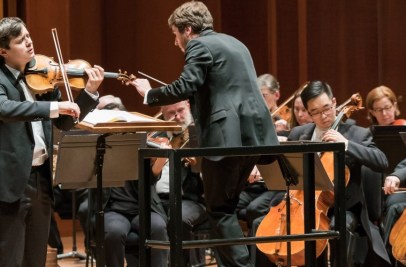
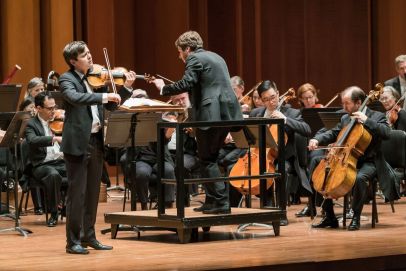
Kinan Azmeh, Ludovic Morlot, and Seattle Symphony; image (c) Brando Patoc

Some thoughts on recent Seattle Symphony programs, now on Vanguard Seattle:

Say goodbye to ivory towers.

So far this month, the Seattle Symphony Orchestra (SSO) and music director Ludovic Morlot have presented three widely varied programs. Two of these addressed red-hot current events that would have seemed surprising in the middle of a “normal” concert season not too long ago.

continue reading

Filed under: American music, Beethoven, Debussy, Ives, Ludovic Morlot, Prokofiev, review, Seattle Symphony, Vanguard Seattle

Music for Troubled Times: Seattle Symphony’s Shostakovich Concerto Festival

bpatoc_shostakovich-preview_0007-e1485453133404

Violinist Aleksey Semenenko, with Pablo Rus Broseta conducting the Seattle Symphony; photo (c)Brandon Patoc

My review of Seattle Symphony’s remarkable, two-part Shostakovich Concerto Festival is now available on STRINGS:

The Seattle Symphony just offered a rare chance to hear all six of Dmitri Shostakovich’s solo instrumental concertos back-to-back in a two-day marathon (January 19–20) featuring three young virtuosos, all led by the ensemble’s associate conductor, Pablo Rus Broseta.

continue reading

Filed under: review, Seattle Symphony, Shostakovich

Shostakovich Concerto Festival at SSO

sso-shost1

Soloist Aleksey Semenenko with the Seattle Symphony and Pablo Rus Broseta conducting; (c) Brandon Patoc

The Seattle Symphony’s Shostakovich Concerto Festival started off last night with a powerful program covering half of the Russian master’s six concertos for solo instruments.

It’s a fascinating opportunity to hear, compare, and contrast each of the pairs of concertos for piano, violin, and cello in a two-evening marathon. Ditto the three young artists appearing as the soloists: pianist Kenvin Ahfat, violinist Aleksey Semenenko, and cellist Edgar Moreau. Leading the Seattle Symphony is its marvelously talented associate conductor, Pablo Rus Broseta.

I’ll have a report on the whole festival later on in Strings magazine. In the meantime, based on the caliber of the performances — not to mention the new relevance of Shostakovich at the dawn of an era of profound political and cultural angst — I highly recommend Part Two this evening. On the program tonight: the Second Piano and Cello Concertos and the First Violin Concerto.

Filed under: Seattle Symphony, Shostakovich

Heavy-Metal Dmitri

Getting in the mood for the start of Seattle Symphony’s two-concert Shostakovich Concerto Festival.

Filed under: Seattle Symphony, Shostakovich

At Seattle Symphony, Cosmic Radiation from Beethoven and Messiaen

sso

The Seattle Symphony, with guest musicians and vocalists, perform works by Messiaen and Beethoven this weekend. (Brandon Patoc)

My Seattle Times review:

In their first program of the new year, Ludovic Morlot, the Seattle Symphony and guests offer an inspired pairing of Beethoven’s immortal Ninth and the spiritually attuned music of Olivier Messiaen.

continue reading


Filed under: Beethoven, Olivier Messiaen, review, Seattle Symphony, Seattle Times

Revolution No. 9

lb9

It was premiered almost two centuries ago. And Beethoven’s Symphony No. 9 still feels as urgently needed today as ever.

continue reading

Filed under: Beethoven, Ludovic Morlot, Seattle Symphony, Seattle Times

Elgar’s Dream a Transformative Experience at Seattle Symphony

49938-ed-gardner-5sep12-c-b-ealovega-orig-crop

Edward Gardner © Benjamin Ealovega

At this late date, it’s surprising how relatively little-known The Dream of Gerontiusremains among American audiences. Edward Elgar’s masterpiece – even if not the composer’s own favourite among his great oratorio trilogy – contains all the goods to move a concert audience to its core. ..

continue reading

Filed under: choral music, Edward Elgar, review, Seattle Symphony

A Primer in the Romantic Spirit from Seattle Symphony

khachatryan-12Sergey Khachatryan. Image courtesy of Seattle Symphony.

My review of this weekend’s Seattle Symphony program with Ludovic Morlot and violinist Sergey Khachatryan is now live on Vanguard Seattle:

The Seattle Symphony Orchestra (SSO)’s sixth season with Music Director Ludovic Morlot has so far included a pair of electrifying programs that paired world premiere commissions by composers of today with Beethoven classics—the latter part of an ongoing two-year cycle of the composer’s complete symphonies and piano concertos.

continue reading

Filed under: Berlioz, Ludovic Morlot, review, Seattle Symphony, Sibelius, Tchaikovsky, Vanguard Seattle

A Pair of Striking Debuts at Seattle Symphony

5488ee56-9d35-11e6-aac3-ec08c086559c-780x520

Polish soprano/composer Agata Zubel

Along with unveiling a world premiere by composer Agata Zubel, the Seattle Symphony continued its ongoing Beethoven cycle with a rhapsodic contribution by soloist Inon Barnatan at the keyboard.

continue reading

Filed under: Beethoven, new music, review, Seattle Symphony

Pablo Rus Broseta’s Big Night with Seattle Symphony

img_5759

Last night’s concert with Pablo Rus Broseta and soloist Yo-Yo Ma was a delightful confirmation that experiencing an orchestra in live performance can provide a high like no other. It doesn’t need to be a Mahlerian epic or a program of revolutionary breakthroughs — those offer up unique experiences of their own — but it does require the unwavering commitment of the musicians.

This was a modest-sized Seattle Symphony, as some of the players are now on duty in the pit for Seattle Opera’s about-to-open production of Hansel and Gretel. And the program of Bartók, early Mozart, and Haydn offered a straightforward menu. But nothing sounded rote, and the evident pleasure taken by the musicians proved to be infectious for the sold-out hall.

Drawing the large crowd, of course, was Yo-Yo Ma’s presence on the evening’s second half, but SSO Associate Conductor Pablo Rus Broseta led achieved some captivating results of his own from the podium. In the rapid succession of Romanian Folk Dances, — featuring excellent clarinet and flute solos — he elicited a touch of melancholy to spice Bartók’s vivid rhythms.

A pair of youthful Mozart symphonies followed: K. 201 in A major and a true rarity, K. 196 in D major (both from the end of the composer’s teenage years, in the mid-1770s). Rus Broseta approached these scores as if Mozart had just turned them in to fulfill an SSO commission. And it was possible to hear evidence of the young conductor’s experience with new music in the mindful focus on texture and balance.

If the opening movement of the A major symphony could have benefited from more-incisive attacks, Rus Broseta showed his sensitivity to Mozart’s spellbinding way of phrasing melody as well as to his expert comic timing. In his hands the spirited finale of K. 201  was made to sound exhilaratingly fresh, almost proto-Beethovenian. The strings played with superb ensemble.

And then Yo-Yo Ma emerged onstage with his glistening cello to give his first Seattle performance (as far as I’m aware) since last year’s memorable accounts of three of Bach’s Cello Suites and other fare at the University of Washington.

Haydn’s long-hidden-away C major Cello Concerto dates from when Mozart was still a young child (though already embarking on his first tour of Europe). Ma’s performance was a study in how to make a phrase and its subsequent repetitions rivet the attention.

While it’s hard not to thrill at the cellist’s technical mastery of intonation, articulation, rapid-fire scales — you name it —  Ma’s musical imagination is what really calls the shots, making whatever he plays so compelling. The finale in particular, with its sudden shifts in mood, became downright suspenseful.  From the podium Rus Broseta’s confident partnership ensured a lucid orchestral balance.

Ma offered a pair of encores: an elastic Prelude from the G major Cello Suite and Mark O’Connor’s poignant Appalachia Waltz (both in response to vociferous requests shouted from the audience). But with every bow he made his admiration of the orchestra and conductor clear, insisting that they share in the acclaim.

–(c)2016 Thomas May. All rights reserved.

Filed under: Haydn, Mozart, review, Seattle Symphony

Archive

Enter your email address to follow this blog and receive notifications of new posts by email.