MEMETERIA by Thomas May

Music & the Arts

Seattle’s Night at Carnegie

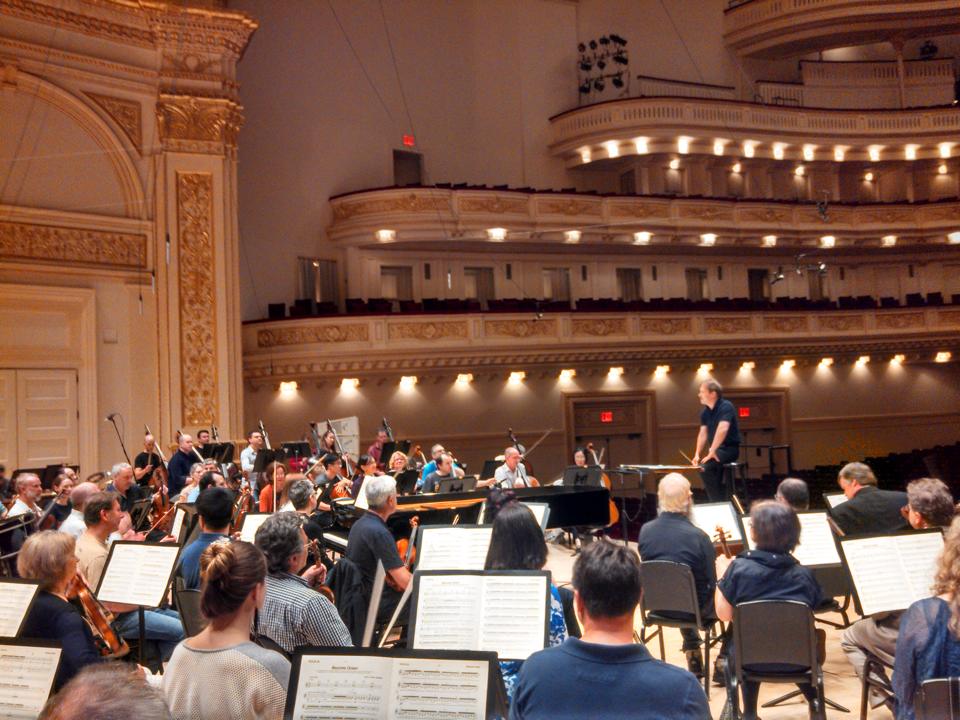
Ludovic Morlot and the Seattle Symphony in rehearsal at Carnegie Hall

Ludovic Morlot and the Seattle Symphony in rehearsal at Carnegie Hall

I’m still processing the experience of the Seattle Symphony’s concert Tuesday evening at Carnegie Hall — part of this week’s Spring for Music series, which will sadly constitute the final chapter of that worthy festival’s history.

By now the program itself is as familiar as a friend. I heard the second half twice in Seattle, some rehearsal sessions, and the entire program last Friday during the SSO’s epic “preview” evening of the Carnegie adventure for Seattle audiences. But Tuesday included an extra dimension of excitement: the New York premiere of Become Ocean, the reactions of major critics in a world music center, and the unmistakeable ambience of Carnegie Hall itself. Even disregarding my obvious bias, this was received as a triumph for the amazing talent of the Seattle Symphony and its music director Ludovic Morlot.

Of course there’s always a substantial amount of guesswork and gut instinct to rely on when it comes to a new composition. Most premieres tend to be somewhere in the vast “middle” range of quality and potential durability, but it’s certainly all too easy to get it wrong, to err in the direction of fatuous dismissal or foolhardy hyperbole. I know I’ve been guilty of both.

So it’s all the more thrilling when instinct kicks in early on in a first encounter with a piece — as it did for me and the John Luther Adams — and you sense that this might be an even greater achievement than you could have reasonably expected. On both occasions I was able to share the experience with trained musician friends who reaffirmed this “instinctual” response to Become Ocean. This time I found myself tuning in even more to an underlying sense of elegy in the music.

Certainly JLA’s big orchestral piece is at the furthest possible remove from any New Agey connotations or glib “environmental” message that some descriptions I’ve seen imply. (That’s not to deny or diminish the composer’s environmental commitment, which is not reducible to a bland gesture of political art.) Instead, this is challenging music, requiring a major effort from the listener while at the same time profoundly engaging the emotions. The days of either/or cliches like “tough” modernism versus “easy-listening” neo-Romanticism should be behind us.

Live stream of Become Ocean

There’s so much to say about this music and its effect, so much about its implications as a commission, that I’m working on a profile of John Luther Adams and Become Ocean. More on that when the time comes.

Meanwhile, the thoughtful dramaturgy of the program — combining JL Adams with Varèse and Debussy — was justly admired for its contrasts and cross-connections. Here’s a quick round-up of the critical coverage I’ve seen so far:

–Alex Ross, as usual, really gets it. He wrote the first substantial critique of Become Ocean after the world premiere last year in Seattle (which I had to miss). On Tuesday Alex found that “Carnegie’s mellow, resonance-rich space brought out the Wagnerian aspect of Become Ocean, favoring sonorities of strings and brass,” adding that from his position in the orchestral seats, “much of the score’s glittering detail was lost … “and the most delicate percussion effects disappeared as well.”

New York magazine’s Justin Davidson neatly summarized the piece’s overall effect: “Serenity comes tightly wrapped up with terror.” He points out that, while Become Ocean is “about boundless nature,”it’s an indoor piece, ravishingly traditional in the way it relies on walls and floor and ceiling to convert raw sound into the illusion of shimmering surfaces and the violent deep.”

–Tony Tommasini writes in The New York Times of how Adams extends the familiar idea of an “organic” composition that evolves “in a swirling mass of sound,” pushing it in “an uncompromising, courageous way.”

–On that score, I was puzzled as to why Martin Bernheimer, in his positive review, insists on labeling Become Ocean “an extended tone-poem.” Even the loose or distant mimesis traditionally associated with the Romantic notion of that genre is merely one level to which JLA alludes.

–At New York Classical Review, George Grella found the programming concept to be mere “window dressing for abstract music about form, structure, and time.” Fair enough, but I disagree with Grella’s assessment of the orchestra’s playing in the Debussy as “surprisingly thin and light.” It was, in my opinion, anything but — in fact, unusually, and unconventionally, muscular and finely articulated, very far from “idées reçues” of French “Impressionist” music.

–On Bachtrack, David Allen offers an interesting and lengthy reflection in which he quotes Gurnemanz’s famous, enigmatic aphorism “Here space becomes time” anent Become Ocean. (I’ve been thinking of another Parsifal reference that comes to mind when I listen to this music, from the Prelude.)

Incidentally, I notice all these critics are male and would love to see a female critic’s reaction to this music. I know my pianist friend Judith was impressed on her first hearing, aptly likening the experience to an extended encounter with a Rothko painting.

Update: this isn’t a review of the concert, but Corinna da Fonseca-Wollheim published a preview for The New York Times. There she writes that Become Ocean “submerges the listener in a swirling, churning wash of sound.”

Update No. 2: Just discovered that the world premiere of Become Ocean was covered for the local Seattle media by Melinda Bargreen. She didn’t much care for it:

But after the first 20 minutes or so, the musical ideas had pretty much run their course, and there were no further developments to justify sustaining the piece. (Some listeners in the balcony areas made a discreet but early retreat.) At least the music fell gratefully on the ear, delivering consonance rather than dissonance, and in its very length, “Become Ocean” evoked a sense of vast oceanic scale.

Interesting, too, to see some of the reader comments from back then:

“spiritdancer47,” mistaking the piece for a symphony, didn’t find much there there:

Having been a dancer for PNB, I am familiar with the extended time it takes for the orchestra in the pit to warm up. Listening to Adams’ symphony took me back to that time…and left me there. I would be one of the “early leavers.”

“proud2Bliberal” gave it more thought by trying to locate precedents:

“Become Ocean” was wonderful. It is the perfect piece for just putting your head back, closing your eyes and letting the sounds happen around you. It conveyed what it must feel like to be in Alaska near the ocean and the forests. The piece had a refreshing and genuine feeling, and somewhat of the personality of American experimentalists Charles Ives and Henry Cowell. Morlot was the perfect conductor for this work. Clearly the piece has its roots in Debussy’s “La Mer” and the ocean passages of “Pelleas.” As a French conductor, Morlot was able to conduct all of those “Debussyiste” sea rumblings (bruits, in French). It would be a great piece to have on a CD at home.

And I hope “vf” didn’t place a bet on this prediction:

“It would be unfortunate if the SSO took the Luther Adams piece to NYC, it would be a disaster, hope they reconsider. In comparison to the works of composers like Arvo Part or Phillip Glass Become Ocean is minor league at best.”

–(c)2014 Thomas May. All rights reserved.

Filed under: commissions, John Luther Adams, music news, Seattle Symphony

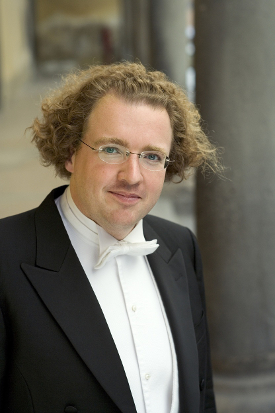
Stéphane Denève and Paul Lewis with the Seattle Symphony

Stéphane Denève; photo by J Henry Fair

Stéphane Denève; photo by J Henry Fair

My review of this week’s Seattle Symphony program, with guest conductor Stéphane Denève and pianist Paul Lewis, is now live on Bachtrack:

This week’s Seattle Symphony programme brings the third and last of the current season’s co-commissions — all of which are United States premières — with The Death of Oscar by James MacMillan. Music director Ludovic Morlot led the SSO in the previous two (Pascal Dusapin’s violin concerto Aufgang and Alexander Raskatov’s piano concerto Night Butterflies); for the MacMillan, Stéphane Denève, a champion of the composer since his tenure with the Royal Scottish National Orchestra, was on hand as guest conductor. Denève had also premièred The Death of Oscar in November in Stuttgart, where he currently helms the Stuttgart Radio Symphony Orchestra.

continue reading

Filed under: Beethoven, commissions, conductors, review, Seattle Symphony

2014 Pulitzer Prize for Music

John Luther Adams

John Luther Adams

And the winner is … John Luther Adams. This is especially exciting news, since Ludovic Morlot and the Seattle Symphony will be taking Become Ocean, the large-scale work they recently commissioned from Mr. Adams, to Carnegie Hall next month as the centerpiece of their Spring for Music program.

The Pulitzer Prize citation states:

Awarded to “Become Ocean,” by John Luther Adams, premiered on June 20, 2013 by the Seattle Symphony, a haunting orchestral work that suggests a relentless tidal surge, evoking thoughts of melting polar ice and rising sea levels (Taiga Press/Theodore Front Musical Literature).

In his review of the world premiere last June for The New Yorker, Alex Ross memorably wrote:

Anyone who has gone down a stretch of road and then reversed course knows that a landscape does not look the same when viewed from opposite directions. One mystery of “Become Ocean” is how different the material often sounds during the second half of the [overall] palindrome [structure]. The section after the first climax is thick with minor chords, particularly in the brass. Somehow, as these chords loom again in the buildup to the final climax, they take on a heavier, more sorrowful air. There is a sense of unwinding, of subsiding, of dissolution… That a piece constructed with such fanatical rigor can convey such potent emotion is the greatest mystery of all.

In an interview from 2011 with Molly Sheridan of NewMusicBox, Mr. Adams explains that his music is “never about representation or reproduction” but about “authentic personal experience, about the primary experience of being there and paying attention.”

Music is not what I do; music is how I understand the world. I hope that if I find myself in a singular place: wilderness, urban, indoors, outdoors, real, imaginary—doesn’t matter—if I find myself in a real place, a true place, and I am paying attention, then maybe I hear something that becomes music. If that happens, then I hope the music floats away, takes on a life of its own, and becomes something else to you when you hear it. What I may have experienced, what I may have been reading, or looking at, or listening to, or thinking about when I was in that place working on the music really doesn’t matter. What matters is the music and how it touches you.

Filed under: American music, culture news, new music, Seattle Symphony

A Concerto Première Takes Wing in Seattle

Tomoko Mukaiyama; photo by Takashi Kawashima

Tomoko Mukaiyama; photo by Takashi Kawashima

My latest concert review is now live on Bachtrack:

The music of Alexander Raskatov remains relatively little known in the United States. Smart concert programmers, though, should take note of the effectiveness of his new Concerto for Piano and Orchestra, “Night Butterflies”, as demonstrated in this performance by Tomoko Mukaiyama and the Seattle Symphony. With these concerts, Ludovic Morlot gave the work a persuasive American premiere, fully alert to the score’s psychological fascination. The SSO co-commissioned Night Butterflies with Het Residentie Orkest Den Haag, which presented the world première in the Netherlands last May.

continue reading

Filed under: new music, programming innovation, Seattle Symphony

Creative Diaspora and Russian Composers

Alexander Raskatov

Alexander Raskatov

UPDATE on Saturday 22 March, 9:42: I just learned that Richard Taruskin will not be at the Conference to give the keynote speech; he’s prevented from traveling on account of illness. The lineup given here appears to have just been updated.

This weekend brings a conference co-hosted by the Seattle Symphony on the topic Creative Diaspora: Émigré Composers from the Former USSR. It’s taking place in conjunction with the U.S. premiere of Alexander Raskatov’s new piano concerto, Night Butterflies. Here’s my preview for CityArts:

Living in exile, crossing borders, starting over—are there any experiences more definitive of the modern era? Along with their concrete political and social consequences, these experiences have shaped cultural expression. What, for example, does it mean to be a “Russian” composer today? Does it even make sense to keep referring to national musical styles in this century of instant global connectivity?

continue reading

Filed under: commissions, musical research, new music, Seattle Symphony

A Homecoming and a Debut in Seattle

James Ehnes

James Ehnes

My latest Seattle Symphony review is now live on Bachtrack:

Not until the morning of the day before their concerts this week with the Seattle Symphony did conductor and soloist meet for the first time, yet the shared sympathy and depth of understanding they together brought to their interpretation of Béla Bartók’s Violin Concerto no. 2 made this the richly satisfying highlight of the Seattle Symphony’s program.

continue reading

Filed under: Bartók, James Ehnes, review, Seattle Symphony

The Bach Passions Project in Seattle

Passions Project

Over the weekend, Stephen Stubbs and his Pacific MusicWorks company concluded their ambitious Passions Project with performances of the St. John Passion. The project included partnering with the Seattle Symphony for the St. Matthew Passion the previous weekend. Here’s my review for Bachtrack:

Adducing Simon Schama’s comparison of Rubens’s Descent from the Cross with the same subject as painted by Rembrandt, the conductor and Bach authority John Eliot Gardiner has observed that the differences drawn by the art historian – chiefly, between an emphasis on “action and reaction” in the former and “contemplation and witness” in the latter – might broadly be applied to Bach’s two great Passions as well: St John and St Matthew, respectively. Audiences in Seattle have been provided an opportunity to compare and contrast these unfathomably rich works on the basis of live performances of both, presented over consecutive weekends.

continue reading at Bachtrack

Filed under: Bach, Pacific MusicWorks, review, Seattle Symphony

Morlot, Seattle Symphony, and Berlioz: An Explosive Match

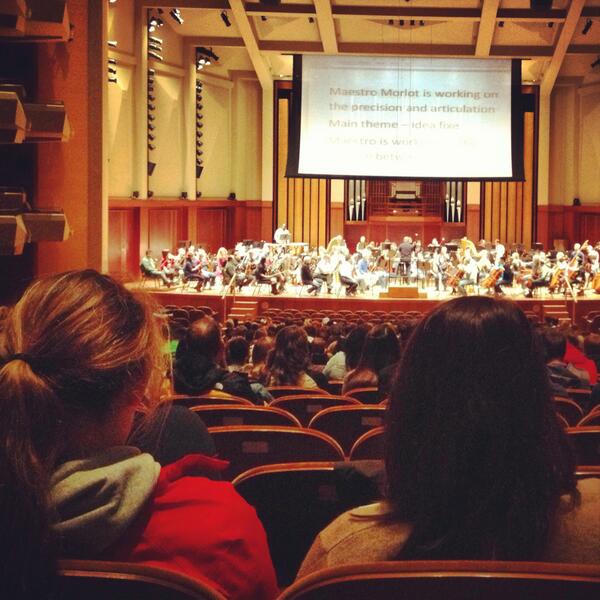
High school students discovering the world of Berlioz at a Seattle Symphony rehearsal

High school students discovering the world of Berlioz at a Seattle Symphony rehearsal

Ludovic Morlot is now back from his winter duties as chief conductor at La Monnaie in Brussels (where he just led performances of Janáček’s Jenůfa). And in its most incandescent moments, last night’s program — his first with the Seattle Symphony following the hiatus — blazed with the impatient passion of lovers meeting after an enforced absence.

The players were champing at the bit to whip up the energy of the brief concert opener, Emmanuel Chabrier’s Bourrée fantasque. Despite the nice thematic tie-in of the title, Chabrier’s piano piece felt like a mere diversion from the heart of the matter. The orchestration by the famous fin-de-siècle Wagnerian Felix Mottl layered lavish, high-calorie toppings over Chabrier’s zesty piano piece – frankly, at times, threatening to smother it.

Morlot has a genuine affinity for the music of the Romantics, so there’s a fascinating opportunity in this program to compare his approaches to the subjectivity of Robert Schumann versus Hector Berlioz. The issue of Schumann’s mental illness is by now such a cliche that it was refreshing to encounter a performance so alert to the astonishing mindfulness of his poetic reveries. In other words, what came across in the Cello Concerto wasn’t so much a sequence of “moody,” unsettled and changeable emotions as one lengthily sustained poetic fantasy.

The three chords in the orchestra that launch and unify the piece were shaped with an appropriately evanescent dreaminess, setting the tone for the Concerto’s primarily meditative as opposed to show-offy quality. The soloist, the French cellist Xavier Phillips, was especially memorable in the slow middle section of the three interlocking movements, when his orchestral “doppelgänger” (SSO principal cellist Efe Baltacıgil) engages him in a duet.

Phillips played with an inviting warmth and intimacy well-suited to Schumann’s elaborate lyricism, but the moment when the cello “rouses” the orchestra from the fantasy at the very end of the Concerto sounded underwhelming. Acoustic imbalances with the orchestra — a particular peril of cello concertos, and one reason composers avoided them for so long — were a persistent distraction. Still, there was breathtaking beauty to be enjoyed in Phillips’ sensitive and musically intelligent phrasing.

A good concert then became great in the program’s second half: Berlioz’s Symphonie fantastique, that blockbuster of Romanticism that flips the bird to the conventional polarities of French/German, Classical/Romantic, fact/fiction.

Too often we hear the Symphonie as a manifesto of its moment in time, a “textbook” of Romanticism with the usual checklist — and the result is a performance that sounds like the epitome of a museum piece (in the bad old sense of museums, before the smart ones started updating themselves).

Young Berlioz in 1832, around the time of the Symphonie fantastique ; painting by Émile Signol

Young Berlioz in 1832, around the time of the Symphonie fantastique ; painting by Émile Signol

Last night it suddenly occurred to me that Morlot’s understanding of Berlioz is of the same category as Leonard Bernstein’s identification with Mahler: apart from all the technical knowledge and even sensibility he brings to Berlioz, it’s as if Morlot internally identifies with this music and so is able to give his interpretations a uniquely compelling stamp.

That’s the only way I could make sense of the 3-D vividness of last night’s performance: colors and textures I’ve never noticed before, for sure, but most of all a sense of what’s at stake with the emotions and obsessions of Berlioz’s score. I found myself grinning with near disbelief at how shocking and still over-the-top parts of it can still sound.

Morlot got the SSO musicians to tap into that sense of conviction. There were memorable achievements from every single section of the orchestra. None of this would have worked without the artistry of Michael Crusoe (timpani), Valerie Muzzolini Gordon (harp), Stefan Farkas (English horn), Christie Reside (flute), Ben Haussman (oboe), Seth Krimsky (bassoon), for example, not to mention the thrilling playing by the strings and brass, particularly in the witches’ “orgy” of the last movement.

This wasn’t the usual colorful story of young Hector going all wild after seeing the actress Harriet Smithson and getting tangled in an insanely obsessive/possessive love attachment – the whole business is really a MacGuffin, anyway — just as it wasn’t the corny 1960s-flavored rethink of an orchestra on an LSD/mushroom/opium-fueled trip.

Morlot understands that Berlioz’s “protagonist” in the Symphonie fantastique is an artist above all else — that the Eros, the drive, the alienation, the hallucinations, all of it, are all components of a universe he imagines into being, not mere triggers of emotions that require expression. And that the entire epic he lays out for us in this score is an “instrumental drama” (the composer’s own phrase) that expertly transforms his musical material to give voice to a radical subjectivity.

I especially like how Morlot refuses to settle for one overall approach — stressing Berlioz’s Classical underpinnings, say, or staying focused on his novel orchestration. He understands the multidimensional character of this score and allows its widely varying facets to come out when they make sense in the dramatic context.

There was a particularly persuasive hint of Beethoven of the Pastoral in the beautifully played woodwind writing of the third movement. (Beethoven cast an enormous shadow over Berlioz at this point in his career.) Some of the “spatial” effects of offstage timpani and shepherd’s pipe anticipate Mahler.

The March to the Scaffold, sardonic as hell, actually helped set the scene for what usually seems an abrupt shift of tone in the Witches’ Sabbath/nightmare finale. And in that fantastic musical phantasmagoria, despite all the humiliations and horrors the protagonist endures, it’s the image of the cocky young artist Berlioz who emerges, dominating and enthralling his audience.

So what is it with Berlioz and obnoxiously intrusive noise in Benaroya? Two years ago, smack in the middle of one of my favorite Morlot performances to date — Berlioz’s La Damnation de Faust — a patron’s alarm actually forced the music to a halt for several minutes. Last night someone spoiled the carefully built-up atmosphere by ringing heedlessly away, audible at a good distance. Now that should be a damnable offence.

There’s one more chance to hear this program: Saturday night at 8:00 pm at Benaroya Hall.

(c) 2014 Thomas May – All rights reserved.

Filed under: Berlioz, review, Seattle Symphony

Shostakovich Meets John Adams at Seattle Symphony

Estonian conductor Olari Elts

Estonian conductor Olari Elts

I realize it’s hard to believe, but this weekend in Seattle actually includes some worthwhile activities not related to (or even conflicting with) monitoring the Super Bowl. To wit: the latest music-making by the Seattle Symphony, either in the condensed “untuxed” version this evening or on Saturday 1 February in the complete program designed by guest conductor Olari Elts.

And a damn fine program this is, featuring a combo that might at first seem a bit unusual but that actually makes a lot of sense: Dmitri Shostakovich and John Adams. I’ve grown tired of the hyperbole that compares the pressure to conform to serialism in the West during the postwar decades to the Soviet Union’s cultural watchdogs — it’s insulting, to say the least, to equate whatever American composers who chose not to adhere to the predominant fashion had to face with the year-to-year dread about their very survival that was the experience of Shostakovich and his peers.

Still, there are some valid parallels: composers on other side of the Iron Curtain had to deal with implicit or explicit guidelines as to what was considered the “proper” music to be writing — guidelines that were diametrically directed, as it happened, toward populism in the East and “elitism” in the West. Both Shostakovich and John Adams in his early breakthrough years discovered ways to navigate the fault lines between these putatively incompatible realms, exploring new imaginative possibilities that could balance complexity with accessibility, experimental vigor with a recognizable and rooted vernacular.

Olari Elts, a native of Tallinn, Estonia, as well as this week’s guest soloist, the Moscow-educated Alexander Melnikov, were both teenagers during the waning years of the Soviet Union. So, while still relatively young, they bring a perspective that hasn’t yet forgotten how a composer like Shostakovich could manipulate expectations to write music whose meanings are more ambivalent than what seems on the surface to be the case.

Russian pianist Alexander Melnikov

Russian pianist Alexander Melnikov

And bravo to both for selecting the lesser-known Second Piano Concerto, a later work Shostakovich wrote for his son Maxim to premiere at his graduation from the Moscow Conservatory. Melnikov, in what I believe marks his Seattle debut, revealed why he’s regarded as a leading Shostakovich specialist — his recording of the complete Preludes and Fugues has been heaped with awards — and used his impressive technical precision to make eminent musical sense.

The Second Piano Concerto is a most unusual Shostakovich score — almost neoclassical in sensibility, but without the sense of parody that often goes along with that (especially in Prokofiev), and certainly lacking the ironic air you’d expect from Shostakovich himself. At the same time, it’s not entirely innocent or naive. That hard-to-define zone in between is what emerged from Melnikov’s performance.

He managed to articulate the straitjacketed, percussive metrics of the first movement’s big solo as a joyful romp, discovering a sense of freedom amid its strictly regimented confines. Especially memorable was his dialogue with the SSO strings in the Andante, paced here like a Chopin nocturne. Wistful without giving in to sentimentality, this builds into some of the tenderest moments to be found in Shostakovich — as if he were conjuring in music a hoped-for but knowingly unrealistic future for his son.

Returning after his SSO debut two years ago, Elts maintains a serious podium demeanor but conjures a sensuous and scintillating palette from the players, as his take on Adams’s The Chairman Dances at the top of the program revealed. (Was Daniel Licht listening closely to the woozy middle section when he wrote the theme music for Dexter?) A bit foursquare in his overall approach to the score’s intricate cross-rhythms, Elts was more spontaneous with the beguiling sound picture of this Nixon in China-vintage music.

He similarly showcased Adams’s masterful orchestral thinking in The Black Gondola a late-period, experimental piano score by Franz Liszt which Adams orchestrated in 1989: so many shades of dark, drawing the listener into a black hole of melancholy.

With The Black Gondola as its prelude, Elts apparently also wanted to signal that there’s a good deal more to the Symphony No. 9 by Shostakovich than its allegedly “cheerful” character. He then led a riveting account eager to plunge into the enigmas posed by this compact score, not smooth them over — or explain them away as defensive irony.

A kind of “revocation” of Beethoven’s affirmative Ninth (if not in the spirit of Thomas Mann’s protagonist composer in Doktor Faustus), Shostakovich’s No. 9 caps his epic “wartime symphonies” with a tightly condensed, often lightly textured work that makes for a fascinating contrast with the completely different “lightness” of the Second Piano Concerto.

The performance features some first-rate solo playing by bassoonist Seth Krimsky and flutist Christie Reside as well as Ko-ichiro Yamamoto on trombone and David Gordon on trumpet. Elts brings out the inner logic that connects Shostakovich’s elliptical thinking, above all in the almost cinematic dissolves of the last three movements. It’s rare to find yourself so pleased by being teased and puzzled.

(c) 2014 Thomas May. All rights reserved.

Filed under: concert programming, review, Seattle Symphony

Seattle Symphony Announces the 2014-15 Season

Ludovic Morlot and the SSO; photo by Ben VanHouten

Ludovic Morlot and the SSO; photo by Ben VanHouten

And here it is: the Seattle Symphony’s announcement for the 2014-15 season, hot off the press.

Which means it’s free-association time, as I reveal what I guess is sort of my musical Rorschach test. What leaps out to me from among music director Ludovic Morlot’s choices?

A three-week Sibelius festival – hot-diggity! I loved the personalized touch Morlot brought to his recent reading of Tapiola.

Now we’ll get new principal guest conductor Thomas Dausgaard’s perspective on the Finn. This will be great for the orchestra’s development. I do wish I could hear more of Morlot’s take on Sibelius to juxtapose with Dausgaard. But this is great news. And I’m thrilled to see the bridges being built with other Seattle institutions — here, the Nordic Heritage Museum. This is the way to go.

(And as for Sibelius being “vulgar, self-indulgent, and provincial beyond all description” — dear Mr. Virgil Thomson, professional jealousy much?)

Similarly, Morlot will turn a spotlight on Dvořák with the last three symphonies. I love this in-depth focus. I just wish they’d gone for maybe 5 and 6 instead of 9 for a richer fleshing out of this amazing composer’s portrait. He really is neglected, in the odd way that happens when the rep focus is so absurdly directed to the Cello Concerto and “New World.” And his symphonies are right up there with Brahms. (Excellent to see Daniil Trifonov on the roster, but why oh why Tchaik 1 AGAIN? And Rach 3 AGAIN – really??)

Readers of this blog and of my other writings already know of my high regard for Trimpin and the music of Mason Bates — and we’re getting world premieres from both (including a cello concerto for Joshua Roman!).

As for the remainder of the new-music front, this is mouth-watering: another world premiere from Sebastian Currier, two US premieres from British composers — the eloquent (in words and music) Julian Anderson and the wonderful orchestrator Colin Matthews (responsible for a delicious take on Debussy’s Preludes) — AND a new work by Jugo Kanno, a Japanese composer I will look forward to discovering.

Also mouth-watering: Salonen’s Violin Concerto, featuring the impeccable Leila Josefowicz. Hey — Sibelius isn’t the only great Finnish composer! Wonderful to see this.

Not the world’s biggest Nirvana fan (I won’t get caught up now in an argument about how overrated they are), so the Sonic Evolution 2015 commission of work “inspired by” Pearl Jam and Nirvana does nada for me.

Berlioz’s COMPLETE Roméo et Juliette, in the hands of Morlot — utter musical bliss promised.

Ives 4 – very exciting, I hope it comes off!

Mahler 3 – trepidatious. This happens to be the very first Mahler symphony I got to know inside-out, so I’m especially fond of it, whatever its flaws. I actually love it to death. But if not done right, it can be a disaster. Morlot so far has a shaky record with Mahler. But this could be a breakthrough.

I’ve still got to digest what’s going on with regard to the core rep and the really Dead White Males.

Here’s the official SSO press release:

LUDOVIC MORLOT AND SEATTLE SYMPHONY ANNOUNCE 2014–2015 SEASON

Dvořák’s Last Three Symphonies, Complete Sibelius Cycle,
Stellar Guest Artists, Nine Premieres and Innovative Residency

Highlights

Dvořák’s Final Three Symphonies, Conducted by Ludovic Morlot

Three-Week Sibelius Festival Led by Principal Guest Conductor Thomas Dausgaard Celebrates 150th Birthday of Jean Sibelius in 2015 with Performances of All Seven Sibelius Symphonies and Other Works.

Morlot Conducts Three Epic Symphonies: Mahler’s Third Symphony,
Berlioz’s Roméo et Juliette and Ives’ Symphony No. 4

World Premieres Include Co-Commissions from American Composers Mason Bates and Sebastian Currier, as well as Seattle Symphony Commission and Site-Specific Installation from Seattle-Based “Sound Sculptor” Trimpin

Three World Premieres to be Commissioned for Sonic Evolution 2015,
Including Works Inspired by Music of Pearl Jam and Nirvana

U.S. Premieres Include Works Co-Commissioned from Two Major British Composers,
Julian Anderson (Violin Concerto) and Colin Matthews (The Pied Piper),
as well as New Work from Japanese Composer Jugo Kanno

Morlot to Conduct Parisian-Themed Opening Night Gala Program with Violinist Gil Shaham

London Symphony Orchestra Makes Benaroya Hall Debut Under Michael Tilson Thomas

Symphony Untuxed Series of Informal and Inviting Concerts on Friday Evenings
Expands to Include New Sunday Matinee Series

Principal Pops Conductor Jeff Tyzik Curates Diverse Pops Series Including Film Music of John Williams, Holiday Pops with Cirque Musica, Rodgers & Hammerstein Celebration, Preservation Hall Jazz Band and Tribute to Ray Charles
Distinguished Guest Conductors and Guest Artists:
Conductor debuts with the Seattle Symphony include Jonathan Cohen, Imogen Cooper, Richard Egarr, Mirga Gražinytė-Tyla, Stephen Layton, Cristian Macelaru and Carlo Montanaro. Returning conductors are Andrey Boreyko, Matthew Halls, Miguel Harth-Bedoya, Neeme Järvi, Carolyn Kuan, Nicholas McGegan, Itzhak Perlman, Steven Reineke and Thomas Søndergård. Soloists include: violinists Augustin Hadelich, Hilary Hahn, Leila Josefowicz, Pekka Kuusisto, Itzhak Perlman, Gil Shaham and Pinchas Zukerman; cellists Yo-Yo Ma and Joshua Roman; pianists Kristian Bezuidenhout, Yefim Bronfman, Imogen Cooper, Ingrid Fliter, Marc-André Hamelin, Simon Trpčeski and Yuja Wang; sopranos Amanda Forsythe, Hélène Guilmette, Rena Harms and Heidi Grant Murphy; mezzo-sopranos Sylvie Brunet-Grupposo, Sasha Cooke, Jennifer Johnson Cano, Sarah Larsen and Christianne Stotjin; tenors Zach Finkelstein, Ross Hauck, Eric Neuville and Kenneth Tarver; and baritones Patrick Bolleire, Tyler Duncan, Alexander Hajek and Morgan Smith.

Seattle Symphony Musicians Featured with Orchestra:
Alexander Velinzon, Concertmaster; Meeka Quan DiLorenzo, Assistant Principal Cello; Seth Krimsky, Principal Bassoon; and David Gordon, Principal Trumpet.

Seattle, WA – Music Director Ludovic Morlot today announced a vibrant and prestigious 2014–2015 Seattle Symphony season. Continuing and extending his previous seasons’ themes of eclectic and diverse repertoire, accessibility and exploration, interactions with contemporary culture, and creative innovation, the 2014–2015 season also brings the most important list of guest artists that Seattle has seen in many years.

“I’m thrilled that next season will be my fourth with this wonderful orchestra,” Morlot said. “We have planned a musical and emotional journey through an incredibly exciting repertoire, and I can’t wait to share it with our audiences. So many of the works on our season have great meaning and explore feelings and ideas that we can all relate to, from the romantic love in Berlioz’s Roméo et Juliette to Charles Ives’ search for the meaning of life in his Fourth Symphony. I’m also very happy to introduce our new Principal Guest Conductor, Thomas Dausgaard, next season. He will lead our Sibelius Festival, which features all seven of the composer’s symphonies. It will be a season to remember!”

Seattle Symphony Executive Director Simon Woods added, “We pride ourselves on presenting seasons that are the equal of any orchestra in America — and this one is no exception. Our hallmark is to create seasons that run as deep as Sibelius, as broad as Nirvana, as uplifting as Mahler, as inviting as Untuxed, as edgy as [untitled] and as fun as John Williams. We’re about programming for the deep connections that great music can make with audiences — and about celebrating the inspiration of true artistry on the stage of one of the world’s finest concert halls.”

A hallmark of the 2014–2015 season is the Sibelius Festival in March, led by Principal Guest Conductor Thomas Dausgaard. The Sibelius Festival commemorates the 150th anniversary of Jean Sibelius’ birth includes the complete cycle of all seven Sibelius symphonies, and encompasses programs on the Masterworks, Symphony Untuxed and Chamber series, as well as a stand-alone Beyond the Score® performance. The Seattle Symphony has formed a partnership with Seattle’s Nordic Heritage Museum, with additional festival activities to be announced at a later date.
In 2014–2015 the Symphony will present several non-subscription Special Performances. The fourth annual Sonic Evolution concert led by Ludovic Morlot fuses three newly commissioned works with Seattle’s past and present music scene. In 2015 Sonic Evolution includes world premieres inspired by Pearl Jam and Nirvana performed by the Orchestra with a yet-to-be-revealed band from Seattle’s hip music scene.
Special Performances next season will also include a performance with renowned cellist Yo-Yo Ma; two performances with violinist and conductor Itzhak Perlman; the Seattle Symphony signature event Celebrate Asia, led by former Associate Conductor Carolyn Kuan; and two visiting orchestras: the London Symphony Orchestra, conducted by 2010 National Medal of Arts recipient Michael Tilson Thomas and featuring talented young pianist Yuja Wang, and the Seoul Philharmonic Orchestra, led by Myung-Whun Chung and featuring pianist Sunwook Kim. The Opening Night Concert & Gala, conducted by Ludovic Morlot, is planned for Saturday, September 13, and will feature a Paris-inspired program and celebrated guest violinist Gil Shaham.
The Seattle Symphony has co-commissioned six new works for the 2014–2015 season. Two commissions by American composers, including a new Cello Concerto from Mason Bates written for former Seattle Symphony Principal Cello Joshua Roman, and a new work by Sebastian Currier receive their world premieres in Seattle. A Violin Concerto by Julian Anderson, performed by guest violinist Carolin Widmann, and an all-new, large-scale children’s work by Colin Matthews, The Pied Piper, receive their U.S. premieres in Seattle.
A special focus for the 2014–2015 season is a project involving local “sound-sculptor” Trimpin, who is internationally known for his work in creating inventive musical sculptures. Trimpin will create a site-specific sound installation in Benaroya Hall’s Samuel & Althea Stroum Grand Lobby. He has been commissioned by the Seattle Symphony to compose a new work to be premiered by the orchestra and audience during the Symphony’s late-night contemporary music series, [untitled]. In addition, Trimpin will be involved in mentoring pre-college-age composers in the Seattle Symphony’s annual Merriman Family Young Composers Workshop and a number of other activities for the community.

There will be two changes to the season structure for 2014–2015. The Symphony Untuxed concept, which currently consists of five one-hour Friday evening performances at 7pm, is being expanded to add a separate three-concert Sunday matinee series at 2pm. The popular Symphony Untuxed series does away with typical orchestra performance conventions such as formal attire and a separate concertmaster entrance, replacing these with an onstage introduction to the concert and a post-concert Ask the Artist hosted by orchestra musicians. These concerts, known as Sunday Untuxed, will replace the Beyond the Score® series; however, one Beyond the Score® program, Sibelius’ Fifth Symphony, will be held as a stand-alone performance as part of the Sibelius Festival.

The second change to the season is in Seattle Pops series scheduling. The Seattle Pops series will continue to consist of five diverse programs celebrating the great American popular music tradition. However, instead of five performances of each program, there will be three performances of each program. This change will maximize the opportunities for a variety of additional types of presentations in the Hall, including classical and popular events.

MASTERWORKS SEASON HIGHLIGHTS

Masterworks Season Encompasses Dvořák’s Final Three Symphonies
and Sibelius Festival

Music Director Ludovic Morlot will lead the Seattle Symphony in 12 of the Masterworks Season’s 21-program schedule, opening the series in September with a three-week-long Dvořák focus, including the composer’s last three symphonies. Dvořák’s Symphony No. 7 opens the subscription series, paired with Tchaikovsky’s dramatic Piano Concerto No. 1 with Daniil Trifonov in his Seattle Symphony debut, and Wagner’s Overture to Die Meistersinger. The following week, Dvořák’s Eighth Symphony will be performed alongside Dutilleux’s Métaboles and Rachmaninov’s Rhapsody on a Theme of Paganini with pianist Khatia Buniatishvili in her Seattle Symphony debut. The third and final week includes Dvořák’s Symphony No. 9, “From the New World,” John Adams’ Lollapalooza, and Korngold’s Violin Concerto with famed violinist Hilary Hahn. (In addition to these Masterworks series programs, the Dvořák weeks also include a “New World Untuxed” performance on the Symphony Untuxed series with Symphony No. 9 and Dvořák’s Bagatelles on the program, as well as a chamber performance of Dvořák’s folk-influenced Piano Trio No. 4 in E minor, “Dumky,” for piano, violin and cello.)

In October Morlot will conduct the orchestra and Seattle Symphony Chorale in the Mozart Requiem with soprano Hélène Guilmette, mezzo-soprano Sasha Cooke, tenor Zach Finkelstein and baritone Alexander Hajek. All but Cooke are making their debuts in these performances. In November Morlot will conduct Tchaikovky’s Fourth Symphony in a program that also includes Barber’s Second Essay for Orchestra, and Esa-Pekka Salonen’s Grammy-nominated Violin Concerto with critically acclaimed violinist Leila Josefowicz.

In January Morlot is joined for Rachmaninov’s Piano Concerto No. 3 by pianist Denis Kozhukhin, returning to the Seattle Symphony after his sensational debut in 2013’s Rachmaninov Festival. This program also includes Ives’ complex and rarely performed Symphony No. 4. The following month, Morlot will conduct Beethoven’s Violin Concerto with Grammy Award-nominated violinist Christian Tetzlaff on a program that also features works by three French composers: Berlioz’s Le Corsaire Overture, Debussy’s Ibéria and Ravel’s La valse. Also in February, Morlot conducts the Seattle Symphony and Chorale in Berlioz’s Roméo et Juliette, with mezzo-soprano Sylvie Brunet Grupposo, tenor Kenneth Tarver and baritone Patrick Bolleire, all making their Seattle Symphony debuts.

In April Morlot will conduct the world premiere of Sebastian Currier, followed by Grieg’s Piano Concerto with celebrated pianist Marc-André Hamelin, and Schumann’s Symphony No. 2. Later that month Morlot will conduct an all-Beethoven performance that includes the composer’s Symphony No. 7 and Piano Concerto No. 4 with Grammy Award–winning pianist Yefim Bronfman. Then in June, Morlot conducts Brahms’ Symphony No. 1 on a program that also includes Beethoven’s Egmont Overture and the U.S. premiere of Julian Anderson’s Violin Concerto with violinist Carolin Widmann, who makes her Seattle Symphony debut. The Seattle Symphony Chorale will again join the orchestra under Morlot for Mahler’s Third Symphony, which also includes guest mezzo-soprano Christianne Stotjin and the Northwest Boychoir.

Principal Guest Conductor Thomas Dausgaard will lead the orchestra in March 2015 in a three-week festival commemorating the 150th anniversary of Jean Sibelius’ birth. In three Masterworks subscription concerts, in addition to other programs, the Finnish composer will be honored with a complete cycle of his symphonies and additional works. The first week includes the first two symphonies and the rousing symphonic poem Finlandia. The symphonic cycle continues with performances of Sibelius’ Third and Fourth symphonies, as well as his virtuosic Violin Concerto with violinist Pekka Kuusisto, who makes his Seattle Symphony debut. The festival concludes in the third week with symphonies nos. 5, 6 and 7. Numerous ancillary events will also take place in addition to these Masterworks Season concerts.

The Seattle Symphony welcomes six guest conductors to the Benaroya Hall stage for Masterworks Season performances in 2014–2015. In November Carlo Montanaro, a frequent guest conductor at Seattle Opera, will make his Seattle Symphony debut conducting Beethoven’s Fifth Symphony in a program that also includes Rossini’s Overture to The Barber of Seville and Respighi’s Church Windows. Later that month Miguel Harth-Bedoya returns to conduct Mussorgsky’s Pictures at an Exhibition, which is programmed with Esteban Benzecry’s Colors of the Southern Cross and Mendelssohn’s Violin Concerto with brilliant young violinist Augustin Hadelich.

In December the dynamic Mirga Gražinytė-Tyla will make her Seattle Symphony conducting debut leading the orchestra in the world premiere of the Mason Bates Cello Concerto (co-commissioned by the Seattle Symphony) with former Seattle Symphony Principal Cello Joshua Roman. Also on that program are Prokofiev’s Lieutenat Kijé Suite and selections from Tchaikovsky’s Sleeping Beauty.

Thomas Søndergård, lauded for his “piercing intelligence and intense passion” (The Guardian), returns to Seattle in April to conduct Prokofiev’s Symphony No. 5, Chopin’s Piano Concerto No. 2 with pianist Ingrid Fliter, and Szymanowski’s Concert Overture. In May beloved maestro Neeme Järvi conducts Glinka’s Overture to Russlan and Ludmilla, Borodin’s Symphony No. 2 and selections from Prokofiev’s Cinderella.

ADDITIONAL SUBSCRIPTION SERIES PERFORMANCES

The above Masterworks Season encompasses the Symphony’s core programming of symphonic repertoire. Additional subscription series described below include Distinguished Artists, Baroque & Wine, Mozart: The Great Concertos (formerly Mainly Mozart), Symphony Untuxed, Sunday Untuxed, [untitled], Fluke/Gabelein Organ Recital, Chamber, Seattle Pops, Discover Music, Soundbridge Presents and Tiny Tots.

Distinguished Artists
This celebrated three-concert series brings world-renowned musicians to Seattle to perform the great works of the solo and chamber literature. The Distinguished Artists series opens with virtuosic pianist Yuja Wang, praised for her “practically superhuman keyboard technique” (San Francisco Chronicle). Macedonian pianist Simon Trpčeski will also perform a solo recital in March, and Grammy Award–winning violinist Pinchas Zukerman returns to Benaroya Hall in May with pianist Angela Cheng to conclude the series.

Baroque & Wine
The Baroque & Wine series, with performances on Friday and Saturday evenings, pairs the rich music of the Baroque era with pre-concert wine tastings. The series begins in October with guest conductor Nicholas McGegan presenting music by Bach, Handel and Telemann, including two of Bach’s keyboard concertos with pianist Robert Levin. In February noted conductor and harpsichordist Richard Egarr leads all four of J.S. Bach’s orchestral suites from the keyboard. The series concludes in May when Stephen Layton conducts a concert featuring works by Bach, Handel, Purcell and Vivaldi with the Seattle Symphony and Chorale, soprano Amanda Forsythe, alto Deanne Meek and Seattle Symphony Principal Trumpet David Gordon.

Mozart: The Great Concertos (formerly the Mainly Mozart series)
The popular Mozart series opens in January with Stilian Kirov conducting two programs featuring six of Mozart’s great concertos. Over two nights the orchestra will be joined by soloists Boris Allakhverdyan, recently appointed Principal Clarinet of the Metropolitan Opera Orchestra, on Mozart’s Clarinet Concerto in A minor; Jan Lisiecki, “a pianist who makes every note count” (The New York Times), on Mozart’s piano concertos nos. 20 (K. 466) and 21 (K. 467); in-demand Ukranian violinist Valeriy Sokolov on Mozart’s violin concertos nos. 4 (K. 218) and 5 (K. 219); and the London Symphony Orchestra’s Principal Flute, Adam Walker, on Mozart’s Flute Concerto No. 1. In February guest conductor Jonathan Cohen will lead the orchestra in a performance of Mozart’s Piano Concerto No. 22 (K. 482) featuring 2013 ECHO Award–winning pianist Kristian Bezuidenhout, and Mozart’s spirited Overture to The Marriage of Figaro. The concert will also include Beethoven’s Symphony No. 1. Pianist and conductor Imogen Cooper will conclude the series in May by leading the orchestra from the keyboard in two of Mozart’s piano concertos, nos. 17 (K. 453) and 24 (K. 491).

Symphony Untuxed
The Symphony Untuxed series is comprised of five Friday concerts with an early start time of 7 p.m. and a shorter, no-intermission format. This season the Symphony Untuxed series takes listeners on a musical journey through Europe. In September Ludovic Morlot presents a concert of music by Czech composer Dvořák, including his much-loved Symphony No. 9, “From the New World.” In November guest conductor Carlo Montanaro takes a tour of Italy with works by Boccherini, Rossini and Respighi. The series continues in March with a program presenting works by Finnish composer Sibelius, led by the Seattle Symphony’s newly appointed Principal Guest Conductor, Thomas Dausgaard. Music by Polish composers Chopin and Szymanowski will be explored in April, led by Thomas Søndergård and featuring Ingrid Fliter on Chopin’s Piano Concerto No. 2. The series will end in June with Ludovic Morlot on the podium to lead the orchestra in a performance of works by two of Germany’s most enduring composers, Brahms and Beethoven.

NEW! Sunday Untuxed

Like Friday’s Symphony Untuxed concerts, the brand-new Sunday Untuxed series features short, no-intermission concerts, and its afternoon start time makes it perfect for families. The series opens in October as guest conductor Nicholas McGegan samples some of the best of the Baroque era with music by J.S. Bach and his son C.P.E. Bach, as well as Handel and Telemann. In January Ludovic Morlot leads the orchestra in a Classical program featuring the music of Beethoven and Mozart. Additionally, Seattle Symphony Principal Bassoon Seth Krimsky takes center stage in Weber’s Bassoon Concerto. The series concludes its debut season with Romantic works by Brahms, R. Strauss and Tchaikovsky, conducted by Stilian Kirov.

[untitled]
After debuting to critical acclaim in the 2012–2013 season and enjoying a successful second season, the Seattle Symphony’s late-night [untitled] series returns for a third year. In this three-concert series, Seattle Symphony musicians perform contemporary ensemble pieces in Benaroya Hall’s Samuel & Althea Stroum Grand Lobby. The series kicks off in October with Stilian Kirov leading a performance of Djuro Zivkovic’s On the Guarding of the Heart, Three Arias from Ligeti’s opera Le grand macabre, and Andrew Norman’s Try. In February the series continues with music by Vladimir Martynov, Jacob Druckman and John Adams. May’s program, conducted by Ludovic Morlot, will feature a major event in the residency of “sound sculptor” Trimpin, with the premiere of his new work to be performed on a site-specific installation, by members of the orchestra and audience members, in the Grand Lobby. The program will also feature three works by George Perle in honor of the 100th anniversary of the composer’s birth: Molto Adagio, Critical Moments (No. 1) and Serenade No. 3.

Fluke/Gabelein Organ Recitals
This well-established series places three distinguished organists before Benaroya Hall’s 4,490-pipe, 83-stop Watjen Concert Organ. It begins in October with Isabelle Demers, one of North America’s most virtuosic organists. Seattle Symphony Resident Organist Joseph Adam, hailed by The Seattle Times as “an organist who is capable of virtually anything,” takes the stage in February. Organist Douglas Cleveland, Music Director at Plymouth Congregational Church in Seattle, will conclude the series in May.

Chamber Series
In this three-concert series, audiences have the opportunity to hear Seattle Symphony musicians and guests present chamber works in the intimate Illsley Ball Nordstrom Recital Hall in Benaroya Hall. The series begins in October with a program of music by Dvořák, Jolivet, Mahler and Schumann as part of the Dvořák Celebration. March features an all-Sibelius program as part of this season’s Sibelius Festival, and in May Seattle Symphony musicians close the series with works by Brahms, Prokofiev and Tchaikovsky.

Seattle Pops
Jeff Tyzik begins his second season as Principal Pops Conductor with the unforgettable movie music of John Williams, from Superman to Star Wars to Jaws. The series continues in December with Holiday Pops with Cirque Musica, when Tyzik will entertain the whole family with the ultimate holiday extravaganza — acrobats, jugglers, dancers and mimes performing with the Seattle Symphony. In March Steven Reineke celebrates the golden age of Broadway with music from Oklahoma!, Carousel, South Pacific and more. He and the orchestra are joined by special guest vocalists Ashley Brown, Aaron Lazar and the University of Washington Choirs. In April the Preservation Hall Jazz Band brings the sweet sounds of New Orleans jazz to Benaroya Hall. The Seattle Pops series concludes in June with a tribute to Ray Charles, featuring Ellis Hall, a former protégé of the late singer-songwriter. From hits like “I Can’t Stop Loving You” and “Georgia on My Mind,” this concert is filled with Ray’s soulful hits.

Discover Music Series
The Seattle Symphony’s Discover Music series presents five hour-long symphonic programs for children ages 6 to 11 and their families in the S. Mark Taper Foundation Auditorium, each preceded by special performances and activities in the Samuel & Althea Stroum Grand Lobby. The series will open with Stilian Kirov conducting Beethoven Lives Upstairs, a delightful tale from a youngster’s perspective on the “madman” — none other than Ludwig himself — who moves in upstairs. December brings A Spirit for the Holidays, a fun-filled holiday sing-along again led by Kirov. In February Ludovic Morlot and the orchestra bring toys to life in Debussy’s Toy Box. In May Kirov and the orchestra present Carnegie Hall’s The Orchestra Rocks, exploring rhythm, pulse and groove from selected orchestral repertoire like Orff’s Carmina burana, Holst’s The Planets and more. The series concludes in June with Kirov leading the orchestra and a local youth chorus in British composer Colin Matthews’ new piece based on the story of Michael Morpurgo’s immortal Pied Piper.

Soundbridge Presents
The 2014–2015 season is the second season for Soundbridge Presents, a new series aimed at children ages 3–8 and their families. Soundbridge Presents concerts are 45-minute long interactive concerts featuring Seattle Symphony musicians and other local and guest musicians from a variety of genres. Performers this season include Native American violinist and storyteller Swil Kanim in World Beat: The Tree Story, musical duo Harmonica Pocket, local teachers turned kindie rock band Recess Monkey performing with orchestra musicians, and Seattle Symphony Principal Second Violin Elisa Barston and Friends.

Tiny Tots
The Tiny Tots series, presented by Let Your Music Shine with Lisa and Linda™ is for the youngest music lovers, ages 0–5, and their caregivers. These 35-minute performances are highly interactive and are presented in the Illsley Ball Nordstrom Recital Hall. Each of the following programs is presented four times on Friday and Saturday mornings: Hi-Lo Circus, Holiday Hooray!, Magical Melody Train Ride, Sailing the Musical Seas and Teddy Bear’s Musical Picnic. Pre-concert activities take place before each performance.

SUBSCRIPTION INFORMATION

Subscription renewals and purchases are available online at http://www.seattlesymphony.org.

Online subscription renewals are fully automated. Subscribers will receive a unique login name that allows them to see their entire order on the Seattle Symphony website. Subscribers may request changes to their subscriptions and add options ranging from purchasing prepaid parking to requesting wheelchair-accessible seating. Changes to the order will be made instantly, and changes in seating will be made separately, after the subscription renewal deadline has passed. Season brochures are being mailed to current Symphony subscribers, who will have until March 1, 2014, to renew their seats or request seating changes. To receive a 2014–2015 season brochure, please call the Seattle Symphony Ticket Office at (206) 215-4747 or write to Seattle Symphony Ticket Office, Attn: 2014–2015 Season Brochure Request, P.O. Box 2108, Seattle, WA 98111-2108. The brochure may also be viewed online. Subscription renewals will also be accepted in person at the Ticket Office at the corner of Third Ave. and Union St., by phone at (206) 215-4747, by mail at the address above, or by fax at (206) 215-4748.

NON-SUBSCRIPTION PERFORMANCES

Non-subscription concerts and presentations are available exclusively to Seattle Symphony subscribers before they go on sale to the public in August 2014.

The 2014–2015 Opening Night Concert & Gala on Sunday, September 13, at 4pm, features Ludovic Morlot conducting a Paris-inspired program with showpieces by Saint-Saëns, Sarasate, Massenet and more. A number of works will feature special guest violinist Gil Shaham, one of the foremost artists of our time. Special Gala fundraising packages are available and include cocktails, dinner and dancing. Gala packages must be reserved through the Special Events Office at (206) 215-4856.

Holidays at the Symphony
The Seattle Symphony’s holiday performances at Benaroya Hall will be highlighted by the orchestra’s two traditional presentations: Handel’s Messiah, conducted by Cristian Macelaru and featuring soprano Heidi Grant Murphy, mezzo-soprano Jennifer Johnson Cano, tenor Ross Hauck and baritone Tyler Duncan; and Beethoven’s Symphony No. 9, “Choral,” led this year by Matthew Halls and featuring soprano Rena Harms, mezzo-soprano Sarah Larsen, tenor Eric Neuville, baritone Morgan Smith and the Seattle Symphony Chorale. Beethoven’s Ninth Symphony will also be performed on New Year’s Eve, followed by an audience-wide celebration with dancing, a toast and a countdown to 2015. Other holiday performances include the King’s Singers, one of the world’s most celebrated vocal ensembles, performing a festive program of holiday tunes, as well as A Festival of Lessons & Carols with members of the Northwest Sinfonia, and the Northwest Boychoir and Vocalpoint! Seattle under the direction of Joseph Crnko.

In January violin icon Itzhak Perlman will perform with and conduct the orchestra in an unforgettable concert featuring works by the “three Bs”: Bach, Brahms and Beethoven. At the end of the month, Ludovic Morlot and the orchestra will present the fourth year of Sonic Evolution, a project that celebrates the past, present and future of music in Seattle, combining brand-new classical compositions with the styles and genres of pop music. Next season’s program features three new symphonic commissions inspired by Nirvana, Pearl Jam and others.

March also sees the return of Celebrate Asia, the annual Seattle Symphony event celebrating the musical traditions of East and West. This year former Seattle Symphony Associate Conductor Carolyn Kuan returns to lead the program, which features soloists on traditional Japanese instruments, including Chiaki Endo on koto, as well as Dozan Fujiwara on shakuhachi in the U.S. premiere of a new work by Jugo Kanno, co-commissioned by the Seattle Symphony. The program also includes Seattle Symphony Assistant Principal Cello Meeka Quan DiLorenzo performing selections from Tan Dun’s Crouching Tiger Cello Concerto, from the soundtrack to the film Crouching Tiger, Hidden Dragon. Celebrate Asia also includes pre-concert performances by local artists in the Grand Lobby.

Two visiting orchestras take the stage in April. One of the world’s great orchestras, the London Symphony Orchestra, makes its Benaroya Hall debut with works by Britten and Shostakovich, led by Grammy Award–winning conductor Michael Tilson Thomas, as part of his 75th birthday tour. The program also includes Gershwin’s jazz-inspired Piano Concerto in F, featuring the sensational pianist Yuja Wang. (Wang also appears on the Seattle Symphony’s 2014–2015 Distinguished Artists series.) Then, the Seoul Philharmonic Orchestra returns with conductor Myung-Whun Chung, hailed as “a spiritual conductor” by Le Monde, and a program of Romantic blockbusters by Beethoven and Brahms, including Beethoven’s Piano Concerto No. 5 with skilled young soloist Sunwook Kim.

Classical music icon and cellist Yo-Yo Ma joins Ludovic Morlot and the Seattle Symphony in May for a performance of Schumann’s Cello Concerto. The program also features Ravel’s Mother Goose Suite and Stravinsky’s Suite from Pulcinella.

Filed under: season programming, Seattle Symphony

Archive

Enter your email address to follow this blog and receive notifications of new posts by email.