Filed under: photography

July 11, 2015 • 8:55 am Comments Off on Titania’s Out on Coffee Break
Filed under: photography
July 10, 2015 • 9:08 am Comments Off on Leon Kirchner at Seattle Summer Chamber Festival
I was happy to hear Leon Kirchner’s (1919-2009) Trio No. 1 from 1954 programmed on the second concert of the ongoing Summer Chamber Festival. Cellist Ronald Thomas, together with violinist Augustin Hadelich and pianist Orion Weiss, gave an involving and committed performance of this complex score.
By way of introduction, Thomas charmingly recounted memories from years ago of the eccentric composer watching over rehearsals and reacting to the sound of his music. He framed the Trio as a work still rooted in the “gestures of Romanticism” beneath its imposing dissonance and rhythmic complexity. “Imagine it’s Richard Strauss, only with the notes not quite right.”
Filed under: American music, chamber music
July 9, 2015 • 8:39 am Comments Off on Glass on Galileo
A few years ago I was delighted to find Portland Opera’s young artist program presenting Galileo by Philip Glass and headed down to see the production. Here’s the review I wrote:
Here’s something that happens once in a blue moon in our fair Northwest: a chance to see an opera by an iconic contemporary composer in a production being recorded for said composer’s own label. The icon in question is Philip Glass, whose 2001 chamber opera Galileo Galilei just opened [April 2012] in a brand-new staging by Portland Opera that also represents the work’s West Coast premiere.
Though Galileo confounds expectations in its relatively lightweight approach to the fraught topic of science and religion, the production offers an engaging and often refreshingly poetic entrée into Glass’s special brand of music theater.
Presented as the main annual production showcasing the company’s emerging artists, this actually marks Portland Opera’s second outing with a Philip Glass opera. When PO presented Orphée in 2009 (part of Glass’s “Cocteau trilogy,” in a production imported from Glimmerglass Opera), it inspired hands-on involvement from the composer. The result was memorialized in the company’s first-ever commercial recording. The Galileo release to be edited from PO’s live performances will likewise be the first recording of that opera.
Filed under: new opera, Philip Glass, Portland Opera
July 6, 2015 • 8:55 am Comments Off on Chamber Seattle
This evening brings the opening of the month-long Summer Festival presented by the Seattle Chamber Music Society. James Ehnes, director of SCMS, will be here with the Ehnes Quartet to perform a mini-Beethoven festival of three string quartets tonight, Wednesday, and Friday.
The YouTube sample here is of the Ehnes Quartet from their recording of Shostakovich’s String Quartet No. 8.
Later in the month (20 July) SCMS will present the world premiere of this year’s commissioned work: Cantus by the wonderful Steven Stucky (whose first opera, The Classical Style receives its first-ever full staging later this month at the Aspen Festival.
Filed under: chamber music, James Ehnes, Seattle Chamber Music Society
July 5, 2015 • 9:29 am Comments Off on Fur Traders
From the Met’s YouTube archive: A closer look at George Caleb Bingham’s Fur Traders Descending the Missouri (1845).
Filed under: American artists, art history, Metropolitan Museum
July 4, 2015 • 11:30 am Comments Off on A Fourth with Ives
Celebrate American music! And you can’t do much better than Tilson Thomas and the San Francisco Symphony for this rep.
As Charles Ives impishly recalled about this third movement from his Holidays Symphony :
I did what I wanted to, quite sure that the thing would never be played, although the uneven measures that look so complicated in the score are mostly caused by missing a beat, which was often done in parades. In the parts taking off explosions, I worked out combinations of tones and rhythms very carefully by kind of prescriptions, in the way a chemical compound which makes explosions would be made.
And for good measure:
Filed under: American music, Charles Ives, John Adams, Michael Tilson Thomas, San Francisco Symphony
July 3, 2015 • 9:30 pm Comments Off on Da Vinci’s Viola Organista
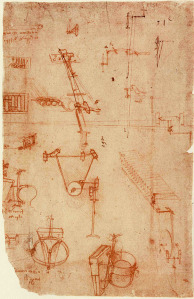 Sketches from Leonardo da Vinci’s Codex Atlanticus
Just ran across This Is Colossal‘s report on the Polish pianist Slawomir Zubrzycki’s realization of one of tne wildly imaginative hybrids Leonardo da Vinci dreamed up in his notebooks. Sketches for this “viola organista” – a mating of the principles of stringed and keyboard instruments – are found in da Vinci’s massive collection of sketches known as the Codex Atlanticus.
Zubrzycki demonstrated his new version of this invention at the recent International Royal Cracow Piano Festival. The Colossal‘s story links to this more-detailed account at The History Blog of the background of the viola organista and attempts to realize it, including this early one:
Almost a hundred years [after the da Vinci sketches] in 1575, church organist Hans Hyden of Nuremberg created the first functional bowed keyboard instrument operated by a foot-treadle. He used gut strings (later switched to metal…
View original post 295 more words
Filed under: Uncategorized
July 1, 2015 • 10:44 am Comments Off on Half Through the Year
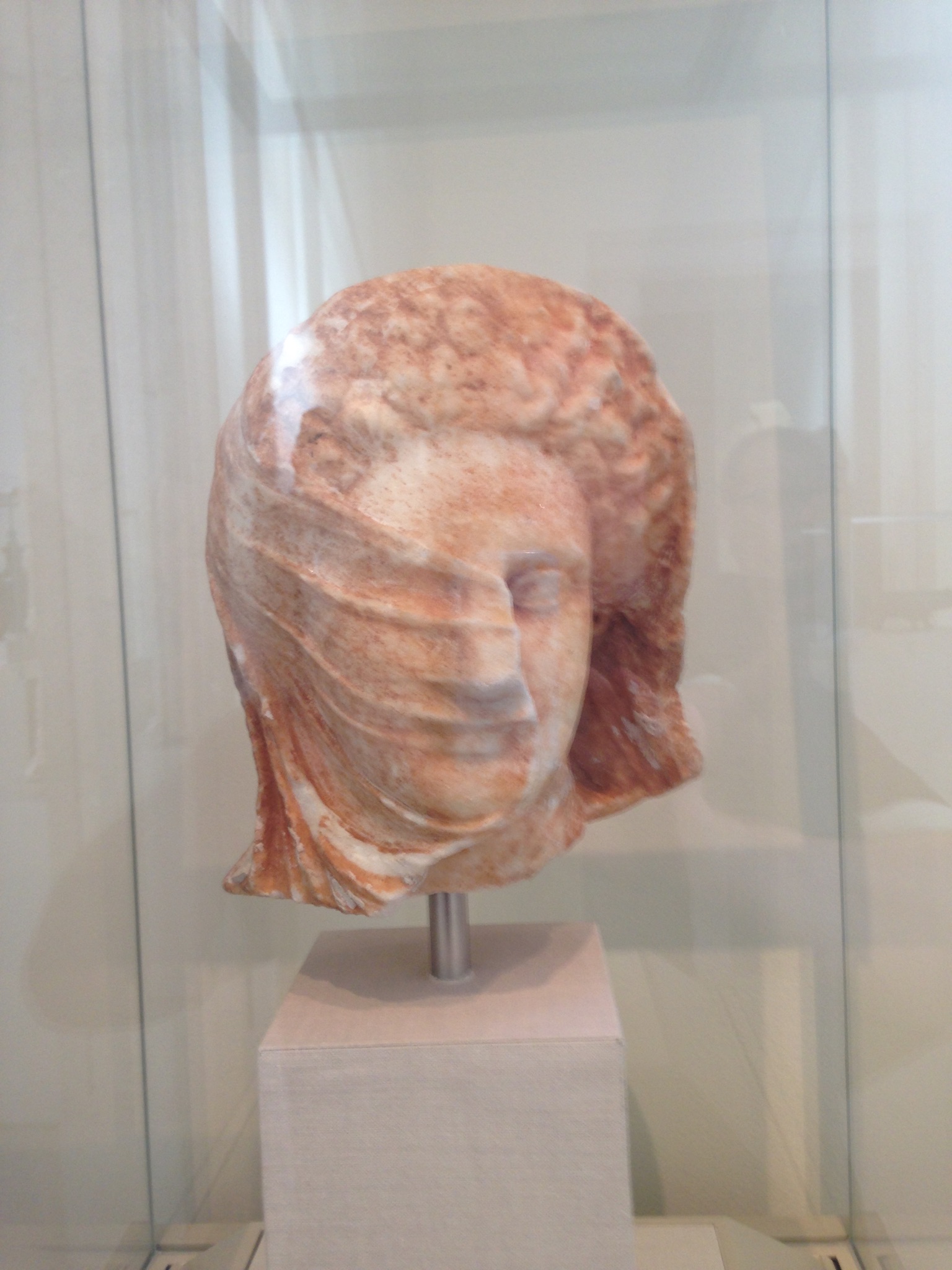
Today’s position in the annual calendar makes me think of Friedrich Hölderlin’s most-famous poem, Hälfte des Lebens. Here’s the original, followed by my inelegantly functional translation (in which I deliberately stick close to Hölderlin’s word order/syntax):
Hälfte des Lebens
Mit gelben Birnen hänget
Und voll mit wilden Rosen
Das Land in den See,
Ihr holden Schwäne,
Und trunken von Küssen
Tunkt ihr das Haupt
Ins heilignüchterne Wasser.Weh mir, wo nehm’ ich, wenn
Es Winter ist, die Blumen, und wo
Den Sonnenschein,
Und Schatten der Erde?
Die Mauern stehn
Sprachlos und kalt, im Winde
Klirren die Fahnen.
Halfway Through Life
With its yellow pears
And laden with roses,
The shore hangs right into the lake,
O lovely swans,
And drunk with kisses
You dip your heads
Into the holy sobering water.Alas, where shall I, come
Winter, [find] flowers, and where
The sunshine,
And shade of the earth?
The walls are standing
Speechless and cold, in the wind
The weathervanes rattle.
And Benjamin Britten’s setting:
 Arts & Culture Stories from NPR