MEMETERIA

Icon

Arts writing by Thomas May

Finding the Key: Anthony Doerr’s All the Light We Cannot See

“What do we call visible light? We call it color. But… really, children, mathematically, all of light is invisible,” is the lesson that beams in on the short-wave radio. The hyper-curious, gifted, white-haired German orphan Werner Pfennig and his sensitive sister Jutta listen in, escaping through the invisible waves for a moment from the coal-mining town of Zollverein.

This is just one of many memorably etched moments in Anthony Doerr’s new novel, All the Light We Cannot See. I became a fan of Doerr’s writing last year when his short story collection Memory Wall fell into my hands. Doerr possesses the rare gift of a distinctive style that avoids mannerism and that endows his characters — well, most of them — with depth and compassionate believability.

The beauty of Doerr’s fiction is both stylistic and structural. His lyrical, keenly observed prose in All the Light We Cannot See supports a meticulously crafted and layered narrative. The narrative follows a more or less old-fashioned model, using a thriller plot as the engine for what is really of interest: the development of its two main characters, the blind French girl Marie-Laure and Werner, as the horrors of the Second World War grimly unfold around them.

Doerr dextrously interleaves different points of view while time-warping back and forth from the climactic scenes in the walled port city of Saint-Malo on the Brittany coast, just after D-Day in the summer of 1944. The tone similarly blends aspects of a fable with penetrating realism.

I agree with William T. Vollmann‘s assessment that one major flaw is the two-dimensional portrayal of Sgt. Maj. Reinhold von Rumpel: an almost comic-book Nazi villain hell-bent on his quest for a rare blue diamond known as the Sea of Flame. This Nazi’s “wickedness and physical loathsomeness are offset by nothing that could make him into a rounded character,” observes Vollmann. “His unbelievability exemplifies a mistake writers often make when describing monsters.”

And Vollmann captures the “old-fashioned” quality of Doerr’s achievement here when he notes that All the Light We Cannot See “is more than a thriller and less than great literature. As such, it is what the English would call ‘a good read.'”

Here’s how the author explains what he means by the title:

It’s a reference first and foremost to all the light we literally cannot see: that is, the wavelengths of the electromagnetic spectrum that are beyond the ability of human eyes to detect (radio waves, of course, being the most relevant).

It’s also a metaphorical suggestion that there are countless invisible stories still buried within World War II — that stories of ordinary children, for example, are a kind of light we do not typically see. Ultimately, the title is intended as a suggestion that we spend too much time focused on only a small slice of the spectrum of possibility.

Why continue to write about WWII? Doerr from his NPR interview with Arun Rath:

We’re losing thousands of people for whom World War II is memory every day. In another decade, there will be nobody left — very very few people left — who can remember the war. And so history becomes something that becomes slightly more malleable.

And I worry about how my own sons, my 10-year-old sons, are learning about the war, whether it’s through video games or the History Channel. Often, particularly politicians, they’re often presenting the war as a very black-and-white narrative. I worry that that’s dangerous. I think it’s important to empathize with how citizens come to a certain point, and you know, that might be a more meaningful way to try and avoid what had happened.

Filed under: book recs, literature

Interviewing Sam Harris

Sam Harris

I ran into this old interview I did years ago with the brilliant and hugely controversial neuroscientist, philosopher, and gadfly thinker Sam Harris.

It’s actually a decade old, from when I was still an editor at Amazon (and when Amazon was, let’s just say, a very different place). The subject was the first book by the prolific Mr. Harris, The End of Faith, which went on to win the 2005 PENN Award for Nonfiction.

Interview with Sam Harris: The Mortal Dangers of Religious Faith
Not long before the birth of Christ, in an age of violence and turmoil, the Roman poet and Epicurean philosopher Lucretius wrote an epic masterpiece titled De Rerum Natura (“On the Nature of Things”). His goal, in part, was to liberate humankind from the religious superstitions that he believed stood in the way of true peace of mind and happiness.

Author Sam Harris plays the role of a contemporary Lucretius in his book The End of Faith: Religion, Terror, and the Future of Reason. Harris received a degree in philosophy from Stanford University and is a doctoral candidate in the field of neuroscience.

Well aware that a book about the inherent dangers of institutional, dogmatic religion would court controversy, Harris wrote The End of Faith out of a sense of urgency regarding what he argues constitutes perhaps the greatest threat we face today. He shared his thoughts about the character of dogmatic faith versus mysticism, the role of reason in civil discourse, and the hope that humans can overcome the propensity toward religious violence before it’s too late.

continue reading

Filed under: book recs, interview, philosophy, religion

Love and War: Partenope

Just to whet your appetite: a snippet from this deliciously sophisticated Handel comedy.

I’ll post my new essay on Handel’s Partenope as soon as San Francisco Opera publishes it. The production, which took the Olivier Award for Best Opera when it premiered at English National Opera, is directed by Christopher Alden, and I had a chance to spend time with him as he was rehearsing the SFO cast (a dream cast, I might add).

Filed under: directors, Handel, San Francisco Opera

Built-In Beauty

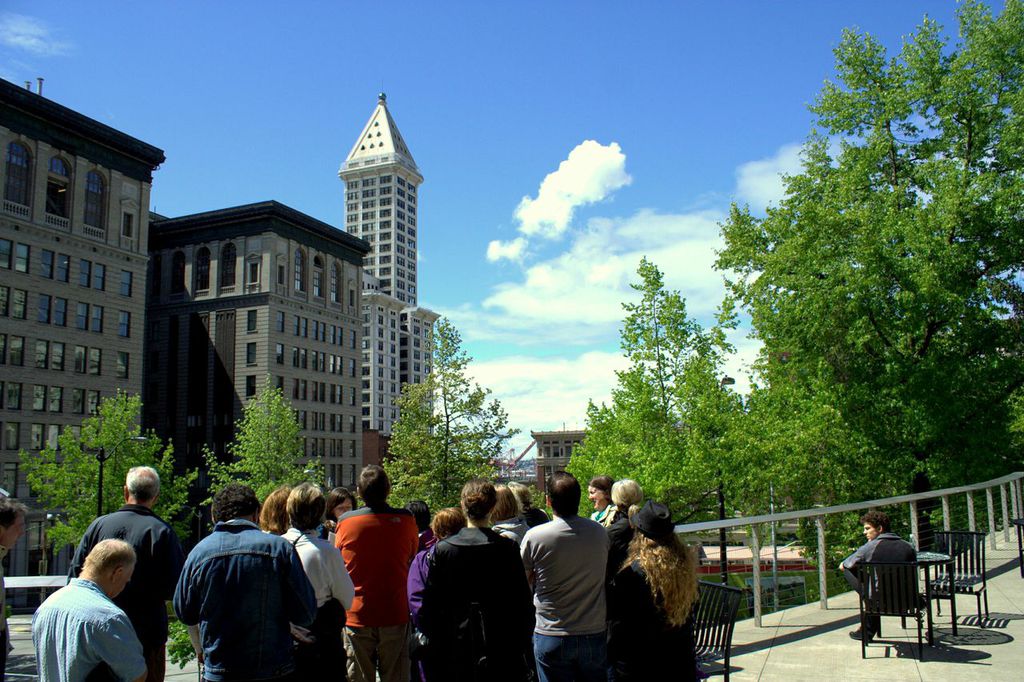
The Seattle Architecture Foundation’s new season has begun. Current tour schedules listed at http://seattlearchitecture.org/tours

Thomas May's avatarMEMETERIA

Photo by Monique Blanchard Photo by Monique Blanchard

My latest piece for City Arts :

The Smith Tower celebrated its 100th birthday earlier this month, and to mark the architectural anniversary visitors were able to enjoy the Tower’s Chinese Room and the vistas from the Observation Deck for the original admission price collected in 1914—a budget-busting 25 cents.

Of course, Smith Tower is always just “there,” part of the ever-present scenery of daily life in downtown Seattle. Maybe on your checklist of show-off-the-city items for visitors. But try for a moment to ignore the familiarity of icons like this.

Because architecture is so integrated into our everyday patterns, it’s easy to take the urban landscape for granted—buildings, facades, interiors, walkways, skylines—yet at the same time they profoundly influence the way we experience those everyday patterns, at however unconscious a level.

It’s the mission of the Seattle Architecture Foundation (SAF) to “awaken people to these…

View original post 50 more words

Filed under: Uncategorized

St. Lawrence String Quartet at 25

SLSQ

One of my favorite string quartets is celebrating its 25th anniversary with a typical overdrive of crative activity. Here’s my recent portrait of the St. Lawrence for Stanford Arts:

“It’s a great time both to be playing in a string quartet and to be writing string quartets,” remarks Geoff Nuttall, first violinist and cofounder of the St. Lawrence String Quartet (SLSQ). He’s thrilled about how both pursuits—those of the recreative performing artist and of the composer who creates from scratch—will be fused in three distinctive ways during the course of the SLSQ’s upcoming season at Bing Concert Hall.

continue reading

Filed under: chamber music, commissions, John Adams, string quartet

The Death of Klinghoffer at the Met

ENO-Klinghoffer

Here’s my recent essay for the Metropolitan Opera’s Season Book on the most controversial opera of the season:

Behind the Headlines
In the world of opera, it’s common for a new work to take some time to establish its place in the repertoire. Just think of Così fan tutte, written in 1790 but largely ignored until the mid-20th century, or Les Troyens, which didn’t reach the United States until more than a century after its composition. A generation has passed since the 1991 premiere of John Adams’s second opera, The Death of Klinghoffer, but for the most part the work is still known solely by its controversial reputation. Apart from that original production, only two other full stagings have been seen in the U.S., and both of these took place within the past three years (at Opera Theatre of Saint Louis in 2011 and Long Beach Opera in spring 2014).

continue reading

Filed under: American opera, John Adams, Metropolitan Opera

A Taste of Josquin

To the extent that anything can be said to be the work of Josquin des Prez — so popular in his time, the gold standard of quality, that his “output” increased enormously after his death thanks to a flurry of false attributions.

Martin Luther remarked: “Josquin is the master of the notes, which must do as he dictates, while other composers must follow what the notes dictate.”

Filed under: Renaissance music

Become Ocean on CD

IMG_1303

I had the fortune of spending an afternoon with the composer John Luther Adams in New York City last May, shortly after his Pulitzer Prize-winning orchestral work Become Ocean received its New York premiere at Carnegie Hall. (My article on this Seattle Symphony commission appears in the current issue of Listen magazine.)

And now the SSO’s recording with music director Ludovic Morlot has been released on Cantaloupe.

The spatial conception that informs JLA’s music really needs to be experienced in live performance, but you can get a decent impression of his aesthetic from the recording. This week NPR is making it available to listen to online for free.

Filed under: American music, John Luther Adams, Seattle Symphony

In excelsis

heights

Filed under: photography

The Awesome Patricia Racette

Congratulations to Patricia Racette on receiving the San Francisco Opera Medal.

From Roger Pines’s recent interview with the soprano:

The city of San Francisco offers endless joys to Racette. She and her wife, mezzo-soprano Beth Clayton, have a ritual of taking their 16-year-old toy poodle, Sappho, to Ocean Beach. And, of course, the years have brought Racette many friends here: “Some of them I’ve known for the entire 25 years, and others have come into my life over the past few years. The only downfall is that I’m always here to work and find myself challenged with not enough time amidst rehearsals and performances to see everyone as much as I’d like!”

And then there is the San Francisco audience, for whom Racette feels immense affection: “There is both loyalty and passion, and I’m quick to remind that we do feel the energy of the audience when we’re on the stage. It really is palpable– you can just tell when the crowd is ‘with you.’ I’m lucky enough to sing around the world, but when I come back to San Francisco, I know that I’m home.”

And here she discusses her current role as the lead in Susannah at SF Opera:

Filed under: San Francisco Opera, singers

Archive

Enter your email address to follow this blog and receive notifications of new posts by email.