A friend of mine unearthed this job posting on Craigslist:
Writer Needed For Support Community for Affluent Individuals
Special community for people who have earned a lot of money or been born into a wealthy family needs a blog ghostwriter. The focus of the community is providing psychological support for the problems money brings — family tensions, unfulfillable expectations, boredom, etc. To do this you must be intimately familiar with the problems faced by wealthy people. If you grew up wealthy or through some other means can write detailed blog posts on this topic, please get in touch.
The posts need to be highly personal, emotional and have a strong editorial voice. These are anything but generic lectures. We are looking for 3 posts per week and each post pays $30. If you’re interested, please send a cover letter telling us about your background and experience and why you would be a good writer for this. If a resume would be helpful please send that as well. Finally, please send a few suggested topics so we can see that you really can come up with specific topics which touch the hearts of people from affluent families. Thanks!
This summer’s 65th anniversary season of the Aspen Music Festival is keyed to the theme of “The New Romantics.” Here’s the feature essay I wrote on current manifestations of “New Romanticism”:
In the summer of 1983, the composer Jacob Druckman triggered something of a mild shockwave in the musical world by programming a festival interrogatively titled “Music Since 1968: A New Romanticism?” This would be the first of two annual new-music festivals that Druckman curated around the rubric of “New Romanticism.” Both were given by the New York Philharmonic during his tenure as the orchestra’s composer-in-residence.
Druckman’s manifesto-like essay introducing the program declared that “the tide began to change” among composers during the mid-1960s, and that amid the profusion of recent new works could be discerned “a gradual change of focus, or spirituality, and of goals.”
He adapted Friedrich Nietzsche’s famous dichotomy of the logical, rational “Apollonian” versus the ecstatic “Dionysian” as representatives of the polar impulses driving creativity (both gods, it’s perhaps helpful to recall from ancient Greek mythology, being sons of Zeus and thus half-brothers). The recent tidal shift, argued Druckman, was toward the “Dionysian qualities” of “sensuality, mystery, nostalgia, ecstasy, transcendency. Whether this new music will be called ‘Neo-Romantic’ or some other term is yet to be seen….”
The American composer Tobias Picker turned 60 this month — another to add to the list of composers born in July (Henze, Gluck, Janáček, Mahler, Unsuk Chin, Birtwistle).
The revised version of his opera An American Tragedy opened on Sunday in a new production directed by the wonderful Peter Kazaras — not a bad way to celebrate a milestone birthday.
I had the privilege of writing the program essay for Glimmerglass:
In an interview from 1927 — two years after “An American Tragedy” was published —Theodore Dreiser’s fellow mid-Westerner F. Scott Fitzgerald praised the novel as “without doubt the greatest American book that has appeared in years.” It’s a judgment that Tobias Picker’s father Julian heartily affirmed when the composer was growing up. “This was his favorite book by his favorite writer,” recalls the composer. “My father even had a signed original edition from 1925.”
This week marks the 45th anniversary of the first human moon landing via Apollo 11: on July 20, 1969, at 20:18 UTC (unless you’re a conspiracy theorist who believes the event was staged — possibly also buying into the claim that the temperature on Mars “disproves” the reality of human-caused climate change).
So in this week filled with depressing reminders of humanity’s dark side and cruelty, reminding ourselves of our greatest aspirations seems more needful than ever.
Discovery offers this trove of rare photos from inside Apollo 11.
Space.com is paying tribute to this historic anniversary with a retrospective including memories from Buzz Aldrin, an Apollo quiz, historic photos, “scariest moments,” and more.
For the 40th anniversary in 2009, the Telegraph compiled a list of music (mostly pop) inspired by the moon. Oddly, Holst’s The Planets is mentioned (none of its movements is devoted to the moon), but these are omitted:
–the “Song to the Moon” from Dvořák’s opera Rusalka
–Haydn’s opera buffa Il mondo della luna
–Bellini! Norma’s prayer to the moon (“Casta diva”) or the arietta “Vaga luna”:
The National Youth Orchestra of the United States of America has just launched its second season. Tomorrow brings the NYO to Carnegie Hall for its official debut there, with a program of music by Bernstein, Britten (Gil Shaham soloing in the Violin Concerto). Mussorgsky, and a newly commissioned orchestral piece by Samuel Adams. David Robertson is serving as the NYO’s conductor this year.
It’s a ploy that always generates controversy: announce the death of “classical music” (however you define it), furnish your obituary with a sauce of ominous statistics and watch your site traffic explode. Another death knell hit the blogosphere and Twitterverse this January, courtesy of a Slate article titled “Requiem: Classical Music in America Is Dead,” which came illustrated with a gray-haired conductor stationed in front of a tombstone. Predictably, the piece triggered a raft ofindignant but thoughtful counterarguments in response.
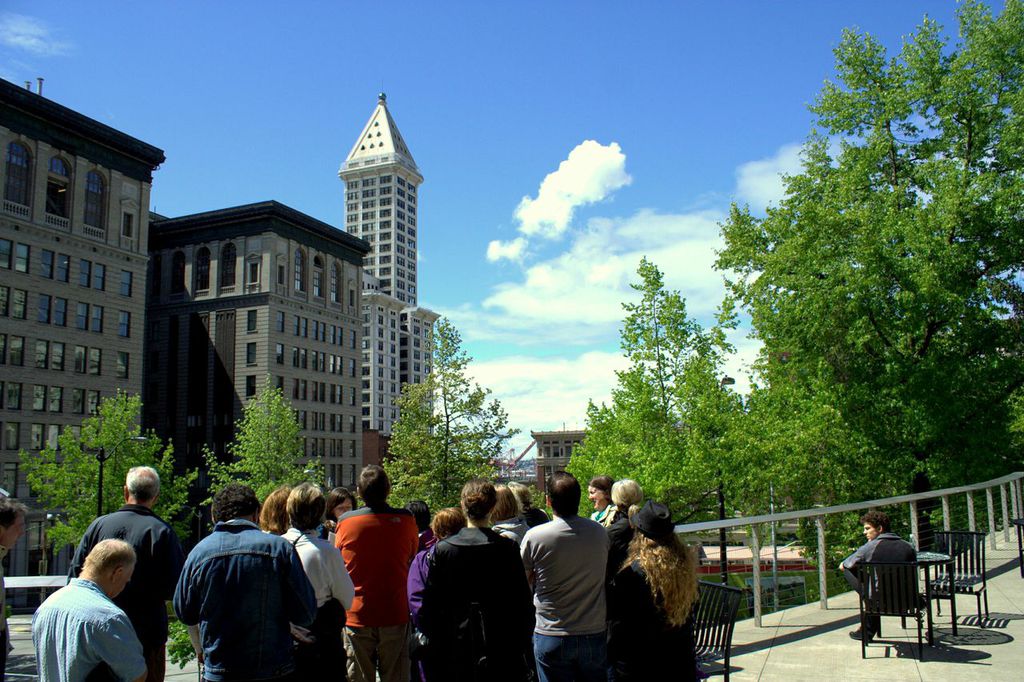
The Smith Tower celebrated its 100th birthday earlier this month, and to mark the architectural anniversary visitors were able to enjoy the Tower’s Chinese Room and the vistas from the Observation Deck for the original admission price collected in 1914—a budget-busting 25 cents.
Of course, Smith Tower is always just “there,” part of the ever-present scenery of daily life in downtown Seattle. Maybe on your checklist of show-off-the-city items for visitors. But try for a moment to ignore the familiarity of icons like this.
Because architecture is so integrated into our everyday patterns, it’s easy to take the urban landscape for granted—buildings, facades, interiors, walkways, skylines—yet at the same time they profoundly influence the way we experience those everyday patterns, at however unconscious a level.
It’s the mission of the Seattle Architecture Foundation (SAF) to “awaken people to these influences and increase the public’s awareness and appreciation of design in the built environment.” To that end, SAF is currently offering a baker’s dozen of walking tours both downtown and in a variety of other neighborhoods, each conducted by members of their reserve of highly trained tour guides.
It’s always interesting to see which composers turn out to be soul mates — especially when the affinity crosses barriers of time and cultural expectations.
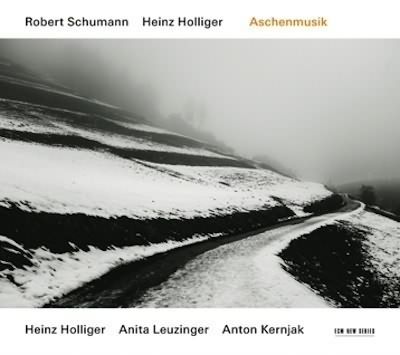
The extraordinary Swiss musician Heinz Holliger — oboist supreme, composer, and conductor — has followed the traces of Robert Schumann throughout his life, always with revealing and sometimes surprising results. This new release from ECM weaves together music by Schumann (viewed, so to speak, from an oboist’s perspective) and one of Holliger’s own Schumann homages, Romancendres (2003) — an attempt to rescue his predecessor’s burned Romances for Cello and Piano “from the ashes” (hence the current album title, Aschenmusik).
ECM has recorded this Holliger composition before (on another intriguing program that includes the Swiss composer’s overlayering of texts by Hölderlin for a reimagining of Schumann’s Gesänge der Frühe, from 1853, the same year as the burnt Romances). But Aschenmusik, released to celebrate Holliger’s 75th birthday this year, also showcases his breathtaking musicianship as an oboist. The entire CD is dedicated to Holliger’s late wife, the harpist Ursula Holliger, who died in January of this year.
Granted, the tracklist is somewhat peculiar, juxtaposing Romancendres (for cello and piano) with Schumann rarities as well as other pieces arranged for oboe or cello. So we have the Six Studies in Canon Form, Op. 56 (1845), for oboe d’amore, cello, and piano; the Three Romances for Oboe and Piano, Op. 94 (1849); the Intermezzo from the “FAE Sonata” in A minor, WoO 2 (1853), reworked for oboe d’amore and piano; and an arrangement of the Violin Sonata No. 1 in A minor, Op. 105 (1851), substituting cello for violin (thus suggesting a sonic coherence with Holliger’s own cello-piano piece).
But listening to the whole program — and late nights seem especially amenable to this music for some reason, I find — gives the impression of a very personal encounter with Schumann, an encounter that seeks to go beyond the myths.
Holliger observes (in an interview with Claus Spahn included in the booklet) how his own views of Schumann have changed over the years, with regard to the Romances for example: “25 years ago I wanted to show that [they] are not only romantic and poetic, but very precise and elaborate in their workmanship. Today I can treat them with greater license. Their linguistic character is more important to me. I try to play them like three completely different poems.”
Indeed his variety of expression is captivating, abetted by sensitive accompaniment at the keyboard from Austrian pianist Anton Kernjak. One of Holliger’s main insights here is that “in trying to write tightly structured music [Schumann] intensified the poetic.”
Aschenmusik prompts reflections on the distance between a composer’s imagined creations and what makes it to “the real world” of pen and paper, manuscript — and then what relation later generations have to these artefacts. Music history is full of stories of composers revising, frustrated by first performances, or rejecting works wholesale and consigning them to the flames.
But in the case of Schumann’s lost Cello Romances, it was those who loved him who thought they were doing right by destroying his work: Clara Schumann, acting on the advice of Brahms, thought she was “safeguarding” her husband’s reputation by suppressing this and other works from his final lucid period. The fear was that the music would be perceived as showing evidence of a deteriorating mind — which in fact became a self-fulfilling prophesy in the case of the rediscovered Violin Concerto, whose reception has been complicated precisely by this bias surrounding the score.
Holliger points out that his Romancendres — performed together with the warmly expressive principal cellist of the Zurich Tonhall Orchestra, Anita Leuzinger — does not aim “to reconstruct a lost Schumann work,” though his “initial impetus was to rebel against this barbaric act of destruction.”
My idea was that Schumann’s entire life is contained in the ashes of the burnt Cello Romances, That’s why I wrote the four middle movements of “Romancendres” from the viewpoint of a dying man whose entire life passes through his mind in fractions of a second at the moment of his death.