

Sub Rosa
“Rose, oh reiner Widerspruch, Lust, niemandes Schlaf zu sein unter soviel Lidern” — Rainer Maria Rilke
Filed under: photography

July 17, 2014 • 12:43 pm Comments Off on Studie in Rosa
Sub Rosa
“Rose, oh reiner Widerspruch, Lust, niemandes Schlaf zu sein unter soviel Lidern” — Rainer Maria Rilke
Filed under: photography
July 16, 2014 • 9:57 am Comments Off on Nietzsche vs. Dawkins

The event itself is far too great, too distant, too remote from the multitude’s capacity for comprehension even for the tidings of it to be thought of as having ARRIVED as yet. Much less may one suppose that many people know as yet WHAT this event really means — and how much must collapse now that this faith has been undermined because it was built upon this faith, propped up by it, grown into it; for example, the whole of our European morality.
-Friedrich Nietzsche, Die fröhliche Wissenschaft
Michael Robbins cites that passage in his recent review of Atheists: The Origin of the Species by Nick Spencer, who directs the London-based, Christian think-tank Theos.
Spencer ventures an historical traversal of the intellectual history of atheism, wherein “one of his most trenchant themes is that it is more proper to speak of atheisms and of various species of atheist.” (It’s worth noting — as the classical scholar Barbara Graziosi does in her excellent and highly recommendable “reception history” of the pagan Greek gods, The Gods of Olympus: A History — that for the ancient Greeks, the alpha-privative word “atheos” [ἄθεος] didn’t normally connote an unbeliever, but rather “someone whom the gods had abandoned.”)
Robbins describes how Nietzsche’s atheism is positioned historically by Spencer:
Nietzsche realized that the Enlightenment project to reconstruct morality from rational principles simply retained the character of Christian ethics without providing the foundational authority of the latter. Dispensing with his fantasy of the Übermensch, we are left with his dark diagnosis. To paraphrase the Scottish philosopher Alasdair MacIntyre, our moral vocabulary has lost the contexts from which its significance derived, and no amount of Dawkins-style hand-waving about altruistic genes will make the problem go away. (Indeed, the ridiculous belief that our genes determine everything about human behavior and culture is a symptom of this very problem. [sic*])
The point is not that a coherent morality requires theism, but that the moral language taken for granted by liberal modernity is a fragmented ruin: It rejects metaphysics but exists only because of prior metaphysical commitments. A coherent atheism would understand this, because it would be aware of its own history. Instead, trendy atheism of the Dawkins variety has learned as little from its forebears as from Thomas Aquinas, preferring to advance a bland version of secular humanism.
(*”sic” because this reads like a caricature of Dawkins’s theories — precisely the kind of superficial, gross misunderstanding of which Spencer is accusing the new atheists.)
More and more, Nietzsche’s importance for Mahler begins to make sense…
Reviewing Spencer in The Guardian, meanwhile, Julian Baggini observes:
Spencer is here promoting the conception of “religiosity as pattern of life rather than a set of verifiable propositions”. On this view, what matters is not whether difficult doctrines such as eternal damnation or even Christ’s resurrection are true or false, but that a life guided by such ideas is somehow richer, more complete, more directed towards a higher good.
If that is right, then atheists who have criticised religion for its doctrines have spectacularly missed the point, “tilting at theological windmills”. But as Spencer himself argues, we didn’t see “theological liberalism redrawing the lines” until the last decades of the 19th century, and, even then, only a minority accepted the new map.
Filed under: book recs, philosophy
July 15, 2014 • 11:00 am 1
And so Sir Harry turns 80! Harrison Birtwistle has created some of the most strangely arresting soundscapes among the composers of our time. It’s extremely difficult music to write about, as I’ve discovered with various assignments over the years. Music that defies even more than most the feeble attempt to circumscribe it with mere words — it makes mincemeat of those who try — but that can strike you as uncannily direct and visceral. (See what a knot he just got me caught up in?)
Among my favorites of his “satellite” works are Earth Dances, The Shadow of Night, and Night’s Black Bird — disturbing and thrilling works Birtwistle conceives as orchestral “processions” and “imaginary landscapes.”
All of these seem to be parts of a vaster, labyrinthine work-in-progress, with a number of threads interwoven among them. Chief among these is a tension between linear and circular patterns, between an “ordinary” sense of chronological time and a heightened awareness of other kinds of times.
Tom Service offers this lovely, user-friendly intro to the utterly distinctive world of Sir Harrison Birtwistle, including Panic, The Cry of Anubis, Secret Theatre, Earth Dances, and the Violin Concerto.
In his excellent series of guides to contemporary composers, Service writes:
So where was the crucible of Birtwistle’s creative imagination? Manchester in the 1950s. Born in Accrington in 1934, and growing up as a clarinetist playing in local theatre bands, Birtwistle studied in the north west with what would become an (in)famous group of composers and musicians: Alexander Goehr, Peter Maxwell Davies, pianist John Ogdon, and trumpeter, conductor, and composer Elgar Howarth.
The usual story about what this “Manchester school” achieved was that they ripped up the rule book, and made British music confront contemporary continental modernisms that previous generations and the establishment had been frightened of. That’s true, to the extent that Harry, Max, and Sandy did engage with and devour everything they could get their hands on by Schoenberg or Webern or Stravinsky, and one of the pieces that changed Birtwistle’s life was Boulez’s “Le marteau sans maître.”
But just as there was a move to the modern, there was an equivalent excavation of the musical and mythical past, as Max and Harry delved into medieval music, into plainchant and polyphony, to find new-yet-old ways of structuring and thinking about what music could be.
Filed under: anniversary, composers, new music
July 14, 2014 • 10:17 am Comments Off on A Derek Bermel Premiere
The composer Derek Bermel gives an introduction to his new Piano Trio, titled Death with Interruptions after José Saramago’s novel. Commissioned by the Seattle Chamber Music Society, it receives its world premiere on tonight’s program, part of the 2014 Summer Festival.
My recent preview of the Summer Festival includes more on Death with Interruptions from my interview with Bermel.
Filed under: chamber music, commissions, new music
July 13, 2014 • 11:07 am Comments Off on R.I.P., Lorin Maazel (1930-2014)
Early into this year we lost one of the greatest musicians of our era with the death of Claudio Abbado. Today brings the sad news of Lorin Maazel’s sudden passing. These were the great conductors I grew up with, so another stark reminder of how quickly that world is fading away.
I recall a very engaging conversation with Maestro Maazel some years ago about his thoughts on Richard Strauss. (Unfortunately the interview is no longer online and I don’t have the file handy so can’t post it for the time being at least.)
Here are a few of the immediate critical reactions:
Maazel was a musical titan who ruled at the podium with a cool, penetrating technical brilliance. This made him a divisive figure through his career, particularly since he didn’t suffer fools lightly…
Mr. Maazel was a study in contradictions, and he evoked strong feelings — favorable and otherwise — from musicians, administrators, critics and audiences.
[…]
He was revered for the precision of his baton technique, and for his prodigious memory — he rarely used a score in performances — but when he was at his most interpretively idiosyncratic, he used his powers to distend phrases and reconfigure familiar balances in the service of an unusual inner vision.
Some reactions from the Twittersphere:
Esa-Pekka Salonen: “Thank you for many unforgettable experiences, Maestro. You had many huge fans among colleagues. I for one certainly.”
Robert Lind: “Rest in peace Lorin Maazel! I remember well when I sang Beethoven’s Ninth Symphony with you a few years ago!”
Matthew Worth: “RIP, Maestro. You gave me one of my first professional jobs after conservatory. Thank you for your faith and nurture.”
And from a 2011 profile in The Guardian by Nicholas Wroe, when Maazel was in London to conduct the Philharmonia in Mahler:
“To be honest I don’t look back with great satisfaction at all the various people I’ve been over the decades,” [Maazel] says. “In fact I often shake my head in dismay at the immaturity and puerile view of life and have the greatest compassion for young people who are going through these same stages. But hopefully you mature and you get smarter, in life and in music. If you sharpen your mind and become open to new ideas you become less enclosed in the ghetto of your fanaticisms.”
He says his relationship with the Mahler symphonies has been lifelong education, “and the place where you learn is on the job. I’m not sure I could listen to my early recordings with the Vienna Philharmonic today. Not because they would be wrong or bad, but the maturing and learning process only progresses inch by inch over the years so this lifetime of interaction with the music now feels part of a much larger experience.
In fact it feels more akin to jumping out of a window and seeing your life pass before your eyes, and I now find myself delivering a performance, simultaneously, both in retrospect and in the present moment. Of course I’m very familiar with interacting with masterpieces, but the emotions engendered by the music are leaving me overwhelmed at the end of the performance. And I’m not the sort of person who is accustomed to being overwhelmed.”
Filed under: conductors, music news
July 11, 2014 • 8:45 am Comments Off on Seattle’s Chamber Music Summer Festival: Review
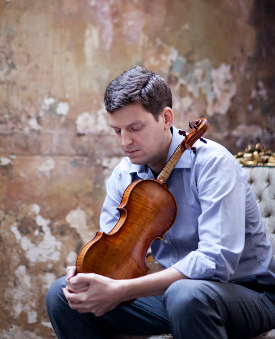
James Ehnes; © Benjamin Ealovega
Tomorrow will mark the first anniversary of Memeteria. I wouldn’t believe it if I didn’t have the archives to the right to prove it — this year has been a whirlwind. A huge thanks to all my readers for taking the time to visit. I hope you will continue to come back and would love to hear from you.
And how’s this for unplanned synchronicity: my very first piece was a report on the opening of the Seattle Chamber Music Society’s Summer Festival. And my latest offering is a review of one of the 2014 Summer Festival’s concerts. To wit:
For 33 summers now, the Seattle Chamber Music Society (SCMS) has been presenting an extensive festival that now ranks as a particularly desired destination for musicians on the summer chamber circuit across North America. This latest edition is off to an especially invigorating start. For their part, the audiences tend to be uniformly enthusiastic and devoted, but last night’s performances met with vociferous approval that reached the extreme end of the applause-meter.
The unusual programme design – juxtaposing Stravinsky’s infrequently heard Octet for Winds with bread-and-butter classics by Mendelssohn and Beethoven – is a signature of James Ehnes, now in his third year as SCMS’s artistic director.
Filed under: chamber music, James Ehnes, review
July 10, 2014 • 9:20 am Comments Off on The Endurance of Proust

Summers were the time for Mahler to compose, and for me summers always seemed the perfect time to become immersed in Proust’s universe, so there’s something pleasing about the fact that both share July as their birthday month.
Here’s another association that intrigues me: the philosophical underpinnings of Proust’s lifelong project. Consider these brief extracts from the philosopher Henri Bergson — an enormous influence on early Modernism and an actual relative of Marcel Proust through marriage (his wife was a cousin of Proust) — on his concepts of time, duration, and consciousness:
The truth is that we change without ceasing, and that the state itself is nothing
but change.This amounts to saying that there is no essential difference between passing from one state to another and persisting in the same state. If the state which “remains the same” is more varied than we think, [then] on the other hand the passing of one state to another resembles — more than we imagine — a single state being prolonged: the transition is continuous.
Yet, just because we close our eyes to the unceasing variation of every physical state, we are obliged when the change has become so formidable as to force itself on our attention, to speak as if a new state were placed alongside the previous one. Of this new state we assume that it remains unvarying in its turn and so on endlessly.
[…]
[O]ur duration is not merely one instant replacing another; if it were, there would never
be anything but the present —- no prolonging of the past into the actual, no evolution, no concrete duration.Duration is the continuous progress of the past which gnaws into the future and which swells as it advances. And as the past grows without ceasing, so also there is no limit to its preservation.
[…]
From this survival of the past it follows that consciousness cannot go through the same state twice.
Meanwhile, the critic, scholar, and writer Daniel Mendelssohn recently observed the following on Proustian “resurrection” in an interview with the Paris Review:
It’s true that “In Search of Lost Time finishes” ‘well.’ There is a sort of optimism in thinking that a work of art can allow us to recreate and to preserve the past. It’s different for me, though. I never claimed that my writing would be able to do anything at all for my family, long gone. The past is the past, the dead are the dead, that is an unchangeable reality.
If literature is able to bring something to life, it’s the writer — and the writer alone — who reaps the benefits, not those he writes about. This is true in the case of Proust’s narrator. All the characters he mixes with have the same fate — transformation into literary fodder, to allow his own reinvention, as a writer.
Filed under: aesthetics, literature, philosophy, Proust
July 9, 2014 • 4:29 pm 1

Sed fugit interea, fugit inreparabile tempus…
Filed under: photography
July 9, 2014 • 9:52 am 1
It’s such a commonplace cliché of a cliche: the string quartet as the embodiment of “classical music” — and hence the emblem of ultra-“serious” art, by which is really meant stuffy attitudes, not substance, as the commercial images all around us present it.
But when Haydn began working with the medium he eventually standardized into the format still used today — drawing from diverse sources — much of the original impulse was simply to have musical pleasure, an occasion for the fun of it.
At least that’s the way Haydn’s first biographer spun it, portraying his focus on the string quartet as happening essentially by chance:
A baron Furnberg had a place some way outside Vienna, and he from time to time invited his pastor, his manager, Haydn, and the cellist Albrechtsberger in order to have a little music. The Baron requested Haydn to compose something that could be performed by these four amateurs. Haydn took up this proposal and so originated his first quartet, which, when it immediately appeared, received such general approval that Haydn took courage to work further in this form.
The notion of chamber music in general as a kind of musical conversation had been an ongoing metaphor in the eighteenth century. The Paris publisher who first brought Haydn’s earliest quartets into print, for example, titled them “quattuors dialogues.”
Goethe later famously codified that image of a conversation specifically to the string quartet when he remarked near the end of his life:
The string quartet is the most comprehensible genre of instrumental music. One hears four reasonable people conversing with one another and believes one might learn something from their discourse and recognize the special characters of their instruments.
Filed under: chamber music
 Arts & Culture Stories from NPR

