This Sunday’s New York Times carried a fascinating article by Alex Halberstadt (“Zoo Animals and Their Discontents”) reporting on recent scientific thinking about the distance between humans and other species:
A profusion of recent studies has shown animals to be far closer to us than we previously believed — it turns out that common shore crabs feel and remember pain, zebra finches experience REM sleep, fruit-fly brothers cooperate, dolphins and elephants recognize themselves in mirrors, chimpanzees assist one another without expecting favors in return and dogs really do feel elation in their owners’ presence.
Meanwhile, as for humans, Helen Thomson at New Scientistreports on the apparent discovery by researchers at George Washington University of a way to turn consciousness “on or off” by means of electrical stimulation of the region deep within the brain known as the claustrum:
When the team zapped the area with high frequency electrical impulses, the woman [epilepsy patient] lost consciousness. She stopped reading and stared blankly into space, she didn’t respond to auditory or visual commands and her breathing slowed. As soon as the stimulation stopped, she immediately regained consciousness with no memory of the event. The same thing happened every time the area was stimulated during two days of experiments.
Thomson reports that Mohamad Koubeissi, who published the study, “thinks that the results do indeed suggest that the claustrum plays a vital role in triggering conscious experience. ‘I would liken it to a car,’ he says. ‘A car on the road has many parts that facilitate its movement –- the gas, the transmission, the engine –- but there’s only one spot where you turn the key and it all switches on and works together. So while consciousness is a complicated process created via many structures and networks — we may have found the key.'”
Shortly before he died in 2004, Francis Crick, according to Thomson, had been pursuing his idea “that suggested our consciousness needs something akin to an orchestra conductor to bind all of our different external and internal perceptions together.” And with his colleague Christof Koch, Crick actually posited the claustrum as the area in charge of this operation. (René Descartes famously claimed that the pineal gland was the locus for the interaction of the immaterial mind with the physical body — and hence the “seat of the soul.”)
“Ultimately, if we know how consciousness is created and which parts of the brain are involved then we can understand who has it and who doesn’t,” Koch told Thomson.
In this excerpt from John Adams’s review of Jens Malte Fischer’s Mahler biography, it’s intriguing to see what one great composer zeroes in on when describing the creative process of another:
When [Mahler] composed he did it in a white heat, sketching the outlines of his large symphonic forms in a hasty shorthand scrawl, going as fast as his quicksilver mental powers allowed him, usually during all-too-brief summer “vacations” in picturesque alpine settings. A symphony might be composed in the course of one or two of these summer retreats.
But the painstakingly detailed writing out and preparation of performance materials would occupy him for another two or more years before the work would be publicly performed. He was in every sense what we’d now call a control freak. He insisted on conducting all first performances, often treating early rehearsals as a further composing phase, trying out this and that effect on often hapless and confused orchestra members.
His printed scores are full of admonitions to the performers. Musical ideas are marked with emphatic underlinings, accents, and notational and verbal reminders that seem to shout at or plead with the performer to do exactly as the composer wanted. Mahler, long used to dealing with careless or indifferent musicians, appears to have had little faith in the ability of future generations to get his music right.
What would Mahler have thought about his interpreters today? Which ones would have pleased him most — or displeased him least?
What a work of beauty it is: a masterpiece of Italian Renaissance Revival architecture that once held the title of tallest building west of the Mississippi and long reigned as the tallest on the West Coast, Smith Tower was opened to the public during the July 4th holiday period 100 years ago (technically, July 3) — the very month in which the First World War began.
And even amid the present Seattle skyline, where it’s dwarfed by the “Darth Vader” Columbia Tower and other urban mountain peaks, the Smith Tower retains its matchless poise and sturdy elegance. It arose in the aftermath of the Great Fire that had destroyed the old downtown Seattle in 1889 and represented the vision of Lyman Cornelius Smith, a prominent New York industrialist (who founded what would become the Smith-Corona Typewriter Company).
Smith Tower under construction, 1913
Smith died before the building was completed, but his son, Burns Lyman Smith, took over to see the project through. Designed by the Syracuse brother architects Edwin H. Gaggin and Thomas Walker Gaggin, the Tower reaches to 489 ft at the top of its spire, with 38 floors of office space (42 total), and 304,350 sq ft. The famous Chinese Room on floor 35 contains gifts from Empress Dowager Cixi, the “Last Empress” of China.
My friend Ben Lukoff observes the following in his book Seattle: Then and Now: “The Smith Tower, which was designated a city landmark in 1987, is still the seventeenth-tallest building in the city. It has twice undergone renovation and was a popular office location during the dot-com boom.”
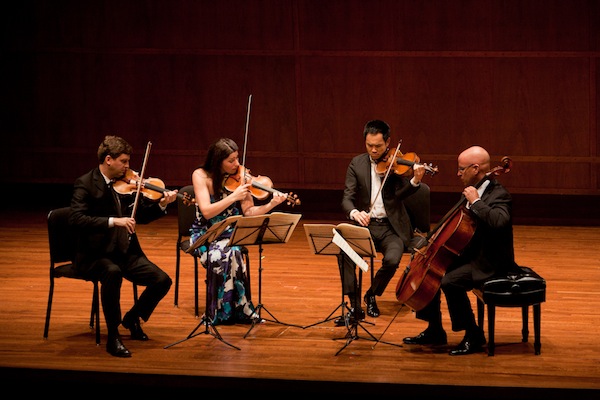
(l to r): James Ehnes, Amy Schwartz Moretti, Richard O’Neill, and Robert deMaine. Photo by Jerry Davis.
My CityArts preview of the latest edition of the Seattle Chamber Music Society’s Summer Festival, featuring a new commission from Derek Bermel:
For classical music lovers, summer has genuinely arrived when the top floor of Benaroya Hall is thrumming to the beats of Schubert, Shostakovich and Ravel at the Seattle Chamber Music Festival, which opens on July 7 and continues for four weeks.
I didn’t allow myself nearly enough time during my last trip to MOMA to dig into the enormous Sigmar Polke retrospective currently on view. It’s titled Alibis — not a recondite Latin phrase, but the plural of “alibi,” as in an exculpatory proof of absence from the scene of a crime.
The MOMA introduction explains further that “Polke studiously avoided any one signature style or medium; his method exemplified the definition of alibi, ‘in or at another place,'” and additionally contains a political connotation: “Polke grew up at a time when many Germans deflected blame for the atrocities of the Nazi period with the alibi ‘I didn’t see anything.'”
Alibis is also almost absurdly huge: 250 works across a wide (and unpigeonholeable) spectrum of media created or conjured into being by Sigmar Polke (1941-2010). Born in Lower Silesia, the provocative Polke was roughly of the same generation as heavyweights Anselm Kiefer (a few years younger than Polke) and Gerhard Richter (9 years older) — but inarguably in a realm all his own, even if he never settled on an identifiable style.
As New Yorker critic Peter Schjeldahl puts it in his glowing review: “With caustic humor and cultivated mystery, he could seem to hit a reset button from phase to phase, and even from piece to piece…” (The near-homonym of Polke’s name with “polka” only enhances the absurdist humor that’s essential to this artist’s aura.)
The exhibit’s first installation, sprawling across part of the atrium on MOMA’s second floor, immediately perplexes as to the intended “tone” as it offers a quick bird’s-eye view of four decades of the eternally distancing, ever-skeptical Polke’s work and “themes.” Not that the roughly chronological layout of Alibis really matters, given how wildly he can dart from one concept to the next: from puncturing art historical purism to complicating his critique of West German consumer culture — “Capitalist Realism” — with an ironic, Pop Art play on the Soviet dogma of “realism.”
And the tone really does perplex, as you travel from high ’60s performance art and Me Decade mushroom psychedelia to imposing glass panels painted with soot. Polke himself had begun collaborating with MOMA’s associate director, Kathy Halbreich, to design the show before he died of cancer in 2010. Doubtless he would have insisted on an even more enigmatic layout and wilder cross-connections; apparently Polke objected to the chronological convention followed here.
Holland Cotter’s New York Times review captures the weird mix of temperaments well:
Yet even in these ominous pictures, he fools around, delights in deviance, frustrates interpretive closure. One watchtower is painted on garishly cheery floral fabric; another is done on Bubble Wrap. A third has been washed with a light-sensitive silver oxide solution that will darken to black over time, obliterating the image.
The reception has been especially fascinating, more than usual. Talk about diametric opposition. Here’s Michael Pepi, maintaining respectfully objective attitude in The New Criterion:
Polke worked on fertile ground for a provocateur… [T]he current show at MOMA further mystifies Polke, drawing his wide-ranging output deeper in line with reactions to modernity’s great shortcomings. Whether it be destructive ideologies, overdependence on technology, or even the abuses of history itself, Polke’s ability to move across not just media but also aesthetic positions is on rapt display.
Jed Perl at The New Republic devotes a lengthy and intense piece to his disappointment: disappointment at what he characterizes as a tame, “sociological” presentation but, more importantly, at the phenomenon of Polke himself as a leading “pompier” of today’s art scene. He suggests some comparisons with Salvador Dalí: for both, “style is a put-on job, an act — but an act pressed with such intensity that it takes on a weird, almost repellent authority.” (Perl co-opts the avant-gardists scornful term for the slick and popular establishment painters they sought to subvert.):
The Polke show is as interested in its own virtuosity — or in its own swaggering anti-virtuosity — as any exhibition I have ever seen… Pompier — and certainly the pompier of Polke — is a performance, and works of visual art are not primarily or essentially performances… I am held by some of what Polke has done, by the cleverness and the bravado and the sheer spectacle of it all. But I exit this retrospective that’s so aptly entitled “Alibis” with a deep sense of relief. No artist who really matters has ever left me feeling that way.
Lance Esplund at The Wall Street Journal finds himself even more repelled and has no doubt this is another example of the Emperor’s New Clothes:
Jester-of-all-trades, [Polke] was actually, according to the show’s curators, “masquerading as many different artists.” But instead of variety we get the same joke—dressed up here as a photograph; over there as a painting—played out over and over again… Deliberately disingenuous and ambiguous, Polke courted randomness through his appropriations and derisions.
[Alibis] is the most dramatic museum show of the century to date. It may also be the most important, if its lessons for contemporary art, both aesthetic and ethical, are properly absorbed.
and
Nearly everything he did reacted, somehow, against something. Celebrity was only one of the threats to the probity of his independence which required an emergency response. He was, and he remains, heroic.
And Maike Pollack at The Gallerist discovers a hopeful message as well:
Ms. Halbreich suggests that for the postwar painter, visual ambiguity represented a resistance to the ghosts of Germany’s wartime political narratives and the authority that accompanied them.
Polke’s paintings created a new terrain… In [his] chemistry and bubbles and ridged screens, we see the Internet with its endless depths of images welling up. What’s more, his paintings are not cynical; they re-enchant the world of images and the possibilities of picture-making.
The late, great Robert Hughes — one of my favorite critics — offers an art historian’s perspective on the American Revolution and its aftermath in his essay “The Decline of the City of Mahagonny” (from the anthology Nothing If Not Critical):
The American Revolution had held, deep in its heart, the vision of a corrupt Europe, a Europe whose hold was long and tenacious but which could be demystified by showing its moral obsoleteness. The idea that Europe was culturally exhausted was an important ingredient of American self-esteem. Its ancient craftiness, its subtlety, its strata of memory, its persistent embrace of elitist against “democratic” cultural values: these, in American eyes, were grounds for suspicion and even hostility…. Europe must be transcended, outdone.
Thus the power of Bernard Berenson’s appeal to the plutocrats of Chicago, New York and Boston at the turn of the century … was his promise of a new American Renaissance which would outdo the old, whose paintings and sculpture would nevertheless furnish indispensable refinement to the new.
(Percy Byssshe Shelley, portrait by Alfred Clint, 1819)
Nowadays the received wisdom seems to follow the Oscar Wilde line — literally, that is, without his archness — that “all art is quite useless.” Especially when the art in question is poetry and, even more, music. This alleged uselessness is then either trumpeted as a glorious thing — a refuge from the brutal world of commerce — or turned into a weapon to arm Philistines (“uselessness” abused).
A recent example of the former strategy is the poet and scholar Meena Alexander’s musing, in an address to the Yale Political Union last April, that poetry stands apart from the everyday world of historical reality: “The poem is an invention that exists in spite of history. Most of the forces in our ordinary lives as we live them now conspire against the making of a poem.”
It never ceases to amaze me: not just the number of tattoo parlors in Seattle, but their continual activity, day and night, buzzing without cease. Can there really be that much skin here to supply the needle?