As I try to work through some of the titles that have grabbed my attention from the most recent pileup of CD releases:
—El Maestro Farinelli with countertenor Bejun Mehta and Pablo Heras-Casado conducting the Concerto Köln. I have yet to hear anything routine from the amazing Spanish conductor. These performances of music by little-heard Baroque opera composers (including Porpora, Hasse, de Nebra, Jomelli, Corradini, Marcolini, and Traetta; there’s also a C.P.E. Bach Sinfonia title “Fandango”) show off the many-faceted Maestro Heras-Casado’s early-music expertise.
The guiding idea behind the program is to retrieve works Farinelli produced during the years he served as an imperial impresario in Madrid and Aranjuez — works long since fallen into oblivion. (Apparently many of these composers’ orchestral scores were destroyed in a palace fire in the 19th century.)
Mehta sings only two numbers (one a brief zarzuela duet with a decidedly non-“HIP” overdubbing of his voice for both parts) but channels all the mystery and charisma of an 18th-century Klaus Nomi for the compelling Porpora aria (“Alto Giove, è tua grazia,” from Polifemo). I wish there were more vocal music here.
Heras-Casado and the players bring stylish, pointed energy to the instrumental selections — the bulk of the material here — but my first impression is that too much of the program may be the 18th-century equivalent of easy-listening music, perky and caffeinated as it is. But what’s wrong with guilty pleasures? (Note: This is Heras-Casado’s debut for Archiv Produktion label just relaunched by Deutsche Grammophon.)
The Spoleto Festival USA for 2014 just opened with a production of a John Adams masterpiece, El Niño, fully staged by John La Bouchardière. Here’s the essay I wrote for Spoleto’s book:
Is it possible to be touched by a sense of the miraculous today? In our guarded, cynical age, can we feel anything remotely similar to the experience of wonder that was the norm rather than the exception for most of human history?
Just before the turn of the millennium, John Adams began a risky new project to explore art’s power to re-enchant us. El Niño is the intensely beautiful and moving result. It’s a work that offers an unforgettable entrée into his musical world — and one that tends to keep a high position on the favorites list of the composer’s most ardent fans.
“I’m very interested in the dramatic staging of musical works,” says Spoleto Festival USA’s new Director of Choral Activities Joe Miller, “and so I proposed doing El Niño at the Festival. One of the aspects that draws me so strongly to it is how Adams presents different perspectives on such a familiar story. I also love novels written about the same event from many different character perspectives. Adams does something very similar here.” Miller explains that the libretto’s use of other perspectives from Latin American poets to supplement and comment on the biblical narrative of Jesus’ nativity calls for an extraordinary richness of musical perspectives as well: “It resembles a website where you click on a link and are able to continue exploring with more depth. Adams brings up these other references within the basic narrative frame.”
For example, the 20th-century feminist novelist and poet Rosario Castellanos (1925-1974), who came of age in the mountainous country in the south of Mexico, provides the textual source for some of the most psychologically pivotal moments in El Niño. One of these is her poem “Memorial de Tlatelco,” about the killing of hundreds of students by police during a heated political protest in Mexico City in 1968. Adams sets this as the dramatic climax of the second part. This soprano aria forms the dark heart of El Niño, the violent negation of all the hope encompassed by the imagery of birth. “Castellanos brings a grittiness and reality to this story, along with a sense of skepticism, that make the hopefulness the piece attains again have all the more meaning,” says Miller.
The conductor’s love affair with El Niño began when he was invited to prepare the choral forces for a high-profile performance at Carnegie Hall in 2009. Adams himself was on hand as lead conductor. “What he imprinted on me was his incredible attention to each detail of his score,” recalls Miller, “and his over-the-top enthusiasm for each of the characters, coaching the singers in nuances of the Spanish text.” The prevalence of non-scriptural Spanish sources represents a key to Adams’s vision in El Niño. Working with his longtime artistic collaborator and friend, the director Peter Sellars (to whom El Niño is dedicated), Adams crafted a libretto from pre-existing sources.
Together they worked out a schema to interweave the well-known “plot points” as depicted in the New Testament — the Annunciation and mystery of the virgin birth, Mary’s visitation with her cousin Elisabeth, the humble surroundings of the birth itself, the homage of the Three Wise Men, Herod’s massacre of the innocents, and the flight into Egypt — with folk-like tales from the apocryphal gospels and poetry spanning from the Middle Ages to the 20th century — much of it by Latin American women poets.
By interpolating the voices of these women, Adams and Sellars wanted to add a fresh perspective to the conventional account of the nativity. A retelling of that specific narrative, Adams realized, could simultaneously serve as the basis for far-ranging meditations on the miraculous reality of birth in general. Mary’s experience of pregnancy in El Niño represents the pregnancy of women across time, much as the birth of Jesus figures the birth of all children.
“All of us know the nativity story, but what we don’t see and hear about is a palm tree bending on the command of the Christ child to quench the thirst of his mother,” remarks Spoleto Festival USA General Director Nigel Redden. “We don’t expect Spanish language poetry from other centuries to suddenly show up the middle of a depiction of the nativity. Through taking up this story John [Adams] is trying to remind us of what redemption means. But it’s a story that is fundamentally incomprehensible to us today in the way that it was for well over a millennium to people.”
An attempt to rekindle the sense of the miraculousness that fuels this story inspired the choices made by Peter Sellars for his inaugural staging of El Niño (which received its world premiere in Paris in December 2000). Sellars’s central concept was to emphasize the everydayness of the characters; their story unfolds in tandem with an accompanying silent film in which Latino actors from Los Angeles re-enacted a contemporary allegory of the Nativity.
“I think Sellars’s idea of a social allegory of outsiders is very valid,” observes Redden, “but we decided on an entirely different approach.” He invited the British stage director John La Bouchardière to develop a full-scale staging for the Memminger Auditorium. Ever since El Niño’s initial unveiling in a theatrically staged context, performances have tended to go in the direction of straightforward concert presentations in the manner of an oratorio — looking back to the role of Handel’s Messiah as an important model for Adams’s conception. This new production by Spoleto Festival USA therefore represents a significant new chapter in the reception history of a major contemporary masterpiece.
“I wanted to push it as far as possible in the other direction of a dramatic staging,” explains La Bouchardière, “whilst accepting the conventions of the piece itself. He points out that this aspect of El Niño; could be confusing to audiences expecting a linear narrative with one-on-one, naturalistic correspondence between the performers and characters. Instead, roles are fluidly exchanged. Both the soprano and mezzo-soprano, for example, represent different aspects of Mary, while the bass-baritone alternately sings the parts of Joseph and Herod and, at one point, even projects the voice of God. “It became important to find a way to play the story that would allow these characters to be consistent.”
La Bouchardière found a solution in his research into medieval miracle plays and didactic religious plays used by Franciscans in the New World (see p. X for director’s note), , providing “vessels” that anchor the biblical characters in a recognizable iconography. “They provide a way of accessing the nativity play through the medieval world — the last period in which miracles were believed in, in which the story was not told as a metaphor,” La Bouchardière elaborates. “John Adams, for example, was brought up to think of religious stories as allegories, and he wrote El Niño as an attempt to understand what is meant by a miracle. In our staging, the subject is not just the story of Jesus’s birth but the story of us and Jesus’s birth. We see the characters onstage reacting to the narrative, as in the Memorial scene itself.”
Redden draws an analogy with our internet age of too-much-information: “To some extent with so many instant answers at our disposal, we’ve lost the excitement and majesty of the unknown. This new production seeks a way not just to make the old familiar story surprising and fresh again but to have it captivate us with that newness as well.”
For Joe Miller, the music Adams has created makes this possible. “El Niño combines a sense of heat — the heat of the street — and pulsation with ingenious orchestration. There is both lyricism and athleticism to the vocal writing, and the music for the countertenors is pointillist. It all conveys a tremendous sense of light and wonder. El Niño is a very 21st-century work because it is so active and alive.”
Vincent van Gogh, Green Wheat Fields, Auvers, 1890
Delirium: the state induced by a mere couple hours at the National Gallery of Art, my old home away from home in Washington, D.C. This time I was able to finally see the National’s most recent acquisition: Green Wheat Fields, Auvers, which Vincent van Gogh painted most likely mere weeks before his suicide in 1890. This marks the ninth van Gogh painting in the National’s collection, six of which are on view (along with another 11 prints and drawings that can be seen by appointment.)
Hanging in the same gallery as five other late-period van Goghs — Girl in White (1890) (also from Auvers) La Mousmé (1888), The Olive Orchard (1889), Roses (1890), and Self-Portrait (1889) — the new acquisition invites the viewer to make some very interesting comparisons. Both the sense of a mystical energy animating the landscape and the drive toward abstraction seem to me the most striking features here.
Green Wheat Fields, Auvers came into the possession of the artist’s brother Theo and was sold to a Berlin collector in 1906, who later sold it to the great National Gallery benefactor Paul Mellon in 1955. Mellon’s widow, Rachel Lambert Mellon, was given rights of possession of this painting for her lifetime but chose to relinquish it to the National Gallery. What must it feel like to have such an intriguing masterpiece in your home (in Upperville, Virginia, for Mrs. Mellon), day after day? How does one make the decision to then “relinquish” it for the public good?
Notice where van Gogh places the horizon, the mirroring undulations of fields, flowers, clouds, road (or is it a river?). And the pulsating energy, reflecting an elemental joy despite the artist’s psychological condition at this moment in his life. Mary Morton, curator of French paintings at the National, observes the following:
Because there is so little to read in the composition, the focus is on the color but even more so on brushwork — the clouds whipping around in spinning circles, opening out and closing in, van Gogh’s brush squiggling across the surface in long calligraphic strokes. The paint is applied in thick impasto, creating the marvelous textured surface of van Gogh’s best loved paintings. Through his dynamic touch and vivid, unmediated color, van Gogh expresses the intense freshness of this slice of countryside.
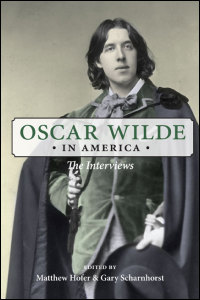
Creating quite the stir was of course second nature to Oscar Wilde, and he set many tongues wagging throughout the course of his extensive North American tour in 1882. Nowadays we have complex PR machines. Back then it was Oscar giving interviews to the local papers to generate buzz for his series of lectures on “the science of the beautiful.” He set the tone immediately upon disembarking in New York after his less-than-pleasing encounter with the Atlantic Ocean by (allegedly) proclaiming to the customs agent: “I have nothing to declare except my genius.”
Wilde ended up making some 140 appearances at cities and towns across 15,000 miles of the continent, alighting in gilded age salons and mining town saloons alike. Anthony Paletta sums up some of the press reaction to his first lecture, in New York, billed as having something to do with the “English Renaissance”:
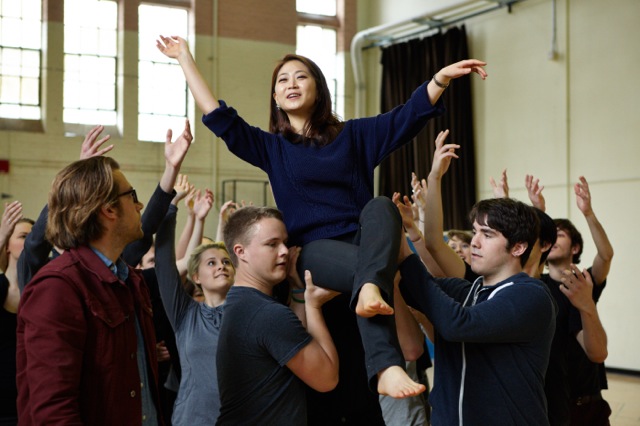
Director James Darrah rehearsing Semele, with Haeran Hong as the title heroine; photo by Steve Korn
Music lovers in the Seattle area will not want to miss this weekend’s performances of Semele, a joint effort by Pacific MusicWorks and the University of Washington School of Music.
I was lucky to be able to attend one of the rehearsals, where I found myself spellbound by the flow of ideas and inspired rapport between director James Darrah and the cast — all this without a stage or costumes and only harpsichord accompaniment. Semele is a late Handel work (1743) that never fit comfortably into the era’s expectations for either opera or oratorio, but Darrah and company are treating it as the liveliest brand of music theater, full of humor, wit, enchantment, and (literally and figuratively) epiphany.
It’s easy enough to imagine the musical and theatrical potential Handel saw in this material, retooling a libretto more than 30 years old — it includes the work of Alexander Pope — which itself retells the classical myth of Semele and Zeus/Jupiter. The human Semele has a fateful love affair with none other than the king of the gods, triggering the jealousy of his wife. Juno’s plan to avenge herself results in the destruction of Semele as a mortal woman but leads to the birth of Dionysus/Bacchus — a boon for humanity.
Handel knew how to carve into the meat of the mythic matter with this story of human aspirations for the impossible, of divine vulnerability to human emotion, of the power of irrepressible desire. A century later, Wagner noted the archetypal aspects of the tale and its similarities to Elsa’s ill-fated questioning of Lohengrin in another human-meets-transcendent encounter. (Another variant is found in Apuleius’s marvelously elaborate narrative of Cupid and Psyche.)
Seattle has tended to be a Handel-deprived zone for far too long, but Stephen Stubbs — the visionary artistic director of Pacific MusicWorks — is changing the playing field with his musically and theatrically stimulating advocacy of early and baroque composers. An internationally acclaimed musical director and lutenist, Stubbs marries the energies of his early music expertise with an appreciation of cutting-edge stage direction and interdisciplinary artistic creativity.
And his choice of the Los Angeles-based director and visual artist James Darrah bodes well. (Darrah has worked with the likes of Peter Sellars and John Adams, and among his upcoming projects is a collaboration with Michael Tilson Thomas next month for the San Francisco Symphony’s semi-staged production of Peter Grimes.)
During the rehearsal I saw, Darrah was coaching the appealing cast of young artists singing the chorus into how to develop into a major character in their own right rather than a passive, fly-on-the-wall musical presence. The chorus became a visible and dynamic extension of the power play among Semele, Juno, and Jupiter. And far from purveying an arbitrary “concept,” Darrah showed with his sensitivity to the subtexts of Handel’s melody and counterpoint that he commands an intimate understanding of the score and of the way Handel constructs his narrative arc.
It should be fascinating to compare the final results of performance with what will happen on the Seattle Opera stage next February-March, when the director Tomer Zvulun returns for a mainstage production of Semele. Meanwhile, Stubbs is spearheading experiments in smaller-scale productions involving partnerships between different organizations and even with companies across the Northwest — all of which promises to enliven the ecology of Seattle’s art scene, for early music and contemporary composers alike.
If you go: Pacific MusicWorks and the University of Washington School of Music present Handel’s Semele Friday and Saturday, May 16 and 17, at 7:30 pm and Sunday, May 18, at 2:00 pm at UW’s Meany Hall. (Sunday’s matinee performance is presented by the student cover cast.) Tickets at 206.543.4880 or 1.800.859.5342 or here.
(c) 2014 Thomas May All rights reserved.
Larry Brownlee just wrapped up the Met’s season with the final “Puritani” performance over the weekend and will be giving a recital Tuesday 13 May sponsored by Vocal Arts D.C.
Lawrence Brownlee as Almaviva in iBarber, one of his signature roles; photo by Ken Howard
The marvelously gifted tenor Lawrence Brownlee makes his Los Angeles Opera debut as Tamino this coming weekend in the Barrie Kosky production of The Magic Flute. Here’s a profile I recently wrote about Larry for Seattle Opera, where he appeared last month as Tonio in The Daughter of the Regiment:
Nowadays no American tenor is more in demand than Lawrence Brownlee when it comes to the bel canto repertoire. And it’s easy to imagine the impression Brownlee’s voice—with its signature combination of sweetness, warmth, and flexibility—would have made on Gaetano Donizetti, or any of the bel canto composers. With their elegant melodies and deeply felt emotions, they were writing, it seems, specifically to Brownlee’s strengths, and he has proved that he has the versatility to excel in the distinctive styles developed by…
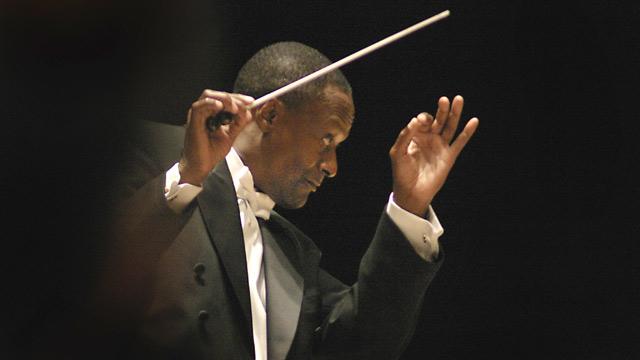
This weekend brings the next installment in the National Symphony Orchestra’s current NEW MOVES: symphony + dance festival. I enjoyed researching this material to write the program essays for all three programs, which are being conducted by the Omaha Symphony’s Thomas Wilkins. Each program pairs classic American rep with music by living composers.
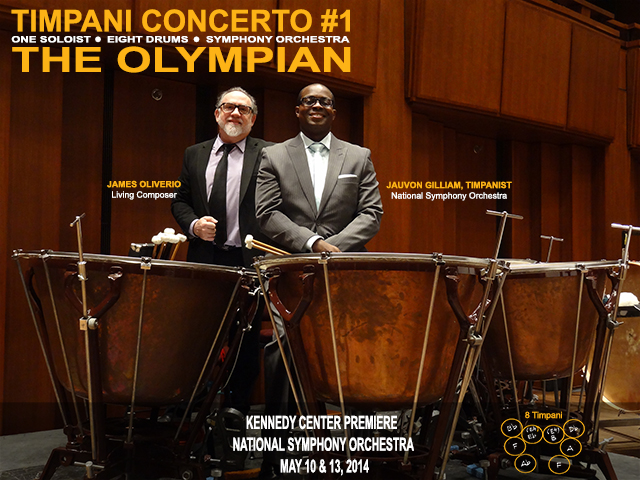
This second of the three programs features the Timpani Concerto No. 1 (“The Olympian”) by James Oliverio. Here’s a bit of my intro to his work:
The composer, educator, and new media producer James Oliverio (now based in Florida) has been redefining what it means to be a creative artist in the 21st century. “As composer there are two main ‘instruments’ that I work with: the symphony orchestra and the digital media studio,” he says, envisioning a music of the future that bridges the gap between traditional acoustic instruments and our rapidly evolving digital world. “Ultimately I want to unite them — to remove the distinction between my digital and orchestral endeavors,” adds Oliverio, an acclaimed pioneer of globally synchronized performing arts collaborations. (The rest can be found here.)
More on the amazing Jauvon Gilliam, principal timpanist of the NSO, from Andrew Lindemann Malone’s blog post. Writes Malone:
Not everyone who attends orchestral concerts knows that the timpani is not a fixed-pitch instrument; drummers tune them through the use of a foot pedal. So to play the right notes, you have to have both your hands and your feet in the right spot. With the typical orchestral complement of four timpani, this is challenging enough; as Gilliam says, “it’s like a choreographed dance. You can overshoot it, you can undershoot it, it’s just like if you do a pirouette.” To really master the instrument, “you almost have to have four different brains or have your brain in four different compartments.”
[…]
It’s an unusual role for an instrument that normally sits in the back and makes everything sound fuller and more forceful, but Gilliam doesn’t mind the change. “My job is to support people. I really enjoy that, that’s what I love about my job,” he says, but performing a solo is a “different way of doing things, and it allows me to expand my talent. It allows me to be a better musician.”
The concerto is also, he says, “the hardest thing I’ve ever played” — a challenge worthy of the title “The Olympian,” and a summit only scalable for a man who’s sure on his feet.
Here’s Jauvon Gilliam’s own blog post on “The Olympian.”
And here’s a radio interview WETA’s Nicole LaCroix conducted with Wilkins (beginning), Gilliam (6:15), and Oliverio (at 9:15).
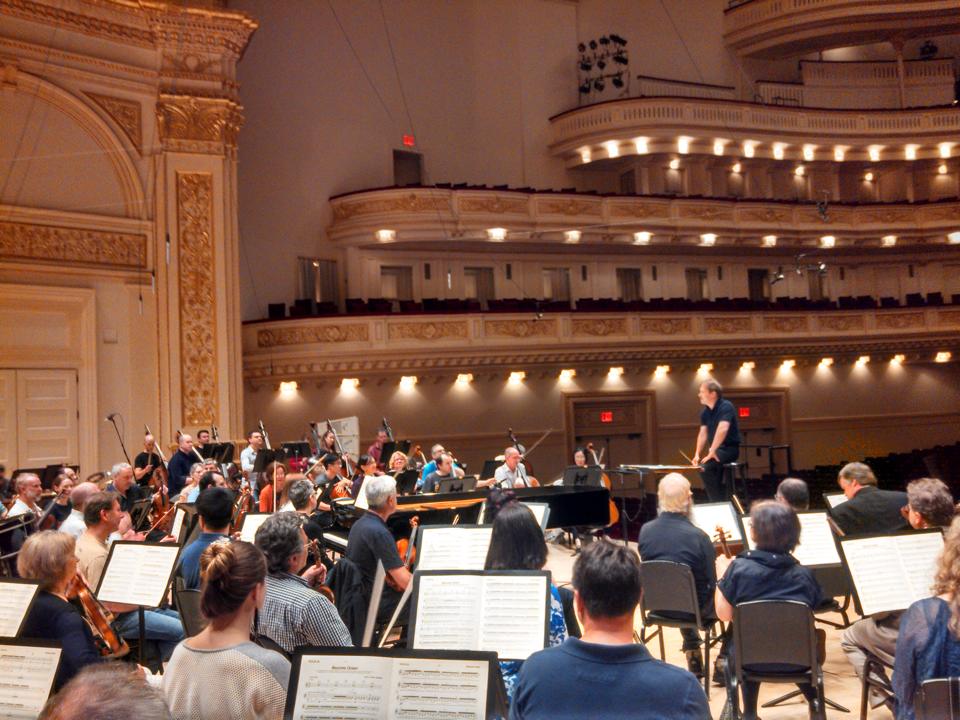
Ludovic Morlot and the Seattle Symphony in rehearsal at Carnegie Hall
I’m still processing the experience of the Seattle Symphony’s concert Tuesday evening at Carnegie Hall — part of this week’s Spring for Music series, which will sadly constitute the final chapter of that worthy festival’s history.
By now the program itself is as familiar as a friend. I heard the second half twice in Seattle, some rehearsal sessions, and the entire program last Friday during the SSO’s epic “preview” evening of the Carnegie adventure for Seattle audiences. But Tuesday included an extra dimension of excitement: the New York premiere of Become Ocean, the reactions of major critics in a world music center, and the unmistakeable ambience of Carnegie Hall itself. Even disregarding my obvious bias, this was received as a triumph for the amazing talent of the Seattle Symphony and its music director Ludovic Morlot.
Of course there’s always a substantial amount of guesswork and gut instinct to rely on when it comes to a new composition. Most premieres tend to be somewhere in the vast “middle” range of quality and potential durability, but it’s certainly all too easy to get it wrong, to err in the direction of fatuous dismissal or foolhardy hyperbole. I know I’ve been guilty of both.
So it’s all the more thrilling when instinct kicks in early on in a first encounter with a piece — as it did for me and the John Luther Adams — and you sense that this might be an even greater achievement than you could have reasonably expected. On both occasions I was able to share the experience with trained musician friends who reaffirmed this “instinctual” response to Become Ocean. This time I found myself tuning in even more to an underlying sense of elegy in the music.
Certainly JLA’s big orchestral piece is at the furthest possible remove from any New Agey connotations or glib “environmental” message that some descriptions I’ve seen imply. (That’s not to deny or diminish the composer’s environmental commitment, which is not reducible to a bland gesture of political art.) Instead, this is challenging music, requiring a major effort from the listener while at the same time profoundly engaging the emotions. The days of either/or cliches like “tough” modernism versus “easy-listening” neo-Romanticism should be behind us.
There’s so much to say about this music and its effect, so much about its implications as a commission, that I’m working on a profile of John Luther Adams and Become Ocean. More on that when the time comes.
Meanwhile, the thoughtful dramaturgy of the program — combining JL Adams with Varèse and Debussy — was justly admired for its contrasts and cross-connections. Here’s a quick round-up of the critical coverage I’ve seen so far:
–Alex Ross, as usual, really gets it. He wrote the first substantial critique of Become Ocean after the world premiere last year in Seattle (which I had to miss). On Tuesday Alex found that “Carnegie’s mellow, resonance-rich space brought out the Wagnerian aspect of Become Ocean, favoring sonorities of strings and brass,” adding that from his position in the orchestral seats, “much of the score’s glittering detail was lost … “and the most delicate percussion effects disappeared as well.”
—New York magazine’s Justin Davidson neatly summarized the piece’s overall effect: “Serenity comes tightly wrapped up with terror.” He points out that, while Become Ocean is “about boundless nature,”it’s an indoor piece, ravishingly traditional in the way it relies on walls and floor and ceiling to convert raw sound into the illusion of shimmering surfaces and the violent deep.”
–Tony Tommasini writes in The New York Times of how Adams extends the familiar idea of an “organic” composition that evolves “in a swirling mass of sound,” pushing it in “an uncompromising, courageous way.”
–On that score, I was puzzled as to why Martin Bernheimer, in his positive review, insists on labeling Become Ocean “an extended tone-poem.” Even the loose or distant mimesis traditionally associated with the Romantic notion of that genre is merely one level to which JLA alludes.
–At New York Classical Review, George Grella found the programming concept to be mere “window dressing for abstract music about form, structure, and time.” Fair enough, but I disagree with Grella’s assessment of the orchestra’s playing in the Debussy as “surprisingly thin and light.” It was, in my opinion, anything but — in fact, unusually, and unconventionally, muscular and finely articulated, very far from “idées reçues” of French “Impressionist” music.
–On Bachtrack, David Allen offers an interesting and lengthy reflection in which he quotes Gurnemanz’s famous, enigmatic aphorism “Here space becomes time” anent Become Ocean. (I’ve been thinking of another Parsifal reference that comes to mind when I listen to this music, from the Prelude.)
Incidentally, I notice all these critics are male and would love to see a female critic’s reaction to this music. I know my pianist friend Judith was impressed on her first hearing, aptly likening the experience to an extended encounter with a Rothko painting.
Update: this isn’t a review of the concert, but Corinna da Fonseca-Wollheim published a preview for The New York Times. There she writes that Become Ocean “submerges the listener in a swirling, churning wash of sound.”
Update No. 2: Just discovered that the world premiere of Become Ocean was covered for the local Seattle media by Melinda Bargreen. She didn’t much care for it:
But after the first 20 minutes or so, the musical ideas had pretty much run their course, and there were no further developments to justify sustaining the piece. (Some listeners in the balcony areas made a discreet but early retreat.) At least the music fell gratefully on the ear, delivering consonance rather than dissonance, and in its very length, “Become Ocean” evoked a sense of vast oceanic scale.
Interesting, too, to see some of the reader comments from back then:
“spiritdancer47,” mistaking the piece for a symphony, didn’t find much there there:
Having been a dancer for PNB, I am familiar with the extended time it takes for the orchestra in the pit to warm up. Listening to Adams’ symphony took me back to that time…and left me there. I would be one of the “early leavers.”
“proud2Bliberal” gave it more thought by trying to locate precedents:
“Become Ocean” was wonderful. It is the perfect piece for just putting your head back, closing your eyes and letting the sounds happen around you. It conveyed what it must feel like to be in Alaska near the ocean and the forests. The piece had a refreshing and genuine feeling, and somewhat of the personality of American experimentalists Charles Ives and Henry Cowell. Morlot was the perfect conductor for this work. Clearly the piece has its roots in Debussy’s “La Mer” and the ocean passages of “Pelleas.” As a French conductor, Morlot was able to conduct all of those “Debussyiste” sea rumblings (bruits, in French). It would be a great piece to have on a CD at home.
And I hope “vf” didn’t place a bet on this prediction:
“It would be unfortunate if the SSO took the Luther Adams piece to NYC, it would be a disaster, hope they reconsider. In comparison to the works of composers like Arvo Part or Phillip Glass Become Ocean is minor league at best.”
Reviewer Christopher Hart points out that the book offers fascinating examples of the many ways creative types “discover for themselves Flaubert’s famous advice that one should live like a bourgeois and put one’s bohemianism into one’s work.”
Thomas Mann evidently loved his kip, rising at 8am, enjoying a good hour’s nap in the afternoon and going to bed around midnight, in a separate bedroom from his wife. Richard Strauss appears to have slept a…
Ligeti’s Le Grand Macabre presented by the New York Philharmonic in 2010; (c) Chris Lee 2010
My new feature for Symphony magazine’s Fall 2013 issue is available online now:
Total immersion: that was the radical brand of opera Richard Wagner hoped to inaugurate at Bayreuth. To enhance its effect, he famously made the “invisible orchestra” an integral part of his design. Yet the overall ideal of intensified theatrical illusion remained frustratingly out of reach, hampered by the limitations of the stage technology of the time. Cosima Wagner reported her husband’s sardonic joke in the aftermath of his deep disappointment over the first complete Ring: “Now that I’ve created the invisible orchestra, I’d like to invent the invisible stage!”
The concert hall has meanwhile long provided an appealing milieu in which to experience opera with another kind of immediacy—one that focuses on the musical dimension of this most collaborative of the…