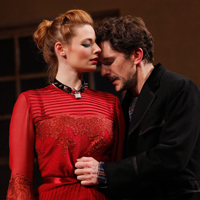
Michael Tisdale and Gillian Williams in Seattle Repertory Theatre’s Venus in Fur; photo by Chris Bennion.
It’s not just the topic of sexual power dynamics combined with S&M role play that makes it seem as if David Ives has taken on something risqué in his Tony-nominated Venus in Fur, which premiered in 2010. He dares a lot formally by writing an evening-length, two-character play set in a drab rehearsal room.
In terms of ambition, he dares even more in his obvious desire to probe the personal politics and psychological complexity of our “theatrical” selves: the rotating, evolving, ever-variable selves we present in our daily encounters.
Seattle Repertory Theatre’s staging — a co-production with Arizona Theatre Company — offers a smart, riveting, often unsettling take on Ives’s much-hyped play. It makes for a largely persuasive theater experience, though without managing to overcome all the dramaturgical stumbling blocks in the script — most of all, the unconvincing swerve that marks the drama’s culmination.
Ives is, to start with, a masterful writer of dialogue, attuned to the ways actors manipulate their subtexts as they monitor and mirror the variabilities of their stage partners. In the ongoing, intermissionless duologue that is the basic structure of Venus in Fur, his two characters assume and cast off multiple identities that continually keep the audience guessing about what the real stakes are.
Venus in Fur starts in quasi-sitcom mode: a frustrated playwright/director, Thomas Novachek, rails against the limitations of the women he’s seen audition for the lead in his new stage adaptation of Venus in Furs, the once-scandalous novella published in 1870 by the Austrian writer Leopold von Sacher-Masoch (part of the first volume of a large-scale fictional cycle he had planned under the overall title Legacy of Cain).
In blusters Vanda Jordan in a scenery-chewing entrance. She’s an actress who presents herself as desperate for the part — so desperate, she ends up convincing the reluctant Thomas to stay on and see her audition, even though she’s hours late and all the others have already left.
But Ives cleverly uses the familiar patterns of lightweight humor to disarm his audience, to set up expectations that repeatedly trip us up — exactly mirroring the dance of role-playing and sudden change of tack Vanda stage manages vis-a-vis Thomas.
Sibyl Wickersheimer has designed an imposingly affectless rehearsal loft — we’re told it’s been converted from a former sweatshop (its identity around the time Sacher-Masoch’s novella was written) — and tilts it to an angle, adding yet another layer of obliquity. Geoff Korf’s lighting starts with unfriendly late afternoon light and descends into terrifying darkness
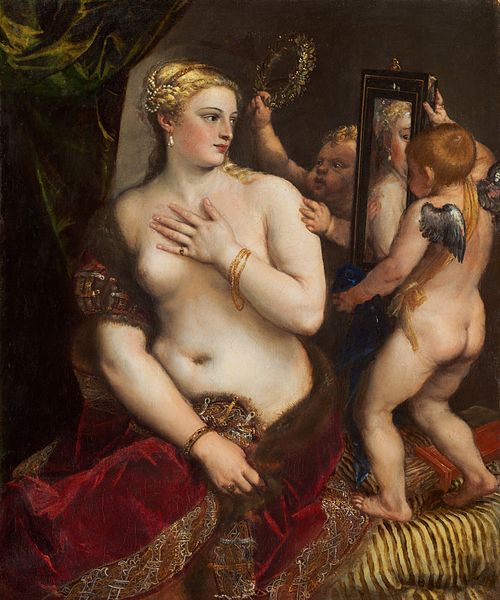
Thomas wants to be appreciated for having written what he believes to be an important play — his Fur is a gloss on the “furs” of Sacher-Masoch and the mirror of Titian. He loathes being misunderstood for tackling the trendy “issues” of the day. Vanda pretends to be clueless about his artistic aspirations, describing the novella that’s the basis for his play as “S&M porn” and hastily showing off the up-to-date dominatrix outfit (Harmony Arnold’s witty costume design) that she picked out for her audition.
Titian, Venus with Mirror, c. 1555 (National Gallery of Art)
Director Shana Cooper sustains the slow burn of tension that underlies the rapidly shifting scenario as Thomas starts to realize Vanda has been dissembling and is intimately familiar with the nuances of Sacher-Masoch. Like a staged Droste effect, ironies begin to proliferate within the play-within-a-play setup. Vanda the over-emoting, stressed-out New Yawk actress suddenly seems to be more authentic when she casts her “real” self aside to play the fictional role of the nineteenth-century, velvet-gown-clad Wanda von Dunajew.
Ives’s play is completely dependent on the effectiveness of his lead actress. Gillian Williams gives an untrammeled and multifaceted performance, toggling back and forth between “acting” and — to the evident unease yet fascination of Thomas — taking over his role as the playwright and director. It’s also an intensely physically aware performance, her shifts in tone mirrored by a virtuosic range of gestures and physical expression.
As Thomas, Michael Tisdale (like Gilliam Williams, making his Seattle Rep debut) doesn’t project the sheer arrogance needed at the beginning to give substance to Vanda’s fury — he’s too fussy — but grows more convincing in the transformation into Sacher-Masoch’s alter ego Severin von Kusiemski, which he willingly undergoes.
Gillian Williams and Michael Tisdale; photo by Chris Bennion.
The real interest of the dramatic arc lies in its unpredictability: shocks of recognition intensify and begin to align Thomas’s script with the power play developing between him and Vanda, but Ives counterpoints this with a movement away from the realism at the start of the play toward an ambivalent surrealism.
And there the chief difficulty lies. As Vanda’s rage gathers righteous feminist force and we’re led to expect a straightforward revenge plot, Ives changes the fundamental tone again — and makes her an archetype, an avatar of the pagan classical world.
But it ends up evoking a bit of old-fashioned stagecraft: a dea ex machina come to deliver a moral lesson for our times. The rattling thunder of a storm raging outside (Robertson Witmer’s atmospheric sound design) isn’t enough to pull off the transformation.
Venus in Fur runs through Sunday, March 9, at Seattle Rep at Seattle Center.
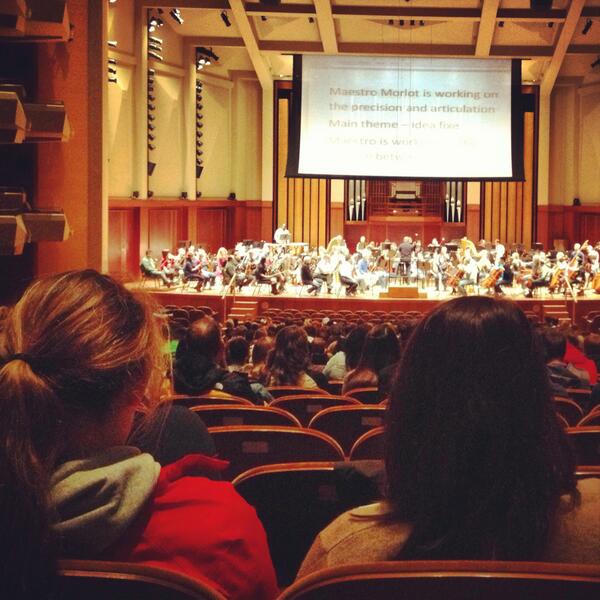
High school students discovering the world of Berlioz at a Seattle Symphony rehearsal
Ludovic Morlot is now back from his winter duties as chief conductor at La Monnaie in Brussels (where he just led performances of Janáček’s Jenůfa). And in its most incandescent moments, last night’s program — his first with the Seattle Symphony following the hiatus — blazed with the impatient passion of lovers meeting after an enforced absence.
The players were champing at the bit to whip up the energy of the brief concert opener, Emmanuel Chabrier’s Bourrée fantasque. Despite the nice thematic tie-in of the title, Chabrier’s piano piece felt like a mere diversion from the heart of the matter. The orchestration by the famous fin-de-siècle Wagnerian Felix Mottl layered lavish, high-calorie toppings over Chabrier’s zesty piano piece – frankly, at times, threatening to smother it.
Morlot has a genuine affinity for the music of the Romantics, so there’s a fascinating opportunity in this program to compare his approaches to the subjectivity of Robert Schumann versus Hector Berlioz. The issue of Schumann’s mental illness is by now such a cliche that it was refreshing to encounter a performance so alert to the astonishing mindfulness of his poetic reveries. In other words, what came across in the Cello Concerto wasn’t so much a sequence of “moody,” unsettled and changeable emotions as one lengthily sustained poetic fantasy.
The three chords in the orchestra that launch and unify the piece were shaped with an appropriately evanescent dreaminess, setting the tone for the Concerto’s primarily meditative as opposed to show-offy quality. The soloist, the French cellist Xavier Phillips, was especially memorable in the slow middle section of the three interlocking movements, when his orchestral “doppelgänger” (SSO principal cellist Efe Baltacıgil) engages him in a duet.
Phillips played with an inviting warmth and intimacy well-suited to Schumann’s elaborate lyricism, but the moment when the cello “rouses” the orchestra from the fantasy at the very end of the Concerto sounded underwhelming. Acoustic imbalances with the orchestra — a particular peril of cello concertos, and one reason composers avoided them for so long — were a persistent distraction. Still, there was breathtaking beauty to be enjoyed in Phillips’ sensitive and musically intelligent phrasing.
A good concert then became great in the program’s second half: Berlioz’s Symphonie fantastique, that blockbuster of Romanticism that flips the bird to the conventional polarities of French/German, Classical/Romantic, fact/fiction.
Too often we hear the Symphonie as a manifesto of its moment in time, a “textbook” of Romanticism with the usual checklist — and the result is a performance that sounds like the epitome of a museum piece (in the bad old sense of museums, before the smart ones started updating themselves).
Young Berlioz in 1832, around the time of the Symphonie fantastique ; painting by Émile Signol
Last night it suddenly occurred to me that Morlot’s understanding of Berlioz is of the same category as Leonard Bernstein’s identification with Mahler: apart from all the technical knowledge and even sensibility he brings to Berlioz, it’s as if Morlot internally identifies with this music and so is able to give his interpretations a uniquely compelling stamp.
That’s the only way I could make sense of the 3-D vividness of last night’s performance: colors and textures I’ve never noticed before, for sure, but most of all a sense of what’s at stake with the emotions and obsessions of Berlioz’s score. I found myself grinning with near disbelief at how shocking and still over-the-top parts of it can still sound.
Morlot got the SSO musicians to tap into that sense of conviction. There were memorable achievements from every single section of the orchestra. None of this would have worked without the artistry of Michael Crusoe (timpani), Valerie Muzzolini Gordon (harp), Stefan Farkas (English horn), Christie Reside (flute), Ben Haussman (oboe), Seth Krimsky (bassoon), for example, not to mention the thrilling playing by the strings and brass, particularly in the witches’ “orgy” of the last movement.
This wasn’t the usual colorful story of young Hector going all wild after seeing the actress Harriet Smithson and getting tangled in an insanely obsessive/possessive love attachment – the whole business is really a MacGuffin, anyway — just as it wasn’t the corny 1960s-flavored rethink of an orchestra on an LSD/mushroom/opium-fueled trip.
Morlot understands that Berlioz’s “protagonist” in the Symphonie fantastique is an artist above all else — that the Eros, the drive, the alienation, the hallucinations, all of it, are all components of a universe he imagines into being, not mere triggers of emotions that require expression. And that the entire epic he lays out for us in this score is an “instrumental drama” (the composer’s own phrase) that expertly transforms his musical material to give voice to a radical subjectivity.
I especially like how Morlot refuses to settle for one overall approach — stressing Berlioz’s Classical underpinnings, say, or staying focused on his novel orchestration. He understands the multidimensional character of this score and allows its widely varying facets to come out when they make sense in the dramatic context.
There was a particularly persuasive hint of Beethoven of the Pastoral in the beautifully played woodwind writing of the third movement. (Beethoven cast an enormous shadow over Berlioz at this point in his career.) Some of the “spatial” effects of offstage timpani and shepherd’s pipe anticipate Mahler.
The March to the Scaffold, sardonic as hell, actually helped set the scene for what usually seems an abrupt shift of tone in the Witches’ Sabbath/nightmare finale. And in that fantastic musical phantasmagoria, despite all the humiliations and horrors the protagonist endures, it’s the image of the cocky young artist Berlioz who emerges, dominating and enthralling his audience.
So what is it with Berlioz and obnoxiously intrusive noise in Benaroya? Two years ago, smack in the middle of one of my favorite Morlot performances to date — Berlioz’s La Damnation de Faust — a patron’s alarm actually forced the music to a halt for several minutes. Last night someone spoiled the carefully built-up atmosphere by ringing heedlessly away, audible at a good distance. Now that should be a damnable offence.
There’s one more chance to hear this program: Saturday night at 8:00 pm at Benaroya Hall.
Pages from one of Emily Dickinson’s small poetry booklet “fascicles”
So just how many of the dear, withering Muses are supposed to be on death row? Of course the meme of The Death of Classical Music (TM) gets periodic play.
And poetry? The art that is inseparable from language itself, the very signature of our humanity? There’s no lack of doomsayers claiming with a straight face — and hoping to boost hits in the process — that poetry “is about as useful as the clavichord.”
One common denominator in this litany of obits: the relentlessly short-sighted, quick-fix worldview of contemporary capitalism.
“Poetry is dead by capitalism’s standards – it is not an obvious moneymaking venture, despite traceable employment and readings’ payoffs via the academy – and that emboldens some folks limited by capitalist blinders to herald poetry’s last breath,” writes Amy King, co-editor of the PEN Poetry Series, in a worthwhile new essay for the Boston Review: “Threat Level: Poetry.”
And talk about blinders: “The naysayers of poetry’s vastness seem to be primarily fueled by declaring poetry’s defeat or impotence instead of engaging in the more difficult work of creating beyond what they know.” King continues:
“The limits of my language are the limits of my world” is not Wittgenstein’s defeatist end; it is his challenge to set out boldly and with curiosity to expand and explore through the language we think through. He didn’t stop with the “Tractatus Logico-Philosophicus” where that statement appeared; it was his first of many books, such as the “Philosophical Investigations,”that explicated his theory of “language-games” and complexly broadened his considerations of language use overall.
What a lazy, pretentious approach to think we’ve located our limits and can now only recycle and shuffle what’s been said before as cut-and-paste, as the Conceptual poets would have it, or by squeezing words into forms without any sense of language’s expansiveness or trust in the person using it, as traditional formalists would claim.
[…]
Further, the writers of poetry’s obituaries are aligning themselves with a capitalism that is patriarchal by default: it is more beneficial to divide and conquer or imperialistically claim, in sound-byte fashion, than to identify and envision beyond perceived limitations or some institutionalized formulaic trend.
I especially admire Amy King’s eloquent manifesto for what poetry can do:
Poetry is as large as language. Just as language pushes its limits, poets can make connections where connections are frowned upon. We might engage with our intuition or emotion or even that mysterious and popularly denounced “spiritual” part of ourselves. We can juxtapose the arbitrary with the arbitrary and invoke a maddening sense of the reality we’ve inherited. We can move from our depression or fleece a corrupt order with a vision of existence that incites responses varying from the call to question to the responsive insurrectionary. We can also highlight the beautiful-ugly among us that everyday language would insist is either one or the other.
“We, as human beings, have not seen ourselves until we have been seen through the eyes of another animal,” says the film director Godfrey Reggio, quoting (or perhaps paraphrasing) the anthropologist Loren Eiseley. Last night brought the local opening of Reggio’s latest collaboration with Philip Glass Visitors, shown on the magnificent Cinerama screen in Seattle (one of only three such remaining screens in the world).
The Eiseley quote was Reggio’s reference for discussing the powerful images of the Bronz Zoo gorilla named Triska whose deep, straight-on gaze haunts this meditation on the contemporary situation of the technology-crazed human species. “Visitors” deliberately plays off the etymology of its title – as in one who goes to see something.
Glass’s partnership with Reggio has resulted in some of my favorite work by this composer. I’ve heard stories of Koyannisqatsi changing people’s lives the way we sometimes hear about Einstein on the Beach (one of my big artistic adventures in 2012).
Each time Glass and Reggio work together, they rethink the very foundations of how image and music can interface and together generate powerful emotional responses that are at the same time thought provoking. As Reggio aptly put it, the music doesn’t illustrate a narrative. Conventional film narrative is jettisoned, there are no words, and the linear, plotted “foreground” we expect from a film experience is stripped away so that the background becomes foreground. Music and image are co-equal partners.
And what’s especially striking on first viewing/hearing of Visitors is the often-somber tone of Glass’s score – played with exquisite care and conviction by the Bruckner Orchestra Linz and Glass authority Dennis Russell Davies.
I may have been influenced by the silver-intensified dark palette of Reggio’s black-and-white filming, but the music often seems elegiac, certainly more meditative and slower paced in general than the Qatsi trilogy scores and without their exuberant explosions of manic energy. Glass’s orchestration continues to fascinate: especially his percussive touches and simple but mysterious blends.
Jay Michaelson eloquently describes the focus on temporality in Visitors in his recent article “Philip Glass Is Getting Older — for Better or Worse”:
We don’t know anything about these people visiting planet Earth – only that their time is short, especially measured by the geological time of the moon, but even according to our own reckoning and the lines in their faces.
“Visitors” is a film about the evanescence of life, its mystery and its frailty. It is about how we make meaning out of meaninglessness, and how ultimately we are brought to the blinding light of oblivion. It is a late work by a 73-year-old filmmaker and a 76-year-old composer, reflecting as much on their own oeuvre as on the essential questions of mortality and meaning.
Image from Visitors
In the post-viewing discussion with Reggio, the director was asked whether he thought we were better or worse off than in 1982, when Koyannisqatsi came out. Are humans even more out of balance? Unsurprisingly, Reggio said he thought so, that we’ve reached a point where our imbalances are “the price we have to pay for our technological happiness.”
And something to the effect that it takes “courage to have the hopelessness” we need to be able to recover a sense of hope. Visitors represents another attempt “to see that which is most vital but which is hidden by virtue of its presence” — a process of defamiliarization through art, in other words.
Here’s Philip Glass in a recent interview with Sam Adams for The Dissolve:
We began talking about a film about humor. And [Reggio] focused it on people, that it would be people who would represent that. And from that, very slowly over those years, it shifted to the idea of the gorilla. And once the gorilla was there, the whole thing changed, because of the reciprocal gaze…
And then we got into a very interesting idea that the film is really about looking at the film….
Then the role of the music takes on a completely different role. So the question is, how does music function in this?
Add another one to the list: Mamoru Samuragochi, hyped as the “Japanese Beethoven,” is apparently neither deaf nor the composer of the works that were praised as creations of a “digital-age Beethoven.” The story of his scam broke this week. According to Martin Fackler in The New York Times:
It was unclear exactly how Mr. Samuragochi duped the world since asserting he went deaf in the late 1990s. No one, it seemed, suspected the onetime child music prodigy had not composed his own work. But in past interviews with the news media, Mr. Samuragochi gave an explanation that might explain why no one ever doubted his hearing loss: He said he was completely deaf in one ear, but had some hearing in the other that was assisted by a hearing aid…. Much of Mr. Samuragochi’s appeal seemed to lie in his inspiring life story, especially for a country so fascinated by classical music.
Probably the most-famous example of ghost-writing in music is Mozart’s Requiem, paid for in advance by Count Franz Walsegg-Stuppach, a nobleman and dilettante who wanted to pass off the score as his own creation, written in memory of his wife.
There’s also a famous anecdote (which of course has its skeptics) that Mozart did his Salzburg buddy Michael Haydn (a younger brother of Joseph) a favor by pitching in to complete a project. The story goes that he dashed off the Duos for Violin and Viola (K. 423-24) to help the ailing Michael complete a set of six requested by Wolfgang’s hated former boss (the Archbishop of Salzburg).
But Michael Haydn was a bona fide composer himself — his own Requiem in C minor from 1771 left a deep impression on his younger colleague, which you can easily trace by comparing it with the Requiem Mozart undertook two decades later.
The film music industry is said to be rife with mis- or non-attributed composers. And in the world of literature we have the harrowing Doctor Faustus by Thomas Mann, whose protagonist, the tormented composer Adrian Leverkühn, “sells his soul” to write works of genius. But merely paying off a ghost-writer to con the public certainly belongs to a less-extravagant category.
Hearing a super-charged performance of Béla Bartók’s Third String Quartet by the Ehnes Quartet on Sunday – a condensed cosmos of formal and tonal experimentation – reminded me of why this composer’s quartets are genuinely comparable to what Beethoven achieved with the medium.
By happy coincidence, my friend Philip Kennicott, one of the most brilliant critics writing today, had just been immersed in the entire Bartók cycle on the other coast, back in my old hometown. The performers were the Takács Quartet. (I’d heard their two-evening Bartók cycle in D.C. back in the ’90s.)
In his reflections on the experience, Kennicott makes a very important point about the much-misunderstood presence of “folk elements” in Bartók’s music: “The turn to folk music was not, for Bartók, nostalgic, but rather a way forward. What he found there wasn’t simplicity, but density, and in that density was a modernity as vital as anything hatched in the musical systems of Paris and Vienna.”
And on Bartók’s sense of an ending:
So the music is always anxious, always driving forward, which is both exhausting and exhilarating, and perhaps that’s why Bartók’s endings—ironically anticlimactic, humorously flippant, pompously emphatic—are so appealing. By the time Bartók ends something, no honest listener could claim to want to hear more. The idea, the gesture, the mood has been wrung out, used up, finished off. And then it’s on to the next thing, with renewed energy and relentlessness.
Kennicott then works George Steiner’s interpretation of the door metaphor in Bartók’s Bluebeard’s Castle into his discussion:
We open successive doors in Bluebeard’s castle because “they are there,” because each leads to the next by a logic of intensification which is that of the mind’s own awareness of being. To leave one door closed would be not only cowardice but a betrayal—radical, self-mutilating—of the inquisitive, probing, forward-tensed stance of our species.
This was Steiner’s best hope for hope, after the brutality of World War I, the obscenity of Hitler, ages of anti-Semitism, and the terrors of the post-war age, especially its predation on what was once called, without embarrassment, Culture. It is also a perfect description of the powerful, dutiful, heroic denial of self in Bartók’s string quartets, which also proceed by a logic of intensification, and which leave the listener grasping at “the mind’s awareness of being.”
l to r: James Ehnes, Amy Schwartz Moretti, Richard O’Neill, and Robert deMaine; Photo by Jerry Davis
As if the Super Bowl victory weren’t enough, yesterday chamber music-loving Seattleites were treated to a spectacularly satisfying program to conclude the brief Winter Festival of the Seattle Chamber Music Society. James Ehnes and his quartet of fellow SCMS regulars (violinist Amy Schwarz Moretti, violist Richard O’Neill, and cellist Robert deMaine) played a knock-out recital of Beethoven, Bartók, Josef Suk, and Ravel.
And then they’re off on their first-ever tour of Europe — with stops in Birmingham, Oxford, London, Tilburg, and Paris. Not to miss, I’d say: above all, their explosive but many-faceted Bartók.
Here’s a shorter version of my recent interview with violinist and SCMS artistic director James Ehnes for Crosscut.com in connection with his latest Seattle visit:
James Ehnes became the artistic director of SCMS two seasons ago. In his “off” time from Seattle, the native Canadian is a prized soloist and chamber musician in demand around the globe.
This fall, for instance, took him to Melbourne, Moscow and Glasgow. And just a few weeks ago, when his duo partner became ill right before a recital in London’s Wigmore Hall, Ehnes saved the day stepping up to perform two of the monumentally challenging Bach solo partitas.
Ehnes feels a strong sense of loyalty to Seattle and has been involved with SCMS as a performer since he was still a teenager. Yet while the long-running festival is part of his blood, he’s been artfully introducing some subtle changes.
For anyone who relishes the amazing craft, interpretive spontaneity and emotional directness that give the chamber music medium such power, it’s good to see Ehnes bringing a new focus to the string quartet.
His own quartet is taking the stage for Béla Bartók’s First and Third Quartets and Beethoven’s “Harp” Quartet, Op. 74, as well as the Ravel Quartet in F and Josef Suk’s Meditation on the old Czech Chorale “St. Wenceslas.”
The Bartók quartets represent Ehnes’s ongoing advocacy for the Hungarian composer. Ehnes has already made splendid recordings of Bartók’s concertos and solo works for violin, and he launched his first full season two years ago with a program that included a breath-taking performance of the pioneering Fourth String Quartet.
“We’ve been doing a bit of focus on Bartók for the last few festivals. His is one of the greatest and most unique musical voices of the 20th century, and it bothers me that despite his name having great recognition among music lovers, a very great majority of his music remains unknown to the general public.”
As usual, Ehnes’s programming ideas encourage intriguing cross-connections and discoveries to be made. The Jan. 31 concert, for example, offers music by Bartók’s compatriot Zoltán Kodály. “I think it will be fascinating for our audiences to compare the Kodály [Serenade for Two Violins and Viola] to the Bartók String Quartets.”
And Ehnes has no qualms about programming one of the best-loved warhorses in all chamber music for opening night: Dvořák’s Op. 77 Quintet for Strings. After all, his birthday (January 27) falls in the middle of the festival. “I have to admit this quintet is one of my very favorite things in the world, particularly the unbelievably beautiful third movement. So I programmed this as a bit of a present to myself.”
I realize it’s hard to believe, but this weekend in Seattle actually includes some worthwhile activities not related to (or even conflicting with) monitoring the Super Bowl. To wit: the latest music-making by the Seattle Symphony, either in the condensed “untuxed” version this evening or on Saturday 1 February in the complete program designed by guest conductor Olari Elts.
And a damn fine program this is, featuring a combo that might at first seem a bit unusual but that actually makes a lot of sense: Dmitri Shostakovich and John Adams. I’ve grown tired of the hyperbole that compares the pressure to conform to serialism in the West during the postwar decades to the Soviet Union’s cultural watchdogs — it’s insulting, to say the least, to equate whatever American composers who chose not to adhere to the predominant fashion had to face with the year-to-year dread about their very survival that was the experience of Shostakovich and his peers.
Still, there are some valid parallels: composers on other side of the Iron Curtain had to deal with implicit or explicit guidelines as to what was considered the “proper” music to be writing — guidelines that were diametrically directed, as it happened, toward populism in the East and “elitism” in the West. Both Shostakovich and John Adams in his early breakthrough years discovered ways to navigate the fault lines between these putatively incompatible realms, exploring new imaginative possibilities that could balance complexity with accessibility, experimental vigor with a recognizable and rooted vernacular.
Olari Elts, a native of Tallinn, Estonia, as well as this week’s guest soloist, the Moscow-educated Alexander Melnikov, were both teenagers during the waning years of the Soviet Union. So, while still relatively young, they bring a perspective that hasn’t yet forgotten how a composer like Shostakovich could manipulate expectations to write music whose meanings are more ambivalent than what seems on the surface to be the case.
Russian pianist Alexander Melnikov
And bravo to both for selecting the lesser-known Second Piano Concerto, a later work Shostakovich wrote for his son Maxim to premiere at his graduation from the Moscow Conservatory. Melnikov, in what I believe marks his Seattle debut, revealed why he’s regarded as a leading Shostakovich specialist — his recording of the complete Preludes and Fugues has been heaped with awards — and used his impressive technical precision to make eminent musical sense.
The Second Piano Concerto is a most unusual Shostakovich score — almost neoclassical in sensibility, but without the sense of parody that often goes along with that (especially in Prokofiev), and certainly lacking the ironic air you’d expect from Shostakovich himself. At the same time, it’s not entirely innocent or naive. That hard-to-define zone in between is what emerged from Melnikov’s performance.
He managed to articulate the straitjacketed, percussive metrics of the first movement’s big solo as a joyful romp, discovering a sense of freedom amid its strictly regimented confines. Especially memorable was his dialogue with the SSO strings in the Andante, paced here like a Chopin nocturne. Wistful without giving in to sentimentality, this builds into some of the tenderest moments to be found in Shostakovich — as if he were conjuring in music a hoped-for but knowingly unrealistic future for his son.
Returning after his SSO debut two years ago, Elts maintains a serious podium demeanor but conjures a sensuous and scintillating palette from the players, as his take on Adams’s The Chairman Dances at the top of the program revealed. (Was Daniel Licht listening closely to the woozy middle section when he wrote the theme music for Dexter?) A bit foursquare in his overall approach to the score’s intricate cross-rhythms, Elts was more spontaneous with the beguiling sound picture of this Nixon in China-vintage music.
He similarly showcased Adams’s masterful orchestral thinking in The Black Gondola a late-period, experimental piano score by Franz Liszt which Adams orchestrated in 1989: so many shades of dark, drawing the listener into a black hole of melancholy.
With The Black Gondola as its prelude, Elts apparently also wanted to signal that there’s a good deal more to the Symphony No. 9 by Shostakovich than its allegedly “cheerful” character. He then led a riveting account eager to plunge into the enigmas posed by this compact score, not smooth them over — or explain them away as defensive irony.
A kind of “revocation” of Beethoven’s affirmative Ninth (if not in the spirit of Thomas Mann’s protagonist composer in Doktor Faustus), Shostakovich’s No. 9 caps his epic “wartime symphonies” with a tightly condensed, often lightly textured work that makes for a fascinating contrast with the completely different “lightness” of the Second Piano Concerto.
The performance features some first-rate solo playing by bassoonist Seth Krimsky and flutist Christie Reside as well as Ko-ichiro Yamamoto on trombone and David Gordon on trumpet. Elts brings out the inner logic that connects Shostakovich’s elliptical thinking, above all in the almost cinematic dissolves of the last three movements. It’s rare to find yourself so pleased by being teased and puzzled.
This week’s National Symphony program features Paul Hindemith’s beautiful When lilacs last in the dooryard bloom’d: A Requiem for those we love in a program conducted by Christoph Eschenbach. This was one of the favorite works of Robert Shaw, who commissioned Hindemith’s remarkable setting of Walt Whitman’s eulogy for Lincoln. Here’s the essay I wrote for the NSO program (which opens with Joshua Bell in the Mendelssohn Violin Concerto — hence the lede):
A descendant of one of Mendelssohn’s cousins, Arnold Mendelssohn, turned out to be the first composition teacher of another precociously gifted musician, Paul Hindemith (1895-1963), who was born in Hanau (near Goethe’s city of Frankfurt). Hindemith came of age during a period of violent, revolutionary change in the early 20th century – the years that gave birth to modernism in its many forms. In the 1920s, Hindemith caused one scandal after another with his stage works and was considered a rebellious upstart who flirted with the avant-garde.
Like Shostakovich vis-à-vis Stalin, Hindemith managed to incur the personal displeasure of Hitler. The latter’s unyielding loathing of Hindemith was set in stone after seeing a scene from the satirical 1929 opera Neues vom Tage (“News of the Day”) featuring a “nude” soprano (actually, in a flesh-colored stocking) as she sings in the bathtub. Though he wasn’t Jewish, Hindemith gained a place of honor among the “degenerates” singled out by leading Nazis, who regarded him as “spiritually non-Aryan” and banned his music. The situation was actually more convoluted, however, with some pro-Hindemith voices among the hierarchy.
Hindemith may have hoped to influence cultural policy by finding a way to remain in Germany – in hindsight, his failure to express vociferous dissent from within the Third Reich has been criticized – but the situation grew intolerable and Hindemith, together with his wife (who was partially Jewish), emigrated first to Switzerland and then to the United States, where he influenced a new generation during his 13-year tenure teaching at Yale. When Lilacs Last in the Dooryard Bloom’d ranks as the most significant creative legacy of this American period – Hindemith and his wife became U.S. citizens in 1946, the year of its premiere, although they returned to Europe in 1953 – and was acclaimed “a work of genius” by the legendary critic Paul Hume, writing of a performance at the National Cathedral in 1960.
Portrait of Walt Whitman by Thomas Eakins, dated 1887-88
“It is probable,” the great conductor Robert Shaw once declared, “that no foreign-born composer has made such a direct and healthy contribution to American music as Paul Hindemith.” Shaw was in fact the prime mover behind When lilacs last in the dooryard bloom’d, which he commissioned for what was then known as his Collegiate Chorale in the winter of 1945. Shaw led the world premiere in New York on May 14, 1946 (featuring a young George London as the male soloist), and he championed the work for the rest of his career; according to Michael Steinberg, Shaw treasured Hindemith’s dedication of the score to him “as perhaps the most significant honor of his professional life.”
The immediate occasion that prompted Lilacs was the sudden death in office of President Franklin Delano Roosevelt in April 1945 – 80 years after the assassination of Abraham Lincoln had plunged the nation into a period of prolonged mourning and soul-searching, the artistic fruit of which was one of Walt Whitman’s (1819-1892) most extraordinary poems. Hindemith had actually begun to cultivate a fascination with Whitman’s poetry long before: as far back as 1919 he had composed three “hymns from Whitman” (for baritone and piano, in German), including a setting of “Sing on, there in the swamp” (the fifth vocal section in Lilacs).
In his book New World Symphonies, Jack Sullivan reports that “Shaw initially took this single song to Hindemith, who had reworked it in 1943, with the proposal that it be used as a memorial to Roosevelt. Hindemith’s admiration for both President and poet was so great, however, that he responded, ‘No, we should do the whole thing.’ A two-minute song became an hour-long New World Requiem, an American epic set to European forms, including a sinfonia, a chorale, marches with trios, double fugues, arias, choruses, motets, fanfares, and much else.”
To undertake “the whole thing” entailed setting a text of 208 lines comprising more than 2200 words, arranged by the poet in 20 sections. In one of his commentaries, Robert Shaw refers to the “technical virtuosity” of setting such a lengthy text meaningfully within a musical span lasting about an hour (without, that is, resorting to “dry recitative”). He contrasts the first 20 minutes of Bach’s B minor Mass, which sets just three words, with the roughly 900 words Hindemith sets in the first 20 minutes of his work: “And these are words not lightly tossed into the composition heap. They are Walt Whitman words, burdened with emotional ponderosity and ponderability.”
By 1865, Whitman had already gathered a collection of poems inspired by his experiences nursing the wounded and dying in Washington, D.C., which he titled Drum-Taps (an excerpt from which can be seen engraved at the Q St. entrance to the DuPont Circle Metro station). Within weeks of Lincoln’s assassination at Ford’s Theater on Good Friday in 1865, Whitman had completed a new addition to this, When lilacs last in the dooryard bloom’d (a “dooryard” refers to a yard adjacent to the door of a house). That poem was published in the Sequel to Drum-Taps by the D.C.-based Gibson Brothers.
Whitman weaves a complex network of imagery together to fashion the deeply moving reflections of his Lincoln elegy. He mines the evocative power of three dominant symbols, which recur but with ever-changing connotations throughout the poem: lilacs, the “Western star” (i.e., Venus), and the “gray-brown” wood thrush. The specific occasion of Lincoln’s death (the President is never referred to by name) and the spectacle of “the silent sea of faces” grieving as the coffin passes give way to further meditations on the cycle of mourning and the artist’s task. Whitman builds to a larger vision of loss and life’s journey, drawing on images from nature and American civilization alike. The poem reaches a climax with its epiphany of the “death carol” and compassion for the war dead, ending with an affirmation of “retrievements out of the night” and the work of memory.
When lilacs last in the dooryard bloom’d moreover incorporates much musical imagery (above all, references to “song”). Not surprisingly, it has appealed to a remarkable variety of composers, including Roger Sessions, George Crumb, George Walker (whose Lilacs won the Pulitzer Prize in 1996 and whose recent composition will be featured later this season in an NSO premiere), and, most recently, Jennifer Higdon. For his setting, Hindemith translates Whitman’s poetic elegy into a kind of combined oratorio-requiem, with the subtitle A Requiem “For Those We Love.”
Matthew Brady’s photograph of Whitman
Hindemith always maintained a deep and also practical respect for musical tradition, despite his earlier reputation as a shocker (which by this time, in any case, had long since been overwritten by his image as an éminence grise). His emphasis on pragmatism might be seen as one manifestation of a general cultural rejection of Romanticism – including the cult of art for art’s sake and the idealized notion that musical inspiration should not be sullied by the contingencies of everyday reality. And Hindemith was also hearkening back to a pre-Romantic ethic of music as a craft to be plied. He had an affinity for Baroque counterpoint and other technical tricks of the trade, all of which are in evidence in the score of Lilacs (including his profound admiration of J.S. Bach).
Implicit in his division into arias, duets, choruses, arioso, and the like are references to Bach’s Passions. Aficionados of the St. Matthew Passion will recognize echoes in his use of particular instrumental timbres, meters, and even emotional pacing. And another, later model is also evident: Brahms’s A German Requiem, with its male and female soloists and symphonic use of orchestra. The Kurt Weill expert Kim Kowalke has pointed out that Hindemith originally considered using An American Requiem as his subtitle, thus drawing attention to the parallels with Brahms in a way that “seems to mirror the composer’s ambivalence about his own national identity at this crucial point in his career.”
Yet a further layer is encoded by the phrase Hindemith did choose: A Requiem “For Those We Love.” Kowalke’s research led to the discovery that the instrumental hymn that occurs in section 8 (a quotation of an Episcopal hymn in which that phrase occurs) was known to the composer to be based on a Jewish liturgical melody, thus conferring what musicologist Richard Taruskin describes as “a specifically post-Holocaust resonance.” Together, writes Philip Coleman-Hull, the music and the poetry of Hindemith’s Requiem “intertwine in a reciprocal relationship, so that the ‘Americanness’ of Whitman’s poetry infuses Hindemith’s musical response, and the music, in turn, illuminates Whitman’s text.”
That illumination of the pre-existing text indeed involves a good number of European imports – including the massive double fugue (i.e., fugue based on two different themes) in which section 7 culminates. Robert Shaw, in conjunction with his mentor, Julius Herford, incisively parsed the 11 sections into which Hindemith divides his Lilacs into a larger architectural scheme of four movements as follows. The purely instrumental Prelude establishes the fundamental key of C-sharp minor – first in the bass, against which the pregnant motif A-C-F-E is heard (each of whose notes defines key tonality governing the larger structures to follow). The first movement extends through section 3, ending with the choral march and a canon between solo baritone and orchestra.
Sections 4-7 comprise the second movement in Shaw’s analysis, in which Whitman’s poem depicts “the stage of receiving knowledge, the first understanding.” Hindemith’s tonal scheme shifts to A minor and culminates in the E minor/major double fugue. There is a darkening in the C minor beginning the third movement (sections 8-9) as the poet “moves from the state of receiving knowledge, with its shock and its ecstasy of tribute, to the state of possessing knowledge.” Following the duet between mezzo, who is closely associated with the bird’s voice, and the baritone, the Death Carol (in F minor) ends with a passacaglia at “Approach, strong deliveress.”
There follows “the panorama of death” in the fourth movement (sections 10-11), with the baritone evoking a terrifying vision of war. Hindemith’s counterpoint channels something of the restless, sardonic energy of a march Weimar era-style, while an off-stage bugle quotes Taps. The baritone also initiates the finale of Lilacs (section 11), where Whitman and Hindemith join hands to stage a sense of reconciliation, gathering together the poem’s principal symbols in the final chorus. In his one emendation to the poem, Hindemith has the soloists intone the opening line once again in a subdued monotone. The reiteration of the fundamental C-sharp minor underscores the convergence of journey and cycle.
The quietness of the ending makes perfect emotional sense for Shaw, who sums up Hindemith’s Lilacs as “a hymn for those he loved. It has nothing to do with proclamations of national mourning, the public beating of breasts, but with quiet private grief and a lonely broken heart.”