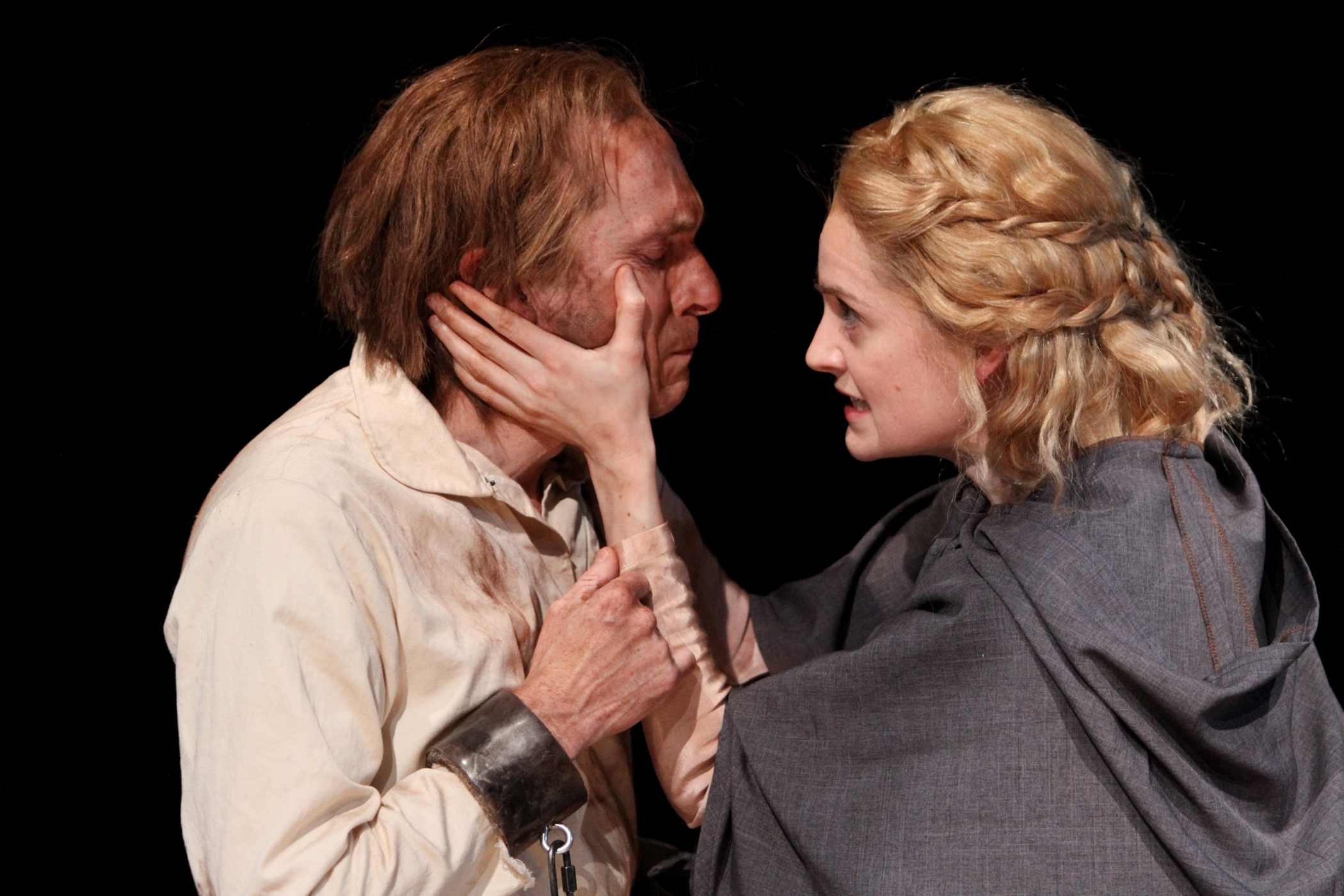
Quite happy to see Tom Adès take the Best Opera Grammy for The Tempest. I had the opportunity to write this essay for the Met when the production staged by Robert Lepage first appeared there:
When The Tempest opened at London’s Royal Opera House in February 2004, the anticipation couldn’t have been more intense. Composer Thomas Adès—only 32 at the time—had already been thrust into the international spotlight in the previous decade and found himself having to live up to recurrent comparisons with his similarly precocious compatriot and predecessor Benjamin Britten. Despite all this pressure, the overwhelming, almost unanimous response to Adès’s second opera seemed to confirm the parallels. “Only time will tell whether the first night of The Tempest in 2004 was a moment to set alongside the first night of Peter Grimes in 1945 in the history of British music,” wrote The Guardian the day after the occasion. “But it felt that way in the theatre.”
Time has proved that the initial verdicts weren’t idle hyperbole. The Tempest belongs to that rare group of contemporary operas whose critical acclaim is matched by the ultimate practical test of stage-worthiness. In fact, The Tempest—still less than a decade old—can already boast an astonishing track record of five different productions: the original Covent Garden staging (which was revived in 2007 and recorded for EMI’s award-winning CD), the American premiere at Santa Fe Opera in 2006, two separate productions in Germany, and now the opera’s premiere at the Met, which promises to be among the highlights of the new season.
Robert Lepage’s staging is a co-production of the Met, Opéra de Québec, and the Vienna Staatsoper and will also feature Adès (pronounced AH-diss) making his company debut as conductor. Reprising his performance as Prospero is baritone Simon Keenlyside, whose combined vocal and physical presence were widely admired as ideally suited to the role he created at the Royal Opera House.
The once-obligatory references to Britten became a kind of shorthand for English critics eager to spell out the high expectations pinned on Adès. In fact, he is an artist whose voice is unmistakably and audaciously original. Many gifted young composers demonstrate an eclectic, anxiety-free facility when it comes to claiming elements from the musical past for their own creative tool kit, but what was especially striking about Adès, while he was still just in his twenties, was the uncanny confidence with which he forged a rich, complex, allusive language with a coherence all its own.
Even more, before the millennium Adès had already found exciting ways to develop his flair for formal, abstract structures, vivid orchestration, and spirited detail while also demonstrating a compelling theatrical instinct. His range was apparent, whether in writing for a large Mahlerian orchestra (the symphonic Asyla, commissioned for the Berlin Philharmonic, for example) or in his first work for the stage, the chamber opera Powder Her Face (1995).
The latter, which used the scandalous story of an aristocrat’s fall from grace to ironically turn the mirror back on a tabloid-saturated culture, also revealed Adès’s extraordinary feel for portraying characters in music. With the far vaster canvas of The Tempest, he progressed to a mature mastery of his art, taming the often volatile energy found in his youthful scores into a sustained, emotionally gripping arc.
Shakespeare’s beloved final romance, remarks Adès, “is famously full of references to music, while the intangibility of some of its characters has always inspired music.” Purcell, Tchaikovsky, Sibelius, and Berio are just a few of the many composers who have fallen sway to its spell; even Mozart, near the end of his life, may have contemplated turning The Tempest into an opera. Yet instead of finding himself daunted by the weight of associations bound up with the source material—above all by the sheer power and poetry of Shakespeare’s language—Adès discovered a fresh approach to “translating” the Bard’s vision into opera.
The composer collaborated closely with librettist Meredith Oakes, an Australian-born playwright and poet whose talent for evoking traditional poetic patterns through “a very specific, archaistic style” felt particularly appropriate. Oakes distilled the original verse into pithy, condensed couplets that echo the play’s most famous passages in eminently singable phrases—instead of competing with them. Many of the couplets take the form of half-rhymes or slant-rhymes that acquire an extra charge by being ever so slightly off. The result, Adès says, “is a translation of Shakespeare into modern English, to be all the more faithful and concentrate the drama.”
Yet the three-act opera remains remarkably true to the arc of Shakespeare’s story and the spirit of his characters, while at the same time opening up the creative space necessary for Adès to add the unique perspective of his musical imagination. “I want it to be The Tempest. I want it to be Shakespeare and to bring that vision into the opera house as faithfully as possible,” the composer points out. “We actually started further away from the play than we ended up but found ourselves going back to Shakespeare’s structure much more.” But to achieve such fidelity—as opposed to a pale imitation—Adès and Oakes determined early on that they needed to swerve away from dogged, literal re-creation.
The most striking shift involves the opera’s conception of Prospero, the former Duke of Milan who, in the back story, has been usurped by his brother Antonio and shipwrecked on an island with his young daughter, Miranda. Prospero’s desire for vengeance is more pointed in the opera, as is his related assertion of control over the island’s indigenous creatures—Ariel and Caliban—and over Miranda’s emerging emotional autonomy as she falls in love with Ferdinand, his enemy’s son.
The libretto provided Adès with clearer “musical emotions” that motivate the dynamics of enslavement and liberation in the story as well as the transforming power of love and compassion. The real turning point, observes the composer, comes when Ariel tells Prospero that the suffering he has caused his enemies to endure would soften Ariel’s own heart if he were human. “And it’s the moment when Prospero realizes he’s gone too far and has to stop.”
Lepage, familiar to Met audiences for his stagings of Berlioz’s The Damnation of Faust and Wagner’s Ring cycle, praises the opera for capturing the “magic” of what is often considered the playwright’s final artistic testament. Not surprisingly for this wizard of theatrical illusion, the figure of Prospero has long fascinated Lepage, who has directed numerous productions of Shakespeare’s play. Each time he returns to it, he uncovers new insights. For his own concept of the opera, Lepage has expanded its aura of magic into a metaphor for artistic performance itself, envisioning Prospero as an 18th-century impresario of La Scala, the opera house in Milan, which he has recreated on the island of his banishment as a reminder of home.
“In those days, La Scala was a very magical place to set operas because it had all of the new state-of-the-art machinery,” Lepage explains. “The beach where everybody is marooned is actually a stage that’s been planted there and constructed by Prospero.” Lepage adds that each of the three acts presents a different perspective—from the stage itself, from the auditorium, and what goes on behind and off stage—to encompass this “opera-within-an-opera house.”
Members of his creative team will be making their Met debuts: Jasmine Catudal designed the sets, and the costumes are by Kym Barrett (known for her collaborations with Baz Luhrmann and her work on The Matrix films). The overall look will marry a sense of the island’s “native, aboriginal culture” with the Italian Baroque sensibility imported by the European interlopers.
Lepage’s mastery of both traditional stagecraft and its most up-to-date technological forms provides an ideal complement to the composer’s unique fusion of a classic play with a contemporary vision of opera. In his musical characterizations of the five leads, for example, Adès developed wonderfully effective alternatives to the vocal type casting that might have tempted a less-imaginative composer. While Ariel, a male character played by a soprano, sings in a stratospheric tessitura (frequently perching on Ds, Es, and Fs above high C, even reaching to G), “this isn’t a way of expressing high emotion and shouldn’t feel like the top of the singer’s range. That’s where she lives.”
Ariel is an elemental force of nature who—in another alteration of the original source—sings the final airborne phrase and becomes the wind again. Her island counterpart, the “monster” Caliban, is depicted not as a “lumpen, earthy brute” with a bass voice but is a lyrical tenor. “He’s often described in the play as being like an eel or a fish, and I suddenly thought he could be more like one of those exotic, wonderful voices from the East, with a weird elegance. And of course he is an aristocrat, not only in his own mind,” says Adès, who gives Caliban one of the most radiantly beautiful passages in the score: his aria reassuring the shipwrecked newcomers not to fear the island’s “noises.”
As for Prospero, the composer created a fully dimensional baritone role (with shades of Verdi’s and Wagner’s authoritarian father figures) who nevertheless defies the stereotype of the wise old sage. Adès was especially inspired by crafting the role for Keenlyside. “Simon’s a terrifically physical performer who projects youth. In a way, it’s that characterization, as much as the extraordinary voice, that was on my mind. I don’t think of Prospero as an old man. This is the only play of Shakespeare which observes the classical unities of happening in one place, in one day. When Prospero meditates on the evanescence of life, my feeling is actually it’s not that he does that every day and has been doing it for years and he’s an old bore. It’s that he’s just realizing it at that exact moment. That’s the first time he’s thought this.”
While Adès writes for the voice with great character, his score is also distinguished by its symphonic intricacy and architecture. This quality provides the opera with a richly satisfying cohesion and unity. Adès achieves this not through conventional leitmotif technique but by expertly manipulating his uniquely evocative harmonic language. He explains: “The music has its own internal logic of relationships; it doesn’t just do what it wants to do because the characters suddenly decide to go somewhere. It’s a tissue that’s woven in, so that everything is related in the music, and all the elements create a view of the world that’s whole, a sphere.”
I came across this very interesting London Review of Booksdiscussion of Brian Levack’s The Devil Within Possession and Exorcism in the Christian West by Terry Eagleton. According to the jacket copy by one of my erstwhile employers, Yale University Press, Levack’s examination of the epidemic of reported demonic possessions in Reformation Europe takes into account “the diverse interpretations of generations of theologians, biblical scholars, pastors, physicians, anthropologists, psychiatrists, and historians.”
The “common sense” model today of course ascribes what was believed to be or presented as possession to the symptoms of mental or physical illness. But Levack’s contextual approach argues that “demoniacs and exorcists—consciously or not—are following their various religious cultures, and their performances can only be understood in those contexts.”
Eagleton, a prominent literary critic who delivered the Terry Lectures in 2008, homes in on this cultural contextualization as a problematic method:
“In [Levack’s] view, falling prey to the lures of the Devil is always culturally specific. One cannot, he claims, use contemporary psychological models to explain the mentality of people who lived several centuries ago. This is surely implausible. Psychological ailments, like physical ones, display a degree of continuity across the ages….All illnesses, Levack writes, ‘are socially constructed, and can be understood only if they are studied in the cultural context in which they took place’. Yet cancer is not a social construct in the sense that melancholy is, and a German physician could treat an arthritic Peruvian peasant without knowing much about his or her cultural context.
In capitulating to a fashionable culturalism, Levack is unclear about what part if any he considers mental illness to play in demoniac behaviour. On the one hand, he is deeply suspicious of universalist claims, regards the modern definition of hysteria as far too protean to be useful, and dismisses too briskly the notion of mass hysteria, which would seem a reasonable explanation for the various epidemics of diabolical invasion which erupt from time to time. On the other hand, he concedes that psychological disturbance may account for some aspects of the business in hand. His book thus combines a scepticism of medical explanations with the concession that hysteria and demonic possession may be closely related.
I’m also intrigued by Levack’s focus on the “performative” aspects both of those possessed and of the rituals devised to exorcize them. According to Eagleton, Levack believes that “demoniacs have to be understood as acting out a script encoded in their religious cultures, in a theatrical performance which involved themselves, the exorcist and the community as audience. Though the performance was predetermined, the occasional ad lib was permissible. People mugged up on their roles by reading accounts of other possessions, so the growth of printing played a vital role in the whole business.”
But Stuart Clark, author of Thinking with Demons: The Idea of Witchcraft in Early Modern Europe, finds Levack’s thesis of possession as the expression not of illness but of the religious cultural context in which it is rooted to be plausible. Clark writes that this explanation “restores a powerful sense of agency to those affected and gives meaning to their bizarre behaviour.”
Eagleton, on the other hand, while he admires Levack’s “erudite, absorbing account,” comes to a very different conclusion about possession and agency:
The idea of being appropriated by alien powers challenges the modern concept of individual autonomy. In its own way, it recognises that there is a level at which men and women do not belong to themselves. Our relation to ourselves is not like our relation to a piece of property. As the concept of the unconscious would suggest, there are destructive forces over which we have only precarious mastery, and which can assume a deadly momentum of their own. It is just that there are more productive ways of recognising that at a certain level we do not belong to ourselves than spewing up frogs.
This is a fuller version of my profile of the Seattle-based director Rosa Joshi for Crosscut.com. Joshi and her team at Seattle Shakespeare Company have staged Richard II, a play that’s been in the spotlight thanks to the BBC’s Hollow Crown series but that — at least in the U.S. — remains a relative rarity.
“I don’t choose easy plays!” admits Rosa Joshi. She’s explaining her selection of Richard II as the vehicle for her directorial debut with Seattle Shakespeare Company.
The match between Joshi and Seattle Shakes is long overdue, given what she has brought to the Bard’s twist on “sad stories of the death of kings.” For my money, her Richard II ranks among the finest of the company’s recent productions, achieving a delicate balance of clarity and forceful poetic imagination.
“Shakespeare is my greatest love to direct,” says Joshi, who has been on the fine arts faculty at Seattle University since 2000.
“There are no small choices in Shakespeare. He makes you go to the extremities of emotion and experience, from the heights of joy to the depths of despair. That to me is infinitely challenging.”
Extreme situations frame Richard II, which traces the downfall of its titular king. Ill-suited to the throne, the impolitic Richard is forced to hand the crown over to his cousin-made-rival, Henry Bolingbroke, before being imprisoned and assassinated. His dramatic reversal of fortune has its counterpart in Henry’s equally dramatic ascent.
Richard (George Mount) surrenders his crown to Henry Bolingbroke (David Foubert); photo by John Ulman
Over the past decade, Joshi has made a splash in Seattle with her all-women versions of Shakespeare. In 2006 she co-founded upstart crow, a local collective devoted to producing classic theater with exclusively female casts. Their inaugural production took on the Bard’s King John; their second effort followed in 2012 with the ultra-violent Titus Andronicus.
A central aim of upstart crow has been “to create opportunities for women to participate in the Western classical canon for which they share a passion – in a way they don’t get to do in more conventional arenas.”
“Any time you have one gender onstage it makes you look at gender differently,” Joshi says. “I’m not so much prescriptive about what it means, but think of it as an experiment in how the audience relates to the work. For some people, the gender simply goes away, and some people really notice it. There isn’t just one experience I’m trying to make the audience have.”
Joshi is well-aware of the seeming paradox that with the conventionally cast Richard II at Seattle Shakes, she’s chosen a play featuring a predominantly male cast (with just two actresses). In fact, she points out, upstart crow has also gravitated toward heavily male plays.
“With Richard, there is a way of looking at him as a character who has a certain female energy in a male world,” Joshi explains. As he loses the confidence of his subjects, Richard becomes increasingly marginalized. The actual women in the play, meanwhile, “are the only ones who hold on to family while the others are torn by loyalty to the state.”
Richard (George Mount) and his Queen (Brenda Joyner); photo by John Ulman
In a similar vein, Joshi expresses puzzlement over another question she says is inevitably posed: “Why do you, as a woman of color, insist on doing this work by Dead White Males? Whenever I’m asked that, I point out that these plays are just as much my heritage, too.”
Joshi, who grew up in England and Kuwait, initially thought she was destined to become a doctor like her father. Still, she decided to keep her options open by studying in the United States and pursuing her love of theater on the side as a double major.
The turning point that made her decide to choose theater over medicine came when she was given the chance to direct during a semester abroad in London. Naturally, it was a thorny piece: Harold Pinter’s one-act “The Lover.”
After internships at the Williamstown Theatre Festival and Juilliard in New York, Joshi headed to Yale Drama School (during the Stanley Wojewodski era). Her classmates included Paul Giamatti, Liev Schreiber and the indie director Tom McCarthy. “I learned so much just from being around my peers,” she recalls.
Joshi relocated to Seattle during the 1990s, when the fringe theater scene was exploding. Legendary local director John Kazanjian of New City Theater, she says, became a key mentor. Kazanjian gave her the opportunity to produce her own shows — including her Seattle debut, a “Twelfth Night” staged on the steps of Capitol Hill’s Richard Hugo House.
“I think Seattle is a great place where emerging artists can sink their teeth into work. But it’s harder to sustain mid- and late-career artists.” Still, Joshi sees a positive development in the resurgence of adventurous theater in recent years from groups like New Century Theatre, azeotrope, Washington Ensemble Theatre, and Strawberry Workshop.
“A lot of these are companies started by artists who realize they need to self-produce: artists who have a shared mission and the expertise to produce their work, which is empowering. One of the things we try to promote here at SU to my students is the idea that they need to be nimble and able to do more than one thing.”
Joshi herself had taken that advice to heart during her early years in Seattle by self-producing. A stint as artistic director at the Northwest Asian American Theater got her involved in collaborations between Asian-American and Asian artists.
Since taking up her position at Seattle University, Joshi has guest directed at several Seattle theaters. She seems especially at home with Seattle Shakespeare, where she coaxes a poetically nuanced performance of the doomed Richard from George Mount, the company’s artistic director.
Cast of Richard II; photo by John Ulman
The complexity of Richard II, along with its confusing back story, poses daunting challenges for any director and cast. But Joshi and her actors bring a red-hot focus to what’s at stake for the two sides, and the story plays out with riveting dramatic rhythm.
It is Shakespeare’s ability to convey all of this through elaborately poetic language that particularly enthralls Joshi. Richard II is his only play written entirely in verse (even a gardener and his assistant carry on in lofty iambic pentameter).
“He’s able to use language to convey the inner workings of character and to externalize the souls and emotions of these characters,” Joshi explains. “At time we might feel the language is excessive: and that’s exactly the language we need in order to understand what’s going on with Richard.”
“I know lots of directors work from a very visual world, but I consider myself very text-driven.” Which hardly means Joshi’s work can’t be strongly visual — her production’s most indelible image reverses the moveable throne that dominates the minimalist set so that, in the prison scene, it becomes a looming gravestone — but she emphasizes that she wants such visual ideas to “emerge from the text. And what richer playground is there than Shakespeare, where the text delivers and encapsulates so much.”
Joshi is also intrigued by the ways in which Shakespeare blends the genres of history and tragedy in Richard II. And though it’s one of his less frequently staged plays, Richard II strikes a relevant chord because of the very modern crisis Richard faces, even within the play’s medieval setting.
Joshi points to Richard’s most self-reflective moments in the pivotal Pomfret Castle prison scene. “Take his lines: ‘but whate’er I be,/Nor I nor any man that but man is/With nothing shall be pleased, till he be eased/With being nothing.’ The density of meaning in that has always struck me as something that could be out of Samuel Beckett.”
“The existential journey that Richard goes through is something I think contemporary audiences can relate to in terms of how we define ourselves in the world. Richard has to grapple with who he is when he’s no longer king.”
“How does he cope with the absence of that identity? How does Henry edit his identity in order to become a leader? And how much are both shaped by who they are versus the people they have around them? Do we get the leaders we deserve?”
Richard in Pomfret prison; photo by John Ulman
In fact, Richard II appears to have become a hot theatrical topic of late. Recent broadcasts by the BBC of The Hollow Crown series (the cycle of four history plays that begins with Richard II) has brought the melancholy Richard into the spotlight – as has a much-touted Royal Shakespeare Company production starring David Tennant as the deposed king, which was widely disseminated via HD cinemacast.
For Joshi, it’s no surprise that Richard II is suddenly brimming with contemporary relevance. “The history plays seem to come up more and more in part because we live in a politically cynical age. These are plays that focus on what people do for power and ambition. The first week of rehearsals, one of the news stories was of how Kim Jong-un had his uncle executed to consolidate his power.”
Yet in this case, Joshi has seen no need to “modernize” the setting in order to emphasize its relevance. “I’m always interested in the artificiality of theater. What does theater do that film doesn’t do?”
“We don’t compete with the kind of verisimilitude that you get in film because theater demands that the audience’s imagination be engaged to complete the experience. It is this pact we go into – audience and actors and designers – to create this world together through this act of imagination.”
Ludovic Morlot and the SSO; photo by Ben VanHouten
And here it is: the Seattle Symphony’s announcement for the 2014-15 season, hot off the press.
Which means it’s free-association time, as I reveal what I guess is sort of my musical Rorschach test. What leaps out to me from among music director Ludovic Morlot’s choices?
A three-week Sibelius festival – hot-diggity! I loved the personalized touch Morlot brought to his recent reading of Tapiola.
Now we’ll get new principal guest conductor Thomas Dausgaard’s perspective on the Finn. This will be great for the orchestra’s development. I do wish I could hear more of Morlot’s take on Sibelius to juxtapose with Dausgaard. But this is great news. And I’m thrilled to see the bridges being built with other Seattle institutions — here, the Nordic Heritage Museum. This is the way to go.
(And as for Sibelius being “vulgar, self-indulgent, and provincial beyond all description” — dear Mr. Virgil Thomson, professional jealousy much?)
Similarly, Morlot will turn a spotlight on Dvořák with the last three symphonies. I love this in-depth focus. I just wish they’d gone for maybe 5 and 6 instead of 9 for a richer fleshing out of this amazing composer’s portrait. He really is neglected, in the odd way that happens when the rep focus is so absurdly directed to the Cello Concerto and “New World.” And his symphonies are right up there with Brahms. (Excellent to see Daniil Trifonov on the roster, but why oh why Tchaik 1 AGAIN? And Rach 3 AGAIN – really??)
Readers of this blog and of my other writings already know of my high regard for Trimpin and the music of Mason Bates — and we’re getting world premieres from both (including a cello concerto for Joshua Roman!).
As for the remainder of the new-music front, this is mouth-watering: another world premiere from Sebastian Currier, two US premieres from British composers — the eloquent (in words and music) Julian Anderson and the wonderful orchestrator Colin Matthews (responsible for a delicious take on Debussy’s Preludes) — AND a new work by Jugo Kanno, a Japanese composer I will look forward to discovering.
Also mouth-watering: Salonen’s Violin Concerto, featuring the impeccable Leila Josefowicz. Hey — Sibelius isn’t the only great Finnish composer! Wonderful to see this.
Not the world’s biggest Nirvana fan (I won’t get caught up now in an argument about how overrated they are), so the Sonic Evolution 2015 commission of work “inspired by” Pearl Jam and Nirvana does nada for me.
Berlioz’s COMPLETE Roméo et Juliette, in the hands of Morlot — utter musical bliss promised.
Ives 4 – very exciting, I hope it comes off!
Mahler 3 – trepidatious. This happens to be the very first Mahler symphony I got to know inside-out, so I’m especially fond of it, whatever its flaws. I actually love it to death. But if not done right, it can be a disaster. Morlot so far has a shaky record with Mahler. But this could be a breakthrough.
I’ve still got to digest what’s going on with regard to the core rep and the really Dead White Males.
Here’s the official SSO press release:
LUDOVIC MORLOT AND SEATTLE SYMPHONY ANNOUNCE 2014–2015 SEASON
Dvořák’s Last Three Symphonies, Complete Sibelius Cycle,
Stellar Guest Artists, Nine Premieres and Innovative Residency
Highlights
Dvořák’s Final Three Symphonies, Conducted by Ludovic Morlot
Three-Week Sibelius Festival Led by Principal Guest Conductor Thomas Dausgaard Celebrates 150th Birthday of Jean Sibelius in 2015 with Performances of All Seven Sibelius Symphonies and Other Works.
Morlot Conducts Three Epic Symphonies: Mahler’s Third Symphony,
Berlioz’s Roméo et Juliette and Ives’ Symphony No. 4
World Premieres Include Co-Commissions from American Composers Mason Bates and Sebastian Currier, as well as Seattle Symphony Commission and Site-Specific Installation from Seattle-Based “Sound Sculptor” Trimpin
Three World Premieres to be Commissioned for Sonic Evolution 2015,
Including Works Inspired by Music of Pearl Jam and Nirvana
U.S. Premieres Include Works Co-Commissioned from Two Major British Composers,
Julian Anderson (Violin Concerto) and Colin Matthews (The Pied Piper),
as well as New Work from Japanese Composer Jugo Kanno
Morlot to Conduct Parisian-Themed Opening Night Gala Program with Violinist Gil Shaham
London Symphony Orchestra Makes Benaroya Hall Debut Under Michael Tilson Thomas
Symphony Untuxed Series of Informal and Inviting Concerts on Friday Evenings
Expands to Include New Sunday Matinee Series
Principal Pops Conductor Jeff Tyzik Curates Diverse Pops Series Including Film Music of John Williams, Holiday Pops with Cirque Musica, Rodgers & Hammerstein Celebration, Preservation Hall Jazz Band and Tribute to Ray Charles
Distinguished Guest Conductors and Guest Artists:
Conductor debuts with the Seattle Symphony include Jonathan Cohen, Imogen Cooper, Richard Egarr, Mirga Gražinytė-Tyla, Stephen Layton, Cristian Macelaru and Carlo Montanaro. Returning conductors are Andrey Boreyko, Matthew Halls, Miguel Harth-Bedoya, Neeme Järvi, Carolyn Kuan, Nicholas McGegan, Itzhak Perlman, Steven Reineke and Thomas Søndergård. Soloists include: violinists Augustin Hadelich, Hilary Hahn, Leila Josefowicz, Pekka Kuusisto, Itzhak Perlman, Gil Shaham and Pinchas Zukerman; cellists Yo-Yo Ma and Joshua Roman; pianists Kristian Bezuidenhout, Yefim Bronfman, Imogen Cooper, Ingrid Fliter, Marc-André Hamelin, Simon Trpčeski and Yuja Wang; sopranos Amanda Forsythe, Hélène Guilmette, Rena Harms and Heidi Grant Murphy; mezzo-sopranos Sylvie Brunet-Grupposo, Sasha Cooke, Jennifer Johnson Cano, Sarah Larsen and Christianne Stotjin; tenors Zach Finkelstein, Ross Hauck, Eric Neuville and Kenneth Tarver; and baritones Patrick Bolleire, Tyler Duncan, Alexander Hajek and Morgan Smith.
Seattle Symphony Musicians Featured with Orchestra:
Alexander Velinzon, Concertmaster; Meeka Quan DiLorenzo, Assistant Principal Cello; Seth Krimsky, Principal Bassoon; and David Gordon, Principal Trumpet.
Seattle, WA – Music Director Ludovic Morlot today announced a vibrant and prestigious 2014–2015 Seattle Symphony season. Continuing and extending his previous seasons’ themes of eclectic and diverse repertoire, accessibility and exploration, interactions with contemporary culture, and creative innovation, the 2014–2015 season also brings the most important list of guest artists that Seattle has seen in many years.
“I’m thrilled that next season will be my fourth with this wonderful orchestra,” Morlot said. “We have planned a musical and emotional journey through an incredibly exciting repertoire, and I can’t wait to share it with our audiences. So many of the works on our season have great meaning and explore feelings and ideas that we can all relate to, from the romantic love in Berlioz’s Roméo et Juliette to Charles Ives’ search for the meaning of life in his Fourth Symphony. I’m also very happy to introduce our new Principal Guest Conductor, Thomas Dausgaard, next season. He will lead our Sibelius Festival, which features all seven of the composer’s symphonies. It will be a season to remember!”
Seattle Symphony Executive Director Simon Woods added, “We pride ourselves on presenting seasons that are the equal of any orchestra in America — and this one is no exception. Our hallmark is to create seasons that run as deep as Sibelius, as broad as Nirvana, as uplifting as Mahler, as inviting as Untuxed, as edgy as [untitled] and as fun as John Williams. We’re about programming for the deep connections that great music can make with audiences — and about celebrating the inspiration of true artistry on the stage of one of the world’s finest concert halls.”
A hallmark of the 2014–2015 season is the Sibelius Festival in March, led by Principal Guest Conductor Thomas Dausgaard. The Sibelius Festival commemorates the 150th anniversary of Jean Sibelius’ birth includes the complete cycle of all seven Sibelius symphonies, and encompasses programs on the Masterworks, Symphony Untuxed and Chamber series, as well as a stand-alone Beyond the Score® performance. The Seattle Symphony has formed a partnership with Seattle’s Nordic Heritage Museum, with additional festival activities to be announced at a later date.
In 2014–2015 the Symphony will present several non-subscription Special Performances. The fourth annual Sonic Evolution concert led by Ludovic Morlot fuses three newly commissioned works with Seattle’s past and present music scene. In 2015 Sonic Evolution includes world premieres inspired by Pearl Jam and Nirvana performed by the Orchestra with a yet-to-be-revealed band from Seattle’s hip music scene.
Special Performances next season will also include a performance with renowned cellist Yo-Yo Ma; two performances with violinist and conductor Itzhak Perlman; the Seattle Symphony signature event Celebrate Asia, led by former Associate Conductor Carolyn Kuan; and two visiting orchestras: the London Symphony Orchestra, conducted by 2010 National Medal of Arts recipient Michael Tilson Thomas and featuring talented young pianist Yuja Wang, and the Seoul Philharmonic Orchestra, led by Myung-Whun Chung and featuring pianist Sunwook Kim. The Opening Night Concert & Gala, conducted by Ludovic Morlot, is planned for Saturday, September 13, and will feature a Paris-inspired program and celebrated guest violinist Gil Shaham.
The Seattle Symphony has co-commissioned six new works for the 2014–2015 season. Two commissions by American composers, including a new Cello Concerto from Mason Bates written for former Seattle Symphony Principal Cello Joshua Roman, and a new work by Sebastian Currier receive their world premieres in Seattle. A Violin Concerto by Julian Anderson, performed by guest violinist Carolin Widmann, and an all-new, large-scale children’s work by Colin Matthews, The Pied Piper, receive their U.S. premieres in Seattle.
A special focus for the 2014–2015 season is a project involving local “sound-sculptor” Trimpin, who is internationally known for his work in creating inventive musical sculptures. Trimpin will create a site-specific sound installation in Benaroya Hall’s Samuel & Althea Stroum Grand Lobby. He has been commissioned by the Seattle Symphony to compose a new work to be premiered by the orchestra and audience during the Symphony’s late-night contemporary music series, [untitled]. In addition, Trimpin will be involved in mentoring pre-college-age composers in the Seattle Symphony’s annual Merriman Family Young Composers Workshop and a number of other activities for the community.
There will be two changes to the season structure for 2014–2015. The Symphony Untuxed concept, which currently consists of five one-hour Friday evening performances at 7pm, is being expanded to add a separate three-concert Sunday matinee series at 2pm. The popular Symphony Untuxed series does away with typical orchestra performance conventions such as formal attire and a separate concertmaster entrance, replacing these with an onstage introduction to the concert and a post-concert Ask the Artist hosted by orchestra musicians. These concerts, known as Sunday Untuxed, will replace the Beyond the Score® series; however, one Beyond the Score® program, Sibelius’ Fifth Symphony, will be held as a stand-alone performance as part of the Sibelius Festival.
The second change to the season is in Seattle Pops series scheduling. The Seattle Pops series will continue to consist of five diverse programs celebrating the great American popular music tradition. However, instead of five performances of each program, there will be three performances of each program. This change will maximize the opportunities for a variety of additional types of presentations in the Hall, including classical and popular events.
MASTERWORKS SEASON HIGHLIGHTS
Masterworks Season Encompasses Dvořák’s Final Three Symphonies
and Sibelius Festival
Music Director Ludovic Morlot will lead the Seattle Symphony in 12 of the Masterworks Season’s 21-program schedule, opening the series in September with a three-week-long Dvořák focus, including the composer’s last three symphonies. Dvořák’s Symphony No. 7 opens the subscription series, paired with Tchaikovsky’s dramatic Piano Concerto No. 1 with Daniil Trifonov in his Seattle Symphony debut, and Wagner’s Overture to Die Meistersinger. The following week, Dvořák’s Eighth Symphony will be performed alongside Dutilleux’s Métaboles and Rachmaninov’s Rhapsody on a Theme of Paganini with pianist Khatia Buniatishvili in her Seattle Symphony debut. The third and final week includes Dvořák’s Symphony No. 9, “From the New World,” John Adams’ Lollapalooza, and Korngold’s Violin Concerto with famed violinist Hilary Hahn. (In addition to these Masterworks series programs, the Dvořák weeks also include a “New World Untuxed” performance on the Symphony Untuxed series with Symphony No. 9 and Dvořák’s Bagatelles on the program, as well as a chamber performance of Dvořák’s folk-influenced Piano Trio No. 4 in E minor, “Dumky,” for piano, violin and cello.)
In October Morlot will conduct the orchestra and Seattle Symphony Chorale in the Mozart Requiem with soprano Hélène Guilmette, mezzo-soprano Sasha Cooke, tenor Zach Finkelstein and baritone Alexander Hajek. All but Cooke are making their debuts in these performances. In November Morlot will conduct Tchaikovky’s Fourth Symphony in a program that also includes Barber’s Second Essay for Orchestra, and Esa-Pekka Salonen’s Grammy-nominated Violin Concerto with critically acclaimed violinist Leila Josefowicz.
In January Morlot is joined for Rachmaninov’s Piano Concerto No. 3 by pianist Denis Kozhukhin, returning to the Seattle Symphony after his sensational debut in 2013’s Rachmaninov Festival. This program also includes Ives’ complex and rarely performed Symphony No. 4. The following month, Morlot will conduct Beethoven’s Violin Concerto with Grammy Award-nominated violinist Christian Tetzlaff on a program that also features works by three French composers: Berlioz’s Le Corsaire Overture, Debussy’s Ibéria and Ravel’s La valse. Also in February, Morlot conducts the Seattle Symphony and Chorale in Berlioz’s Roméo et Juliette, with mezzo-soprano Sylvie Brunet Grupposo, tenor Kenneth Tarver and baritone Patrick Bolleire, all making their Seattle Symphony debuts.
In April Morlot will conduct the world premiere of Sebastian Currier, followed by Grieg’s Piano Concerto with celebrated pianist Marc-André Hamelin, and Schumann’s Symphony No. 2. Later that month Morlot will conduct an all-Beethoven performance that includes the composer’s Symphony No. 7 and Piano Concerto No. 4 with Grammy Award–winning pianist Yefim Bronfman. Then in June, Morlot conducts Brahms’ Symphony No. 1 on a program that also includes Beethoven’s Egmont Overture and the U.S. premiere of Julian Anderson’s Violin Concerto with violinist Carolin Widmann, who makes her Seattle Symphony debut. The Seattle Symphony Chorale will again join the orchestra under Morlot for Mahler’s Third Symphony, which also includes guest mezzo-soprano Christianne Stotjin and the Northwest Boychoir.
Principal Guest Conductor Thomas Dausgaard will lead the orchestra in March 2015 in a three-week festival commemorating the 150th anniversary of Jean Sibelius’ birth. In three Masterworks subscription concerts, in addition to other programs, the Finnish composer will be honored with a complete cycle of his symphonies and additional works. The first week includes the first two symphonies and the rousing symphonic poem Finlandia. The symphonic cycle continues with performances of Sibelius’ Third and Fourth symphonies, as well as his virtuosic Violin Concerto with violinist Pekka Kuusisto, who makes his Seattle Symphony debut. The festival concludes in the third week with symphonies nos. 5, 6 and 7. Numerous ancillary events will also take place in addition to these Masterworks Season concerts.
The Seattle Symphony welcomes six guest conductors to the Benaroya Hall stage for Masterworks Season performances in 2014–2015. In November Carlo Montanaro, a frequent guest conductor at Seattle Opera, will make his Seattle Symphony debut conducting Beethoven’s Fifth Symphony in a program that also includes Rossini’s Overture to The Barber of Seville and Respighi’s Church Windows. Later that month Miguel Harth-Bedoya returns to conduct Mussorgsky’s Pictures at an Exhibition, which is programmed with Esteban Benzecry’s Colors of the Southern Cross and Mendelssohn’s Violin Concerto with brilliant young violinist Augustin Hadelich.
In December the dynamic Mirga Gražinytė-Tyla will make her Seattle Symphony conducting debut leading the orchestra in the world premiere of the Mason Bates Cello Concerto (co-commissioned by the Seattle Symphony) with former Seattle Symphony Principal Cello Joshua Roman. Also on that program are Prokofiev’s Lieutenat Kijé Suite and selections from Tchaikovsky’s Sleeping Beauty.
Thomas Søndergård, lauded for his “piercing intelligence and intense passion” (The Guardian), returns to Seattle in April to conduct Prokofiev’s Symphony No. 5, Chopin’s Piano Concerto No. 2 with pianist Ingrid Fliter, and Szymanowski’s Concert Overture. In May beloved maestro Neeme Järvi conducts Glinka’s Overture to Russlan and Ludmilla, Borodin’s Symphony No. 2 and selections from Prokofiev’s Cinderella.
ADDITIONAL SUBSCRIPTION SERIES PERFORMANCES
The above Masterworks Season encompasses the Symphony’s core programming of symphonic repertoire. Additional subscription series described below include Distinguished Artists, Baroque & Wine, Mozart: The Great Concertos (formerly Mainly Mozart), Symphony Untuxed, Sunday Untuxed, [untitled], Fluke/Gabelein Organ Recital, Chamber, Seattle Pops, Discover Music, Soundbridge Presents and Tiny Tots.
Distinguished Artists
This celebrated three-concert series brings world-renowned musicians to Seattle to perform the great works of the solo and chamber literature. The Distinguished Artists series opens with virtuosic pianist Yuja Wang, praised for her “practically superhuman keyboard technique” (San Francisco Chronicle). Macedonian pianist Simon Trpčeski will also perform a solo recital in March, and Grammy Award–winning violinist Pinchas Zukerman returns to Benaroya Hall in May with pianist Angela Cheng to conclude the series.
Baroque & Wine
The Baroque & Wine series, with performances on Friday and Saturday evenings, pairs the rich music of the Baroque era with pre-concert wine tastings. The series begins in October with guest conductor Nicholas McGegan presenting music by Bach, Handel and Telemann, including two of Bach’s keyboard concertos with pianist Robert Levin. In February noted conductor and harpsichordist Richard Egarr leads all four of J.S. Bach’s orchestral suites from the keyboard. The series concludes in May when Stephen Layton conducts a concert featuring works by Bach, Handel, Purcell and Vivaldi with the Seattle Symphony and Chorale, soprano Amanda Forsythe, alto Deanne Meek and Seattle Symphony Principal Trumpet David Gordon.
Mozart: The Great Concertos (formerly the Mainly Mozart series)
The popular Mozart series opens in January with Stilian Kirov conducting two programs featuring six of Mozart’s great concertos. Over two nights the orchestra will be joined by soloists Boris Allakhverdyan, recently appointed Principal Clarinet of the Metropolitan Opera Orchestra, on Mozart’s Clarinet Concerto in A minor; Jan Lisiecki, “a pianist who makes every note count” (The New York Times), on Mozart’s piano concertos nos. 20 (K. 466) and 21 (K. 467); in-demand Ukranian violinist Valeriy Sokolov on Mozart’s violin concertos nos. 4 (K. 218) and 5 (K. 219); and the London Symphony Orchestra’s Principal Flute, Adam Walker, on Mozart’s Flute Concerto No. 1. In February guest conductor Jonathan Cohen will lead the orchestra in a performance of Mozart’s Piano Concerto No. 22 (K. 482) featuring 2013 ECHO Award–winning pianist Kristian Bezuidenhout, and Mozart’s spirited Overture to The Marriage of Figaro. The concert will also include Beethoven’s Symphony No. 1. Pianist and conductor Imogen Cooper will conclude the series in May by leading the orchestra from the keyboard in two of Mozart’s piano concertos, nos. 17 (K. 453) and 24 (K. 491).
Symphony Untuxed
The Symphony Untuxed series is comprised of five Friday concerts with an early start time of 7 p.m. and a shorter, no-intermission format. This season the Symphony Untuxed series takes listeners on a musical journey through Europe. In September Ludovic Morlot presents a concert of music by Czech composer Dvořák, including his much-loved Symphony No. 9, “From the New World.” In November guest conductor Carlo Montanaro takes a tour of Italy with works by Boccherini, Rossini and Respighi. The series continues in March with a program presenting works by Finnish composer Sibelius, led by the Seattle Symphony’s newly appointed Principal Guest Conductor, Thomas Dausgaard. Music by Polish composers Chopin and Szymanowski will be explored in April, led by Thomas Søndergård and featuring Ingrid Fliter on Chopin’s Piano Concerto No. 2. The series will end in June with Ludovic Morlot on the podium to lead the orchestra in a performance of works by two of Germany’s most enduring composers, Brahms and Beethoven.
NEW! Sunday Untuxed
Like Friday’s Symphony Untuxed concerts, the brand-new Sunday Untuxed series features short, no-intermission concerts, and its afternoon start time makes it perfect for families. The series opens in October as guest conductor Nicholas McGegan samples some of the best of the Baroque era with music by J.S. Bach and his son C.P.E. Bach, as well as Handel and Telemann. In January Ludovic Morlot leads the orchestra in a Classical program featuring the music of Beethoven and Mozart. Additionally, Seattle Symphony Principal Bassoon Seth Krimsky takes center stage in Weber’s Bassoon Concerto. The series concludes its debut season with Romantic works by Brahms, R. Strauss and Tchaikovsky, conducted by Stilian Kirov.
[untitled]
After debuting to critical acclaim in the 2012–2013 season and enjoying a successful second season, the Seattle Symphony’s late-night [untitled] series returns for a third year. In this three-concert series, Seattle Symphony musicians perform contemporary ensemble pieces in Benaroya Hall’s Samuel & Althea Stroum Grand Lobby. The series kicks off in October with Stilian Kirov leading a performance of Djuro Zivkovic’s On the Guarding of the Heart, Three Arias from Ligeti’s opera Le grand macabre, and Andrew Norman’s Try. In February the series continues with music by Vladimir Martynov, Jacob Druckman and John Adams. May’s program, conducted by Ludovic Morlot, will feature a major event in the residency of “sound sculptor” Trimpin, with the premiere of his new work to be performed on a site-specific installation, by members of the orchestra and audience members, in the Grand Lobby. The program will also feature three works by George Perle in honor of the 100th anniversary of the composer’s birth: Molto Adagio, Critical Moments (No. 1) and Serenade No. 3.
Fluke/Gabelein Organ Recitals
This well-established series places three distinguished organists before Benaroya Hall’s 4,490-pipe, 83-stop Watjen Concert Organ. It begins in October with Isabelle Demers, one of North America’s most virtuosic organists. Seattle Symphony Resident Organist Joseph Adam, hailed by The Seattle Times as “an organist who is capable of virtually anything,” takes the stage in February. Organist Douglas Cleveland, Music Director at Plymouth Congregational Church in Seattle, will conclude the series in May.
Chamber Series
In this three-concert series, audiences have the opportunity to hear Seattle Symphony musicians and guests present chamber works in the intimate Illsley Ball Nordstrom Recital Hall in Benaroya Hall. The series begins in October with a program of music by Dvořák, Jolivet, Mahler and Schumann as part of the Dvořák Celebration. March features an all-Sibelius program as part of this season’s Sibelius Festival, and in May Seattle Symphony musicians close the series with works by Brahms, Prokofiev and Tchaikovsky.
Seattle Pops
Jeff Tyzik begins his second season as Principal Pops Conductor with the unforgettable movie music of John Williams, from Superman to Star Wars to Jaws. The series continues in December with Holiday Pops with Cirque Musica, when Tyzik will entertain the whole family with the ultimate holiday extravaganza — acrobats, jugglers, dancers and mimes performing with the Seattle Symphony. In March Steven Reineke celebrates the golden age of Broadway with music from Oklahoma!, Carousel, South Pacific and more. He and the orchestra are joined by special guest vocalists Ashley Brown, Aaron Lazar and the University of Washington Choirs. In April the Preservation Hall Jazz Band brings the sweet sounds of New Orleans jazz to Benaroya Hall. The Seattle Pops series concludes in June with a tribute to Ray Charles, featuring Ellis Hall, a former protégé of the late singer-songwriter. From hits like “I Can’t Stop Loving You” and “Georgia on My Mind,” this concert is filled with Ray’s soulful hits.
Discover Music Series
The Seattle Symphony’s Discover Music series presents five hour-long symphonic programs for children ages 6 to 11 and their families in the S. Mark Taper Foundation Auditorium, each preceded by special performances and activities in the Samuel & Althea Stroum Grand Lobby. The series will open with Stilian Kirov conducting Beethoven Lives Upstairs, a delightful tale from a youngster’s perspective on the “madman” — none other than Ludwig himself — who moves in upstairs. December brings A Spirit for the Holidays, a fun-filled holiday sing-along again led by Kirov. In February Ludovic Morlot and the orchestra bring toys to life in Debussy’s Toy Box. In May Kirov and the orchestra present Carnegie Hall’s The Orchestra Rocks, exploring rhythm, pulse and groove from selected orchestral repertoire like Orff’s Carmina burana, Holst’s The Planets and more. The series concludes in June with Kirov leading the orchestra and a local youth chorus in British composer Colin Matthews’ new piece based on the story of Michael Morpurgo’s immortal Pied Piper.
Soundbridge Presents
The 2014–2015 season is the second season for Soundbridge Presents, a new series aimed at children ages 3–8 and their families. Soundbridge Presents concerts are 45-minute long interactive concerts featuring Seattle Symphony musicians and other local and guest musicians from a variety of genres. Performers this season include Native American violinist and storyteller Swil Kanim in World Beat: The Tree Story, musical duo Harmonica Pocket, local teachers turned kindie rock band Recess Monkey performing with orchestra musicians, and Seattle Symphony Principal Second Violin Elisa Barston and Friends.
Tiny Tots
The Tiny Tots series, presented by Let Your Music Shine with Lisa and Linda™ is for the youngest music lovers, ages 0–5, and their caregivers. These 35-minute performances are highly interactive and are presented in the Illsley Ball Nordstrom Recital Hall. Each of the following programs is presented four times on Friday and Saturday mornings: Hi-Lo Circus, Holiday Hooray!, Magical Melody Train Ride, Sailing the Musical Seas and Teddy Bear’s Musical Picnic. Pre-concert activities take place before each performance.
Online subscription renewals are fully automated. Subscribers will receive a unique login name that allows them to see their entire order on the Seattle Symphony website. Subscribers may request changes to their subscriptions and add options ranging from purchasing prepaid parking to requesting wheelchair-accessible seating. Changes to the order will be made instantly, and changes in seating will be made separately, after the subscription renewal deadline has passed. Season brochures are being mailed to current Symphony subscribers, who will have until March 1, 2014, to renew their seats or request seating changes. To receive a 2014–2015 season brochure, please call the Seattle Symphony Ticket Office at (206) 215-4747 or write to Seattle Symphony Ticket Office, Attn: 2014–2015 Season Brochure Request, P.O. Box 2108, Seattle, WA 98111-2108. The brochure may also be viewed online. Subscription renewals will also be accepted in person at the Ticket Office at the corner of Third Ave. and Union St., by phone at (206) 215-4747, by mail at the address above, or by fax at (206) 215-4748.
NON-SUBSCRIPTION PERFORMANCES
Non-subscription concerts and presentations are available exclusively to Seattle Symphony subscribers before they go on sale to the public in August 2014.
The 2014–2015 Opening Night Concert & Gala on Sunday, September 13, at 4pm, features Ludovic Morlot conducting a Paris-inspired program with showpieces by Saint-Saëns, Sarasate, Massenet and more. A number of works will feature special guest violinist Gil Shaham, one of the foremost artists of our time. Special Gala fundraising packages are available and include cocktails, dinner and dancing. Gala packages must be reserved through the Special Events Office at (206) 215-4856.
Holidays at the Symphony
The Seattle Symphony’s holiday performances at Benaroya Hall will be highlighted by the orchestra’s two traditional presentations: Handel’s Messiah, conducted by Cristian Macelaru and featuring soprano Heidi Grant Murphy, mezzo-soprano Jennifer Johnson Cano, tenor Ross Hauck and baritone Tyler Duncan; and Beethoven’s Symphony No. 9, “Choral,” led this year by Matthew Halls and featuring soprano Rena Harms, mezzo-soprano Sarah Larsen, tenor Eric Neuville, baritone Morgan Smith and the Seattle Symphony Chorale. Beethoven’s Ninth Symphony will also be performed on New Year’s Eve, followed by an audience-wide celebration with dancing, a toast and a countdown to 2015. Other holiday performances include the King’s Singers, one of the world’s most celebrated vocal ensembles, performing a festive program of holiday tunes, as well as A Festival of Lessons & Carols with members of the Northwest Sinfonia, and the Northwest Boychoir and Vocalpoint! Seattle under the direction of Joseph Crnko.
In January violin icon Itzhak Perlman will perform with and conduct the orchestra in an unforgettable concert featuring works by the “three Bs”: Bach, Brahms and Beethoven. At the end of the month, Ludovic Morlot and the orchestra will present the fourth year of Sonic Evolution, a project that celebrates the past, present and future of music in Seattle, combining brand-new classical compositions with the styles and genres of pop music. Next season’s program features three new symphonic commissions inspired by Nirvana, Pearl Jam and others.
March also sees the return of Celebrate Asia, the annual Seattle Symphony event celebrating the musical traditions of East and West. This year former Seattle Symphony Associate Conductor Carolyn Kuan returns to lead the program, which features soloists on traditional Japanese instruments, including Chiaki Endo on koto, as well as Dozan Fujiwara on shakuhachi in the U.S. premiere of a new work by Jugo Kanno, co-commissioned by the Seattle Symphony. The program also includes Seattle Symphony Assistant Principal Cello Meeka Quan DiLorenzo performing selections from Tan Dun’s Crouching Tiger Cello Concerto, from the soundtrack to the film Crouching Tiger, Hidden Dragon. Celebrate Asia also includes pre-concert performances by local artists in the Grand Lobby.
Two visiting orchestras take the stage in April. One of the world’s great orchestras, the London Symphony Orchestra, makes its Benaroya Hall debut with works by Britten and Shostakovich, led by Grammy Award–winning conductor Michael Tilson Thomas, as part of his 75th birthday tour. The program also includes Gershwin’s jazz-inspired Piano Concerto in F, featuring the sensational pianist Yuja Wang. (Wang also appears on the Seattle Symphony’s 2014–2015 Distinguished Artists series.) Then, the Seoul Philharmonic Orchestra returns with conductor Myung-Whun Chung, hailed as “a spiritual conductor” by Le Monde, and a program of Romantic blockbusters by Beethoven and Brahms, including Beethoven’s Piano Concerto No. 5 with skilled young soloist Sunwook Kim.
Classical music icon and cellist Yo-Yo Ma joins Ludovic Morlot and the Seattle Symphony in May for a performance of Schumann’s Cello Concerto. The program also features Ravel’s Mother Goose Suite and Stravinsky’s Suite from Pulcinella.
Here’s the more-complete version of my Los Angeles Philharmonic essay on Michel van der Aa’s remarkable cello concerto, Up-close, which gets its West Coast premiere in the Green Umbrella series next week:
Regular followers of the Los Angeles Philharmonic will have encountered the work of Michel van der Aa before, but Up-close has intensified his profile, particularly in North America, thanks to the acclaim it earned last year, when it received the mega-prestigious Grawemeyer Award for Music Composition. Written in 2010 on a commission from the European Concert Hall Association and the Dutch Performing Arts Fund for the Amsterdam Sinfonietta and the Argentine cellist Sol Gabetta – who premiered it in Stockholm in March 2011 – Up-close represents nothing less than a thorough reimagining of the concerto genre to mirror the way our high-tech, wired era shapes and compartmentalizes perceptions of reality.
Like Louis Andriessen, an important mentor with whom he has collaborated on such works as the multimedia opera Writing to Vermeer (1999), van der Aa has evolved a music theater aesthetic that resists classification in its intriguing combination of live performers and film visuals. The younger composer (born in 1970) studied recording engineering as well as composition in his native Holland and later enrolled in classes at the New York Film Academy. Many a composer combines multiple talents within the realm of music, but van der Aa brings a synthesis of composer, stage director, and filmmaker to several of his endeavors, including Up-close.
Van der Aa has also created works showcasing each of those talents separately. He emphasizes that his use of film visuals and extra-musical components has to be “a necessity,” not an adornment “which is there merely to be hip or entertaining. I try to be strict with myself, to use film in a way that extends and enhances my musical vocabulary. The film contributes something I can’t communicate with the music alone.” In Up-close, Van der Aa points out, he conceived the music “in parallel with my work on the script for the film and the small staging. These feed into each other. I like that flexibility. Sometimes the music gives me visual ideas, and sometimes it’s the other way around.” He considers Up-close to be a work of music theater, the cello concerto embedded within as a part interdependent on the whole.
Michel van der Aa (photo: Marco Borggreve)
Along with the familiar three-movement concerto format which he uses as a formal design for Up-close, van der Aa explains that the relative significance of its constituent layers likewise structures our sense of unfolding events. Their interrelations also pose unique challenges of synchronization. There are three such layers: the conventional one of the solo cellist and the all-string ensemble, the “mirror reality” of the film that is projected simultaneously, and the prerecorded sounds (encompassing electronic samples and the film’s soundtrack).
There is a fourth layer, which is less extensive, pertaining to the instructions for the soloist to take part in the mise-en-scène (as at the end of the first movement, when the cellist gets up and moves a lamp on the stage). “It provides a way of exaggerating the inherent theatricality of instrumentalists,” according to the composer. The soloist is required not only to perform with traditional musical virtuosity but also to act. The gulf separating the illusionistic reality of the film and that of the live performance becomes one of a cascading series of metaphors for what van der Aa has described as “a dream about communicating” which in the end fails.
But all of these layers don’t function with equal intensity throughout. The process of creating Up-close involved determining at each point “which of these layers are in the foreground, and which are in the background.” In the opening minutes of the work, the soloist remains in the spotlight, introducing crucial thematic material that will appear in new lights in conjunction with the other layers. The connections between the three movements make the shifting perspectives of van der Aa’s concept especially evident. For example, a lengthy segment of about five minutes bridging the first two movements brings the film to the center of attention as the main bearer of the “narrative,” with a thinned-out sonic background from the prerecorded music and the live ensemble remaining silent until metal chimes link up their world to the enigmatic “code machine” in the film. (Van der Aa collaborated with a friend who works as props master at the opera to build this visual, imagining “a cross between a music box and a Morse machine.”)
For the frenetic final movement, the code machine “ignites the ensemble” back into action, as the strings pulsate with a nervous energy at times reminiscent of Bernard Herman. Van der Aa likens the musical patterns of their “timbral counterpoint” to “little wood fires spreading through the ensemble,” while the woman in the film becomes increasingly anxious.
Writing the piece originally for Sol Gabetta, the composer imagined the elderly protagonist in the film as a kind of “alter ego.” The Dutch actress Vakil Eelman was chosen, he explains, because he wanted “an archetypal elderly figure: someone who carries youth in herself as well as wisdom and experience. I really like that ambiguity in her.” Johannes Moser is the first male cellist to perform as Up-close’s soloist, which, says van der Aa, “will generate different questions, but not necessarily less interesting ones, about the relationship between these two people – the actress in the film and the soloist on the stage. I think it’s important to let the audience take the last steps itself to decide what the piece is about.”
And my commentary on the other works on the program is here:
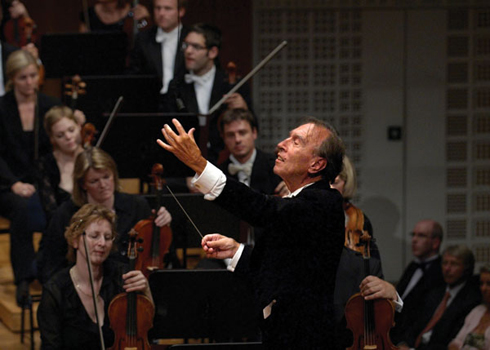
What terribly sad news to wake up to: today Claudio Abbado died at his home in Bologna. He was 80. This should be a front-page news story instead of just a link on the New York Times homepage.
Michael Haefliger, the director of the Lucerne Festival, pays homage to the musician who was a central musical pillar of the festival. The Maestro gave his final concerts leading the elite Lucerne Festival Orchestra, one of the ensembles he was acclaimed for founding:
“Wanderer, there are no paths. There is only wandering.” This quotation, which Claudio Abbado’s long-time friend, the Italian composer Luigi Nono, discovered on the wall of a monastery in Toledo, might also serve as an emblem for the life of Claudio Abbado: not to map out one’s life according to certain paths but rather to proceed, to live, and to remain open to experiencing what is new. In other words, a pathless wandering and searching. In just this sense Claudio Abbado always “pathlessly” sought out the new and unknown in his creative work, and he did so right up until the last second of his very full and fascinating life.
Allan Kozinn describes his self-effacing tendencies:
Mr. Abbado was also known for his disdain for the trappings of a modern, media-driven conducting career. As communicative as his podium manner was, through much of his career he seemed slightly awkward coming on and off the stage. Explaining this in a 1973 interview, he likened himself to the conductor Hans Knappertsbusch, whose habit was to refuse curtain calls.
“I used to be somewhat like that,” he said. “Now I take the time to be polite. Look, I like the reaction of the audience. I’m not sincere if I don’t say that, but it still embarrasses me to take bows. I’m not a showman. I hate all that.”
It was a point of pride for him that he never actively sought the music directorship of any orchestra. But directorships came his way anyway.
Abbado in Lucerne
Included among the in-depth coverage at The Guardian is Tom Service’s eloquent appreciation of Abbado and the “life-changing events” that were his concerts:
The Lucerne project was the zenith of a life in music that had as its essential credo a word that you don’t always associate with conductors, those supposed tyrants of the podium: “listen”… The message of listening was about encouraging every player in the huge ensemble needed to play Mahler’s symphonies to listen to one another, to know the score as well as he did. Their performances of all but the 8th, which Abbado didn’t have the chance to play in Lucerne, are the most revelatory and moving Mahler performances of recent decades – arguably ever.
[…]
[W]ith those musicians in Lucerne, Abbado was able to lift the veil on some other realm of experience, to put us in touch with a larger mystery even than the notes the orchestra was playing.
[…]
[His final Lucerne concert] was a communion between Abbado and his players of devastating intimacy and astonishing emotional bravery, which asked the most profound questions about what the musical experience, and even what life might be about, with its beginnings and unfinished endings, its questions and unfilled answers, its sounds and its silences. Abbado’s concerts weren’t mere performances of pieces of music, they were searing, transformative existential journeys. That they have come to an end is an unimaginable loss.
My ears and nerves are still buzzing from the excitement of last night’s recital by the always-dependable Garrick Ohlsson (at the University of Washington’s Meany Hall). What generous programs he offers: Beethoven’s Op. 109 Sonata, Schubert’s Wanderer Fantasy (D760), a triptych of selections by Charles Tomlinson Griffes, and Chopin’s Third Piano Sonata in B minor. And as if that weren’t enough, two superbly characterized Chopin waltzes for encores: the Op. 18 Grand Valse Brillante and the Waltz in C-sharp minor (Op. 64, no. 2).
I tend to think of Ohlsson as one of today’s least pretentious and fussy pianists, an artist to be counted on to give performances that are filling and satisfying. Of course that’s possible only because of his utterly confident technique — that left hand! — and his deep knowledge and love of the repertoire. What seems at times to be a “straightforward” approach turns out to reveal subtle insights. In the miracle of late Beethoven, for instance, he was able to explore different facets of the last movement’s variations (the new angle on the ultra-minimal two-note motif over which Beethoven obsesses in the first movement) without seeming to short-shrift the larger architecture beauty.
The Schubert Fantasy emerged as it should: a virtuoso showpiece on the surface, sure, but far more exhilarating for its sheer scope of invention and the pleasure Schubert takes in the powers of transformation of a basic idea. Ohlsson left no doubt as to why the next generation of Romantics fell so deeply in love with this spectacular but anomalous example of Schubertian ambition.
The Chopin Sonata may have been the most satisfying interpretation among these three well-known works. What struck me as especially successful was Ohlsson’s understanding of Chopin’s rhythmic articulation, both in his swooningly beautiful skeins of melody and in the robust, hell-bent momentum of the finale. But this didn’t come across as an affected exaggeration, or at the expense of those other aspects essential to this magnificent score. The whole picture is always in view – it’s just that it resembles getting a higher resolution, more dpi for clarity and detail.
Charles Tomlinson Griffes (1884-1920)
And then there were the pieces by the early-twentieth-century American composer Charles Tomlinson Griffes. Two of the Roman Sketches, Op. 7, from 1916 (“The Fountain of the Acqua Paola” and “The White Peacock”) and the Scherzo from his Op. 6 Fantasy Pieces (1913). I found these to be an utterly delightful discovery. Hints of Griffes’s infatuation with then-new French music abound, but there’s something fresh about it all. The killer-energy Scherzo made for a nice cross-link with the Schubert.
Ohlsson recently released a recording devoted to this fascinating artist who died very young, a victim of the influenza pandemic. A gay man from Elmira, New York, Griffes was still of the generation when studying abroad was the done thing to gain any cred as a “classical music” composer.
Here’s what Aaron Copland had to say about this predecessor (in 1952, 32 years after Griffes’s death):
Charles Griffes is a name that deserves to be remembered … What he gave those of us who came after
him was a sense of the adventurous in composition, of being thoroughly alive to the newest trends in
world music and to the stimulus that might have derived from that contact.
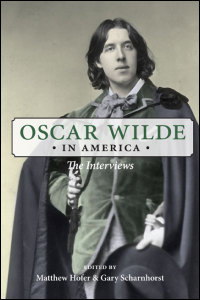
Creating quite the stir was of course second nature to Oscar Wilde, and he set many tongues wagging throughout the course of his extensive North American tour in 1882. Nowadays we have complex PR machines. Back then it was Oscar giving interviews to the local papers to generate buzz for his series of lectures on “the science of the beautiful.” He set the tone immediately upon disembarking in New York after his less-than-pleasing encounter with the Atlantic Ocean by (allegedly) proclaiming to the customs agent: “I have nothing to declare except my genius.”
Wilde ended up making some 140 appearances at cities and towns across 15,000 miles of the continent, alighting in gilded age salons and mining town saloons alike. Anthony Paletta sums up some of the press reaction to his first lecture, in New York, billed as having something to do with the “English Renaissance”:
[It] seems to have faltered in its prepared elements and shone in its improvisational bits, attracting praise from some quarters (“The Cincinnati Enquirer”) and dismissal from others (“The Nation,” grumpy even in the 1880s, observed that Wilde “can hardly succeed in this country”). “The New York Times” commented on the “aesthetic and pallid young men in dress suits and banged hair” in the rear of the venue — banged-hair an attribution with some whiff of the homosexual demimonde at the time.
Caricature from the San Francisco Wasp, March 31, 1882.
But no one quite matched the savage disdain penned by the journalist and short story writer Ambrose Bierce following Wilde’s first lecture at Platt’s Hall in San Francisco in March:
That sovereign of insufferables, Oscar Wilde has ensued with his opulence of twaddle and his penury of sense. He has mounted his hind legs and blown crass vapidities through the bowel of his neck, to the capital edification of circumjacent fools and foolesses, fooling with their foolers. He has tossed off the top of his head and uttered himself in copious overflows of ghastly bosh. The ineffable dunce has nothing to say and says it—says it with a liberal embellishment of bad delivery, embroidering it with reasonless vulgarities of attitude, gesture and attire. There never was an impostor so hateful, a blockhead so stupid, a crank so variously and offensively daft. Therefore is the she fool enamored of the feel of his tongue in her ear to tickle her understanding.
The limpid and spiritless vacuity of this intellectual jelly-fish is in ludicrous contrast with the rude but robust mental activities that he came to quicken and inspire. Not only has he no thought, but no thinker. His lecture is mere vebal ditchwater—meaningingless, trite and without coherence. It lacks even the nastiness that exalts and refines his verse. Moreover, it is obviously his own; he had not even the energy and independence to steal it. And so, with a knowledge that would equip and idiot to dispute with a cast-iron dog, and eloquence to qualify him for the duties of a caller on a hog-ranche, and an imagination adequate to the conception of a tom-cat, when fired by contemplation of a fiddle-string, this consummate and star-like youth, missing everything his heaven-appointed functions and offices, wanders about, posing as a statute of himself, and, like the sun-smitten image of Memnon, emitting meaningless murmurs in the blaze of women’s eyes. He makes me tired.
And this gawky gowk has the divine effrontery to link his name with those of Swinburne, Rossetti and Morris—this dunghill he-hen would fly with eagles. He dares to set his tongue to the honored name of Keats. He is the leader, quoth’a, of a renaissance in art, this man who cannot draw–of a revival of letters, this man who cannot write! This little and looniest of a brotherhood of simpletons, whom the wicked wits of London, haling him dazed from his obscurity, have crowned and crucified as King of the Cranks, has accepted the distinction in stupid good faith and our foolish people take him at his word. Mr. Wilde is pinnacled upon a dazzling eminence but the earth still trembles to the dull thunder of the kicks that set him up.
Today’s shock jocks have nothing on Ambrose Bierce. But just what stirred him to such an extremity of umbrage?
Rigoletto (Marco Vratogna) at work in the court; photo by Elise Bakketun
It’s no surprise that general director Speight Jenkins opted to reprise Seattle Opera’s production of Rigoletto, staged by the American director Linda Brovsky, for his farewell season (which also coincides with the company’s 50th anniversary). Introduced a decade ago, this Rigoletto is of fine vintage and remains hands-down the most satisfying Verdi production I’ve seen at Seattle Opera (a close tie being the Falstaff directed by Peter Kazaras).
Seattle can hardly be called a Mecca for Regie opera in the usual sense in which that term is bandied about. But that doesn’t mean it’s a haven for boringly conservative “traditional” stagings. The company actually is director-centric in that it places a high premium on theatrical values: it prizes directors who can contribute a sensitively close reading so that musical and dramatic meanings enhance each other. (Jenkins is, after all, a Wagnerian, and a good deal of the success of Seattle’s Ring has hinged on director Stephen Wadsworth’s ability to do just that.)
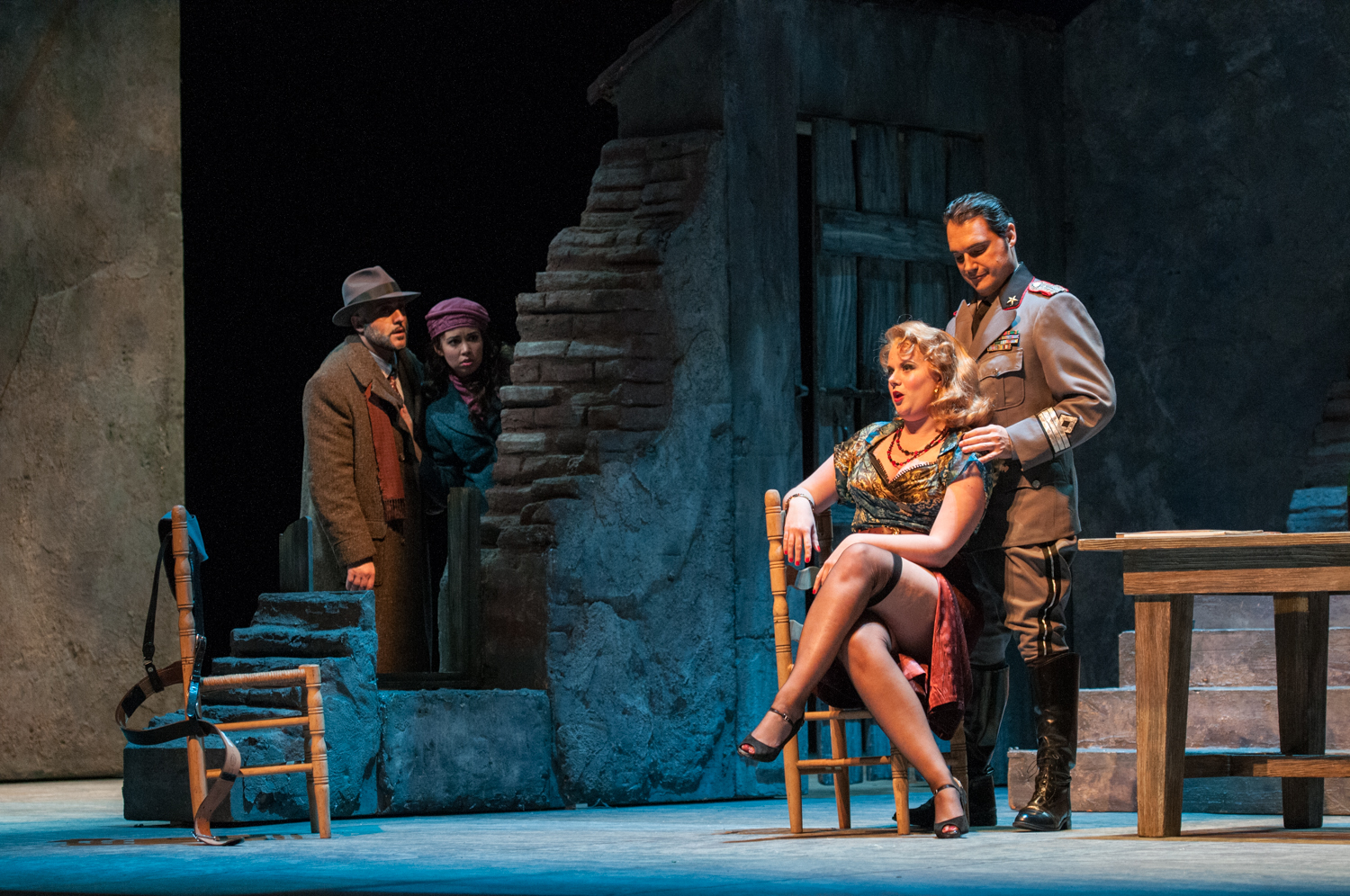
Rigoletto is certainly an opera amenable to directorial transposition, and the concept applied by Brovsky and the design team is to set the swiftly moving plot in the lurid “court” of a Benito Mussolini-like duce in the 1930s, at the height of Italian fascism. Rigoletto serves as a kind of spy who can feed him information and of course also as his procurer. The decadence of the duce/Duke of Mantua and his cronies turns out to be an expression of their unchecked power — the way they “loosen up” when not arrogantly terrorizing the citizens into submission.
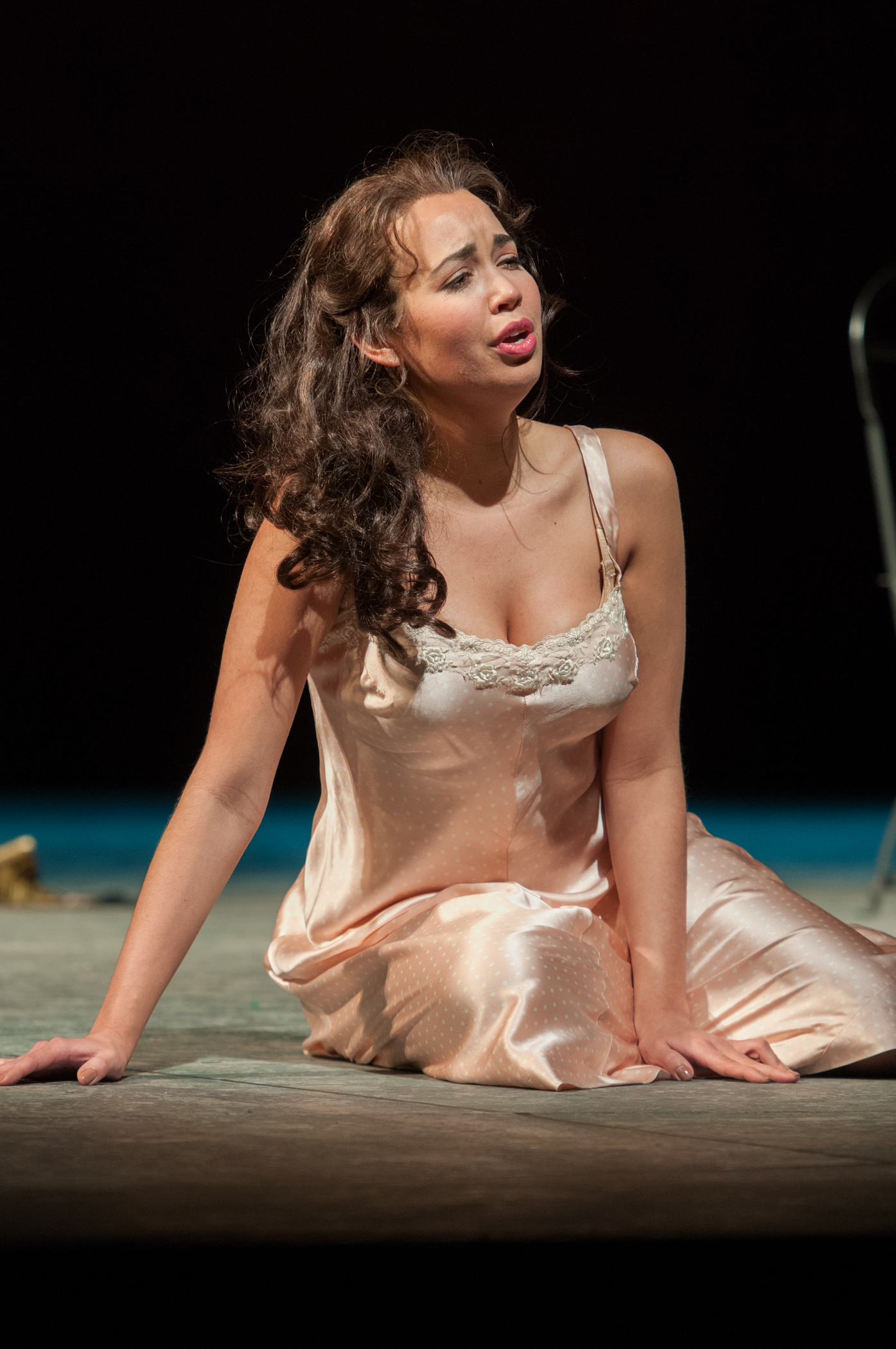
l to r: Marco Vratogna (Rigoletto), Nadine Sierra (Gilda), Sarah Larsen (Maddalena), Francesco Demuro (Duke of Mantua); photo by Elise Bakketun
Robert Dahlstrom’s sets and Thomas C. Hase’s lighting dramatically contrast the two poles of Rigoletto‘s world. The palace, thrumming with lust, is sleekly decked out with the spoils of art (a version of Bernini’s Rape of Proserpina sculpture serves as a prop littered with dirty champagne glasses), while the dimly lit, claustrophobic backstreets where the jester lives with his daughter Gilda are creeping with menace, an underworld that mirrors the cynical brutality of the rulers — only without their stylish veneer and classical trappings. The scenery of the last act, with its storm-swept cityscape across a river, is especially evocative. Marie Anne Chiment’s elegant gowns and chic suits make exceptionally eye-catching costumes.
All this provides more than a mere backdrop against which the familiar melodrama plays out. By anchoring what otherwise might seem a far-fetched series of unfortunate coincidences in a repulsive political and moral order, the fascist setting pushes buttons. When the nobleman Monterone reproaches the Duke for “seducing” his daughter — it’s clear that she’s been traumatized — Brovsky shows the old man wearing a yarmulke and dragged off to prison on the Duke’s orders: a voice of protest silenced by anti-Semitic thuggery. (Could this explain the family secrets Rigoletto keeps hidden from Gilda, including the mystery of her mother?)
Rigoletto will find himself in the same position as Monterone when he mourns the ruin of Gilda. The opera’s denouement is fueled by the jester’s plan for vengeance, his realistic version of the curse pronounced by Monterone. Marco Vratogna portrays an uncommonly sympathetic Rigoletto, making for a harrowing final scene. The problem is that he’s essentially too “nice” for the production’s milieu — particularly in the opera’s opening scene, where Verdi shows his cynical persona at work. The less-than-imposing curse delivered by Donovan Singletary’s Monterone should be the climactic focus of the scene, but the jester’s reaction barely registers.
Vratogna’s baritone admirably balances sturdiness and lyricism — it can be thrilling in a cabaletta wrap-up — but on opening night didn’t display the variety of colors essential to making this character vivid. You need to experience Rigoletto’s jabbing viciousness for his final sorrow to earn its full impact. Vratogna’s pivotal second-act solo lacked the differentiated phrasing Verdi calls for when Rigoletto, accustomed to his role as a performer, at last gives vent to his rage but then quickly changes tack to plead for his daughter.
Francesco Demuro as the playboy Duke; photo by Elise Bakketun
A similar drawback applies to Francesco Demuro’s depiction of the Duke. A lyric tenor with a gorgeous command of legato, Demuro brings out the careless playboy side of the role quite convincingly. It’s just that he’s too suave, too effortlessly mellifluous to generate the effect of a feared, ruthless leader. In fact, the emotional depth Demuro gave to his richly sung “Ella fu mi rapita!” scene (the Duke’s most interesting solo and the one eclipsed by the popularity of his other two famous numbers) ends up jarring against the rest of his characterization. The Duke’s moment of interiority of course goes nowhere — and that’s one dramaturgical lapse Brovsky’s smart production doesn’t solve.
On the other hand, the really, really dark side of this Rigoletto is supplied in spades by Andrea Silvestrelli as the assassin-for-hire Sparafucile. His bass sounds as fathomless as an unlit, echoing cave, and Silvestrelli telegraphs noirish menace with just a flick and boot crush of his cigarette. As his sister and partner-in-crime Maddalena, Sarah Larsen channels a touch of Carmen, working out an entire character transformation in the course of her one scene.
Andrea Silvestrelli (Sparafucile); photo by Elise Bakketun
But no one else matched the art of transition displayed by American soprano Nadine Sierra, making her Seattle Opera debut as Gilda. It’s not hard to discern what wowed the judges when they chose her as the youngest-ever winner of the Metropolitan Opera National Councils a few years ago. Sierra — and you’ll most definitely want to pay attention to her name — has an alluring, immediately identifiable voice that encompasses dark-hued deep notes as well as spectacularly spun, floating light notes at the very top of her range.
And that’s only a starting point for Sierra: her remarkable control allows her to venture an exciting variety in her phrasing. Her characterization complements this vocal richness: Sierra shows Gilda not as the innocent “tabula rasa” we usually see at first but as a loving daughter who already has desires of her own. The pain of her humiliation in the second act is so palpable it’s hard to watch. And her Gilda’s persistent attachment to the Duke isn’t a sentimental weakness but a desperate attempt to salvage some kind of meaning within the opera’s heartless environment. An especially effective touch is the shudder of terror she reveals even after she’s resolved to sacrifice herself.
Nadine Sierra; photo by Elise Bakketun
Another indispensable contribution is made by conductor Riccardo Frizza, doing the best work I’ve heard from him. The orchestra itself wasn’t on quite the same level on opening night, and some sloppy intonation crept into the mix, but the musicians are clearly responsive to the conductor’s reading of the score. Frizza understands that these immortal melodies get their punch precisely from the contexts Verdi creates. As a milestone experiment on the way toward the mature Verdi, Rigoletto is all about restyling the conventions of Italian opera within a context of breathless, dramatically compelling momentum.
Frizza was able to stretch a phrase here and there, effortlessly accommodating the singers, but all the while maintaining the needed tension. He also has a terrific ear for the telling, sometimes ironic details Verdi uses to punctuate the lyrical flow. The first scene especially benefited from a snarling energy that supplied in sound what the staging meant to evoke. The chorus (prepared by John Keene) also used details to excellent effect in the two palace scenes, hinting at a whole spectrum of implicit back stories for the audience’s imagination to supply.
One especially memorable detail from Brovsky: her treatment of “La donna è mobile,” the opera’s most-famous (and ironic) number, as a kind of prop. Here it’s a pop hit that obviously gets a lot of play on the state radio. We hear it (i.e., the orchestra’s preliminaries) as the Duke tunes in the radio while he’s out slumming for sex, prompting him to sing it himself. It’s when Rigoletto hears the Duke’s version again, after his presumed stabbing, that the corpse’s identity becomes a chilling question.
Brovsky’s conceit is right in keeping with Verdi’s own “high concept” interpolation of the tune, which refuses the expected cadence but has the melody fade away. Verdi begins the tune with a false start, and it never really ends — the Duke is left unscathed, ready for his next conquest, leaving us with a catchy tune. Fascism, as Walter Benjamin famously pointed out, is the “aestheticization of politics.”
Seattle Opera’s production of Rigoletto runs through January 25. Tickets available here.
I’ve referred to my skepticism regarding “best-of-the-year” lists, and I admit I’ve started to feel something similar about New Year’s resolutions. But there’s one resolution I made a few years ago (and I think that was a reboot of an impulse from way, way back) which has begun again, quite expectedly, to fascinate me. Namely, to listen closely to a new prelude and fugue from the Well-Tempered Clavier each day before focusing on other music.
Of course this is merely borrowing an idea that inspired me when I came across it in Pablo Casals’s memoirs (Joys and Sorrows, if I remember correctly). Casals got into the habit of starting each day by playing some Bach at the keyboard — I believe this was before he’d made his own epochal rediscovery of the Cello Suites.
It’s unquestionably a wonderful regimen. I’ve only worked my own way through a humiliatingly small portion of the WTC and am badly out of practice, so close listening will have to substitute. I can’t explain why, but from my substantial treasure of Bach recordings, I’ve gravitated toward Rosalyn Tureck. (I hadn’t realized last month marked the centenary of her birth.)
Like Casals, Tureck — the so-called “high priestess of Bach” — was a key player in reclaiming Bach for 20th-century listeners. It’s hard to imagine that when she was coming of age, Bach was still thought of by many music lovers as the music you played to get your fingers in shape and master coordination.
The Chicago-born Tureck, who liked to hang out with Oxford intellectuals and was friends with Bertrand Russell, represented a dramatically contrasting approach to that of Glenn Gould. The meditative quality she brings to her classic account of the WTC belongs to a class of its own. From the start, Tureck knows how to shine a gentle light on what she calls “Bach’s genius for creating a latent richness, implied rather than stated, within a simple framework.” There she’s referring specifically to the “eternal enigma” posed by the opening C major Prelude: “It can be regarded as very simple or as mysterious as Leonardo da Vinci’s Mona Lisa.”
Here Tureck discusses and illustrates Bach’s enormous influence: