MEMETERIA

Icon

Arts writing by Thomas May

Rising Up with Meredith Monk

Meredith Monk; photo by Masimo Agus

Meredith Monk; photo by Masimo Agus

Songs of Ascension is one of Meredith Monk’s creations of the past few years. If you don’t know her incomparable music yet, this is a wonderful place to start exploring it.

Monk’s unclassifiable art is grounded in a unique understanding of the flexibility of the human voice. She loves to create new contexts in which to fathom its expressive depths. The result is music that sometimes sounds as if it had been quarried from an archeological dig or beamed in from a distant future. Both impressions emanate from Songs of Ascension, the tenth project Monk has recorded for ECM since her path-breaking Dolmen Music was released three decades ago. That discography charts her intrepid forays “between the cracks,” as Monk likes to put it, where different ways of perceiving the world through art converge.

On one level, Songs of Ascension encapsulates Monk’s aesthetic outlook over a long career, one in which the voice serves as a guiding thread for her interdisciplinary performance pieces. But it also reveals the undiminished curiosity of her artistic quest by incorporating the expanded musical language Monk has evolved over the past decade. With Possible Sky (2003), her first work for orchestra, Monk began to apply her intuitive sense of the voice as a complicated instrument to larger ensembles, teasing out the feedback between singers and instrumentalists in ways that rethink the very bases of composition.

Songs of Ascension represents an ambitious example of this development in her work. One stimulus for the work was Monk’s encounter with poet Norman Fischer’s translation of the Psalms into a Zen-infused language. His imagery led to further reflections on the trope of worshipers ascending a mountain and pausing periodically to sing a psalm of praise. A simultaneous invitation to collaborate with visual artist Ann Hamilton further clarified her evolving musical images, adding a site-specific dimension. Hamilton’s project involved performing while ascending a new tower the artist had designed in Sonoma County, California, inside which a pair of staircases that resemble a double helix spiral upward. In this form Songs premiered in October 2008.

To explore her fascination with the connection between worship, transcendence, and images of ascension, Monk interweaves a fabric drawn from her recent experience writing for string quartet and the signature extended technique of her own vocal ensemble (with the added contributions of The M6 and the Montclair State University Singers). Other threads she includes are woodwinds, an array of percussion, and a blend of Western and Eastern sonorities (with a prominent role for the harmonium-like shruti box, which is associated with Indian music).

In place of a libretto the “text” consists of unpredictable patterns of abstracted phonemes, fluid vocalise, and shaman-like incantations. Yet even as non-sense replaces the logic of language, the vocalizations by Monk and her collaborators seem to imply the origin of speech rather than the disintegration of Babel.

The effect is especially enchanting at the beginning of the piece, which the string quartet inaugurates with sustained whispers of just a few pitches: a gentle fog which rises to reveal the echo of human voices. These “clusters” (in Monk’s terminology) set the stage for the sprouting of song, the blossoming of harmony. The interlinked sections are the first two of 21 that comprise Songs. Monk’s titles cue us in to recurrent patterns—and are also provocatively enigmatic (why are the seasons out of order, and why are winter and autumn instrumental-only while summer and spring include voices?).

Monk’s continual intercutting of highly varied textures builds a sense of larger-scale momentum. The section “mapping,” for example, suddenly introduces a new tone of festive tintinnabulation, while the gliding swoops of strings and voices in “falling” convey the curious sense of whimsical archaism that tempers the more meditative sections crisscrossing through the work. The range of Monk’s vocal idiom is literally breathtaking: a strangely beguiling repertoire of aviary microtones, robust yodels, insectoid whispers, and (in the penultimate “fathom,” a lengthy solo for Monk as she accompanies herself with a shruti box), dusky, low-range chanting. The final number, “ascent,” makes for an inspiring conclusion to the adventure, its layered sonic tapestry suggesting an endless procession/quest as solo lines leap in ecstatic figures from the drone-like foundation.

Though the original Songs of Ascension was conceived as an “immersive experience” with video and site-specific movement, Monk’s music is thoroughly evocative on its own terms. ECM’s engineering gives the music rich, warm resonance and even manages to convey something of Monk’s spatial acoustic. The recording was made in 2009 at the Academy of Arts and Letters in New York. The booklet includes a smart essay by composer Kyle Gann and a color-photo essay from the premiere in Hamilton’s tower. Songs is further confirmation of the musical treasure we have in Monk, who shows no signs of slowing down.

(c)2014 Thomas May. All rights reserved.

Filed under: American music, CD review, new music
Master Class

What happens when you put Joan Sutherland, Marilyn Horne, and Luciano Pavarotti together, with Richard Bonynge on hand to ask them about bel canto?

Filed under: opera, singers

Portrait of the Artist as a Young-at-Heart Man

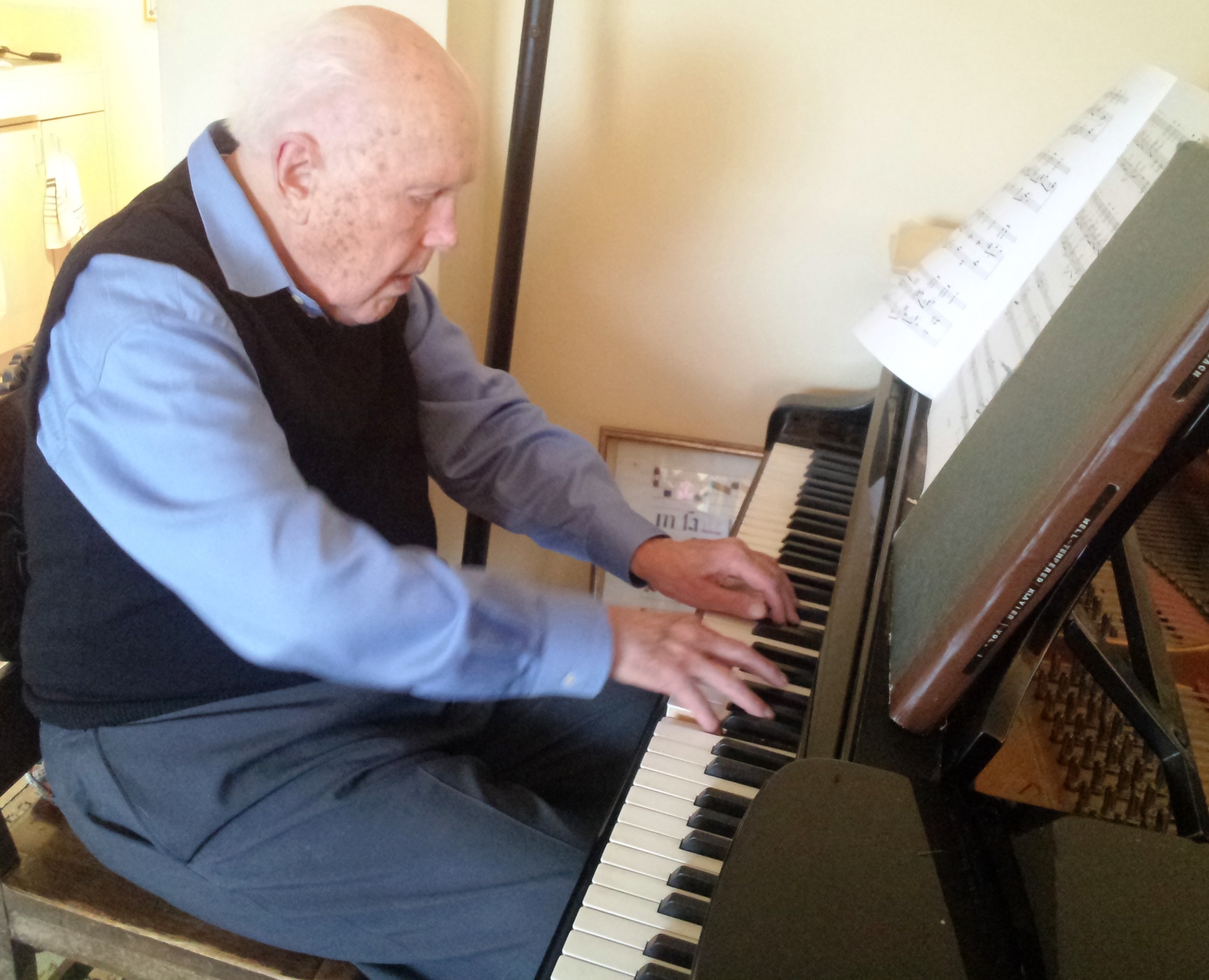
Randolph Hokanson, 2013; photo by Thomas May

Randolph Hokanson, 2013; photo by Thomas May

The pianist, composer, and sage Randolph Hokanson is a font of wisdom and a remarkable human being — with much to teach us as he approaches the age of 99 this June. Here’s my new profile of the artist for Crosscut:

“I’ve seen it all!” announces Randolph Hokanson before losing himself in a mischievous gale of laughter. With someone else, you might be tempted to indulge that as hyperbole. With Hokanson, who was born in 1915 in Bellingham, it’s tempting to take it literally.

This gifted pianist and teacher has witnessed almost a century of not just ceaseless but accelerating change: epochal shifts in technology, in education, in how music and the arts are valued.

Yet underneath the maelstrom, the things that really matter have managed somehow to endure.

continue reading

Filed under: composers, piano

Shakespeare’s Ruthless Dream

Midsummer

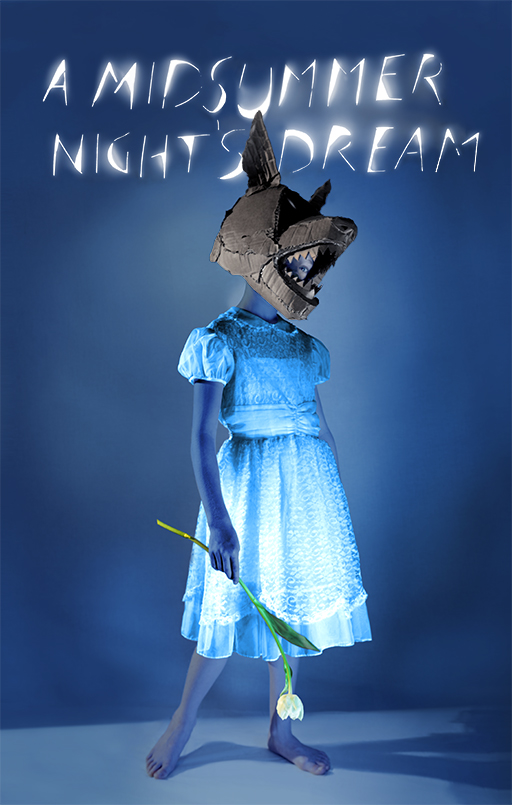
Reviewing Julie Taymor’s highly touted new production of A Midsummer Night’s Dream, Kate Havard floats some
provocative ideas about “the more unpleasant aspects at work” in a play that’s all too often taken for pretty fantasy and screwball identity mix-up.

Dream, writes Havard, “is actually a ruthless play: all four couplings marred with traces of compulsion, faithlessness, pettiness, and cruelty.”

According to Havard — a recent graduate of St. John’s College in Annapolis and a Tikvah fellow — Taymor emphasizes the forest “as a staging ground for the parts of the soul where reason rules not.”

The forest in “Midsummer” is not only the backdrop for chaos, it is full of spirits who egg on the passions, which helps to make us more aware of what must be tamed within us.

It is false to say that what the forest reveals in these Athenians is the true human nature, because reason is what makes us humans. But the unreasoning parts also tell us a lot.

To put it modernly, the forest is to Shakespeare what dreams are to Freud.

Havard draws out the implications of that analogy:

The symbolism isn’t subtle. Taymor’s taking the Frank Underwood approach to psychology: Everything is about sex except for sex, which is about power.

What Freud told us about our desires, the Greeks already knew: Dionysus and Aphrodite can only be contained and educated, not eradicated. They will always be there, just outside the city gates. And if you try and ignore them, it is at your peril.

In a recent interview in Smithsonian Magazine, Taymor describes what she thinks happens when Shakespeare shows these emotions getting “unleashed”:

I think that Shakespeare’s saying that’s how easily we can switch our passions. A little thing can do it. Whether it’s love juice, a psychedelic drug or somebody swishes by in a different way—that love is extremely fickle. I think a lot of this is about all different levels of love, just like “Titus [Andronicus]” is about every single aspect of violence.”

Filed under: Shakespeare

What Makes an “American Composer”?

Piston
I was just researching an orchestral piece by Walter Piston and wondering why his music is hardly ever programmed nowadays. In the mid- twentieth century he was all over the place, winning TWO Pulitzers and getting prestigious commissions year after year from the Boston Symphony. Merely an adept player at musical politics?

In fact, Mr. hard-to-please Igor Stravinsky singled out Piston and Aaron Copland as exemplary American composers: “They have good musical ideas,” Stravinsky wrote in 1945. “They also have the requisite techniques. They are fine orchestrators, too.”

In the 1930s, Copland, six years younger than the New England-born and -bred Piston, listed a sort of posse of prominent American composers that (along with himself) included Piston, Virgil Thomson, Roy Harris, and Roger Sessions. (Thomson apparently liked to refer to this as Copland’s “commando unit.”) Yet of this bunch (“Les Six” made such bands fashionable at the time), it’s really only Copland who gets heard with any frequency today.

But Piston’s definition of “American music” may have actually been closer to today’s multicultural sensibilities than Copland’s — in the sense, that is, that there can be no grand “master narrative,” no single identifiable American style. Howard Pollack, who wrote his dissertation on Piston and a very fine bio of Copland, quotes the following from Piston, who, like Copland, had studied at the “Boulangerie” in 1920s Paris with Nadia Boulanger:

Copland and I had a friendly war about American music. Aaron and I were very thick. We practically grew up together. He had hopes of producing an American music that was just as recognizable as French and German music. I told him that America had so many different nationalities that it would be nearly impossible, I felt that the only definition of American music was that written by an American. He had to agree, but he felt there ought to be a vernacular.

(That obviously echoes – or was echoed by – Virgil Thomson’s famous dictum that American music was ““any music written by an American” — I don’t know who said it first.)

Piston certainly left an indelible mark through the students he influenced during more than three decades teaching at Harvard: the likes of Leonard Bernstein, Elliott Carter, John Harbison, etc. (not to mention his many-times-reprinted textbooks on theory and orchestration).

Piston’s stylishly neoclassical Toccata for Orchestra, a curtain raiser for Charles Munch and the Orchestre National de la Radiodiffusion Française (who played it at 41 stops on their 1948 American tour), gives you a good morsel-size sample of the fine craft that musicians like Bernstein valued. Bernstein admired his former teacher’s compositions for showing “the highest standards of craftsmanship and clarity of sonic intention.”

So here is Piston, an American composer, trying to evoke what he describes as “those qualities of clarity and brilliance which are so outstanding in the playing of French musicians.”

Filed under: American music, Bernstein

The Budding Buddhist

Buddha

Like modern physicists, practitioners of contemporary literary theory of the post-structuralist persuasion trade in ideas that can seem uncannily reminiscent of the ancient insights of Buddhism: ideas like the slippery elusiveness of language, the self/author as an illusion.

But even without the filter of once-fashionable theory, certain artists themselves trigger comparison with aspects of the Buddhist quest. Beethoven’s final piano sonata, the Opus 111, replaces the conventional design with a two-movement dialectic that is frequently likened to a transition from Samsara (the stormy world of struggle of the C minor first movement) to Nirvana (the serene variations of the Arietta). “The farewell of the sonata form,” as Thomas Mann’s character Kretschmar in Doktor Faustus puts it.

According to the writer Pico Iyer, Marcel Proust is another artist who brings Buddhism to mind. Proust “ventures into the farthest reaches of self-investigation and reflection on subjectivity, but brings his understandings back into language and archetypal episodes that anyone can follow.”

The Buddha, as I understand it, ultimately devoted himself to the simple exercise of sitting still and resolving not to get up until he had looked beyond his many delusions and projections to the truth of what he was (or wasn’t) and how to make his peace with that.

A recreation of Proust's cork-lined bedroom (Musée Carnavalet in Paris)

A recreation of Proust’s cork-lined bedroom (Musée Carnavalet in Paris)

Am I the only one who thinks that this sounds very much like someone in a cork-lined room, almost alone for years on end and turning a fierce and uncompromising light on all his experiences and memories so as to see how much of them might be wishful thinking, and what they owe to illusion and the falsifications of the mind? Marcel Proust never formally meditated, so far as I know, and he never officially quit his gilded palace to wander around the world, practicing extremes of austerity and cross-questioning wise men. But if I want to understand the tricks the mind plays upon itself—the ways we substitute our notions of reality for the way things are and need to dismantle the suffering false thoughts can create—I can’t think of a better guide and friend than the author of “À la recherche.”

[…]

Proust’s genius, like that of his compatriot Cartier-Bresson (who called himself “an accidental Buddhist”), is to register every detail of the surface and yet never get caught up in the superficial. Here is the rare master who saw that surface was merely the way depth often expressed itself, the trifle in which truth was hidden thanks to mischievous circumstance (or, others would say, the logic of the universe). It takes stamina, bloody-mindedness, concentration, and a fanatic’s devotion to stare the mind down and see how rarely it sees the present, for all the alternative realities it can conjure out of memory or hope. Proust had the sense to belabor us with little theology, academic philosophy or overt epistemology; yet nearly every sentence in his epic work takes us into the complications, the false fronts, the self-betrayals of the heart and mind and so becomes what could almost be called an anatomy of the soul. I’m not sure sitting under a tree in Asia 2,500 years ago would have produced anything different.

Filed under: aesthetics, Beethoven, Buddhism, creativity, Proust, spirituality

Keep On Keeping On

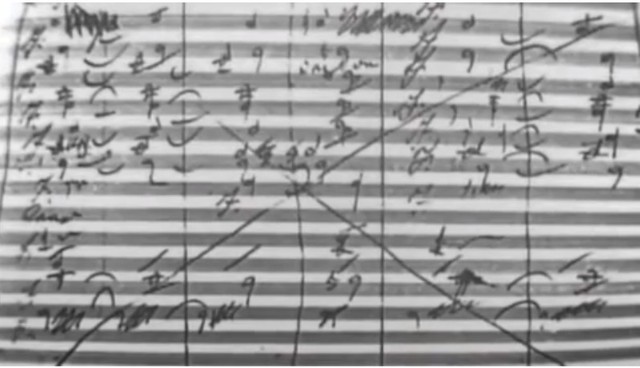
Beethoven: sketches for Fifth Symphony

Beethoven: sketches for the Fifth Symphony

I think I mentioned elsewhere that I’ve started growing tired of “best-of-the-year” lists. Not that I don’t appreciate taking stock of a certain period — I’m actually kind of obsessive about that — but I’ve lately been finding those lists too arbitrary in the way they try to shoe-horn a whole year of experiences into some sort of hierarchy. Anyway, I always end up discovering that excellent things get left out, while trend-think makes undeserving ones crop up to annoy me.

So I won’t give in to this tiresome ritual, with all its problematic meritocracy.* And as the year ends and a new one approaches with its illusion of offering a blank slate, I prefer to focus not on perfection achieved but on the tortuous route toward it. Here are a couple of inspiring examples of the fight against settling for something that’s good but not good enough. Instead of pristine blank slates, let’s consider the crabbed, crossed-out traces of an inner battle to wrest a chaos of ideas into something that will work. It’s the principle of starting with something that’s maybe even unremarkable and then pressing on against the odds to squeeze some sort of beauty or meaning from it. Over and over, facing constant confusion and frustration.

I suppose Beethoven is the most-obvious example of what I’m referring to. To me what’s especially encouraging about the stories of his compulsion to get things right, working them over and over, is that we can see Beethoven sometimes starting out with some really mundane stuff.

In his study of the Missa solemnis (a current preoccupation), Roger Fiske quotes from Beethoven’s first attempts to work out the theme of the Credo: “No one need be surprised that Beethoven’s sketches for the start of the Credo verge on the inept; his preliminary sketches often do. He seems to have needed to write down something which (to us) looks totally unpromising before he could find what he wanted.”

Leonard Bernstein even used the convoluted sketches for the Fifth Symphony to dramatize his point about Beethoven’s aesthetic struggle to write music that somehow seems “inevitable”:

Beethoven’s manuscript [in contrast to the gorgeous, flowing chirography of Stravinsky’s Symphony in Three Movements] looks kike a bloody record of a tremendous inner battle. Before he began to write this wild-looking score, he had for three years been filling notebooks with sketches….And so he tried a third ending, and this one worked…[H]e had to struggle and agonize before he realized so apparently simple a thing: that the trouble with his first ending was not that it was too short, but that it was not short enough. Thus he arrived at the third ending, which is as right as rain….

Imagine a whole lifetime of this struggle, movement after movement, symphony after symphony, sonata after quartet after concerto. Always probing and rejecting in his dedication to perfection, to the principle of inevitability….

[I]t leaves us at the finish with the feeling that something is right in the world, that something checks throughout, something that follows its own laws consistently, something we can trust, that will never let us down.

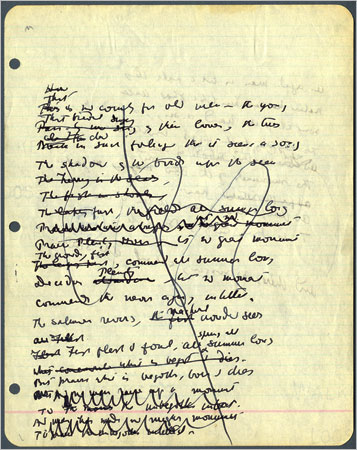
And there’s the example of William Butler Yeats, as Curtis Bradford (Yeats at Work) shows in his intriguing study of the poet toiling over drafts in his bound notebooks. The final version of “Sailing to Byzantium” encompasses a very small percentage of the lines Yeats wrote down in his first draft. The amazing (in every sense) opening line of “Leda and the Swan” — “A sudden blow: the great wings beating still” — started as “Now can the swooping Godhead have his will” or “The swooping godhead is half hovering still” (Yeats initially wanted to title it “Annunciation”).

Draft of a page from Yeats's "Sailing to Byzantium"

Draft of a page from Yeats’s “Sailing to Byzantium”

“The Choice” (1932)

The intellect of man is forced to choose
perfection of the life, or of the work,
And if it take the second must refuse
A heavenly mansion, raging in the dark.
When all that story’s finished, what’s the news?
In luck or out the toil has left its mark:
That old perplexity an empty purse,
Or the day’s vanity, the night’s remorse.

–William Butler Yeats

Thanks to all for visiting my blog. I wish you all a happy and productive new year and hope you’ll continue to visit and share your thoughts.

*OK, now I’m going to go ahead and cheat and slip in a reference to these as absolutely unforgettable experiences I was privileged to enjoy in 2013: the Adams/Sellars Gospel According to the Other Mary in LA; Lucerne Festival AND Seattle Opera Rings; Morlot conducting Messiaen’s Turangalîla; Diaghilev and the Ballets Russes at the National Gallery; Mark Rylance and the RSC’s Richard III and Twelfth Night; the Richard Diebenkorn retrospective at the de Young Museum; SF Symphony concert of Tom Adès, Mendelssohn, Stravinsky, with Pablo Heras-Casado; Azeotrope Theatre’s Gruesome Playground Injuries (Seattle); Gregory Maqoma’s Exit/Exist; the Met’s Dialogues, Giulio Cesare, The Nose, and Frau; and The Good Person of Szechuan at the Public.

Filed under: Beethoven, creativity, poetry, Yeats

CD Review: Hochman/Homage to Schubert

Benjamin Hochman

Benjamin Hochman; photo by Jürgen Frank

I haven’t yet had the pleasure of encountering Benjamin Hochman in live performance, but I come away from his new release, Homage to Schubert, with a remarkably vivid sense of what he brings to the competitive scene of today’s young pianists. This is his second solo album and debut recording for the AVIE label, and it amply reveals Hochman’s qualities as an interpreter as well as the creative and original programming style that appears to be a signature.

A native of Jerusalem now based in New York, Hochman counts Claude Frank and Richard Goode among his mentors. He made his New York debut in 2006 with a Met Museum recital juxtaposing Bach, Berg, Schubert, and a newly commissioned piece. A similar imaginative leap ties together his program here: two lesser-known Schubert sonatas and a pair of contemporary pieces “commenting” on the Austrian’s legacy — by György Kurtág (Hommage à Schubert) and Jörg Widmann (Idyll und Abgrund), respectively. Hochman performs on a Steinway and benefits from the tasteful production and engineering (Eric Wen and Dennis Patterson).

Of course there’s lots of powerful competition even when it comes to these less-familiar Schubert sonatas. Paul Lewis, the spiritual scion of Alfred Brendel, has recently staked an irresistible claim to this territory, and Mitsuko Uchida is another eloquent advocate. (She also began linking Schubert’s piano music with Schoenberg back in the ’90s.) A fundamental attraction of Hochman is that he allies a natural sympathy for Schubert’s brand of musical thinking with superbly balanced technique, all the while effacing any temptation to showboat or force a newfangled reading onto these scores.

In other words, Hochman’s overall stance toward Schubert himself is pretty traditional, while smartly allowing the “moderns” sharing his program to provide a contemporary angle. It’s a daring and subtle strategy, and one that rewards the listener. Which is by no means to imply that there’s anything even remotely stodgy or routine here: Hochman initiates the proceedings with the gorgeously spun lyrical flow of the Sonata in A major D664 (from 1819), his control of the pulse so mesmerizing that it seems as if this music has always been going on — a stream we’ve been graced to chance upon.

Hochman is fully alert to the potential of Schubert’s wild contrasts. That’s the premise, after all, of pairing the gentle, smaller-scale A major with the hugely ambitious and even aggressive Sonata in D major D850 (the so-called “Gasteiner,” after the spa town where it was written in 1825, the year Schubert sketched most of the “Great” C major Symphony). Yet Hochman doesn’t overload these contrasts with melodrama, but lets the few outbursts in D664 take us by surprise within the larger context.

At several points I could almost imagine D664 versus the “Gasteiner” as a precursor for Schumann’s Eusebius (especially in the melancholy appoggiaturas of D664’s Andante) and Florestan dichotomy. But what excites me the most about Hochman’s deeply satisfying approach to D850 is his implicit understanding of the Schubert-Beethoven connection. By this point, Schubert’s acquired admiration of the German composer had begun inspiring a new level of ambition (he was a Beethovenian convert).

Hochman seems to hint at the uncanny echoes of late Beethoven, as in the “Gasteiner”‘s widely wandering second movement, where one passage of reiterated chords suddenly approaches the radiance of the Arietta in Beethoven’s Op. 111. But he avoids any impression of Schubert as an imitator or epigone: these moments occur as genuine Schubertian epiphanies within a remarkably different musical landscape.

Between Schubert and Beethoven, there is an almost diametrically opposed sense of drama, as Hochman points out in his excellent booklet essay, alluding to Brendel’s famous image of Schubert “the sleepwalker” in contrast to Beethoven “the architect.” That groping around unforeseen corners to alight on a new vista that is so characteristic of Schubert is especially apparent in the weirdly mercurial variants of the finale’s rondo theme as Hochman performs it.

As for the contemporary homages, Hochman has chosen two utterly distinct ways of thinking about Schubert. Kurtág’s lapidary piece (lasting about a minute) distills the contradictory ingredients that make up Schubert into an intense poetic reverie — a musical life that flashes before our ears.

The German composer Widmann — who is just 7 years older than Hochman — has meanwhile written a miniature suite of “six Schubert reminiscences” in Idyll and Abyss (originally conceived as a companion work to the great final B-flat Sonata D960). Teasing direct references to cadences and phrases slip a reflective scrim over the distance between Schubert and us. Alternately playful and disturbing, Widmann’s suite rudely juxtaposes the many sides of Schubert’s personality, purposely emphasizing the paradoxical nature of a genius that encompassed sweet melody, leisured reflection, and savagely violent outbursts. Widmann and Hochman leave it up to the listener to put the pieces together.

(c)2013 Thomas May. All rights reserved.

Filed under: CD review, new music, review, Schubert

Alignments

Black Sun; Isamu Noguchi, 1969

Black Sun; Isamu Noguchi (1969); photo by Thomas May

Just a little after the solstice, while taking a walk, I chanced upon this image of the setting sun fitting into the “donut hole” of Isamu Noguchi’s Black Sun, a granite sculpture in Seattle’s Volunteer Park.

For a moment, it felt as if I were encountering an ancient ritual site, designed with astonishing precision, to map out the link between our world and the cosmos. A last flicker of light before the sun was swallowed by the horizon.

Filed under: photography, sculpture

Bernstein’s Chamber Music

Leonard Bernstein in 1944; photo by Carl van Vechten

Leonard Bernstein in 1944; photo by Carl van Vechten

The “curse” of being Leonard Bernstein — of having to cope with too many talents and corresponding passions within a 24-hour day — is usually talked about as too-muchness on the macro level: Lenny the composer, say, becoming frustrated by the energy he had to siphon off into conducting gigs, ditto for Lenny the pianist, Lenny the teacher, etc.

Sometimes what’s shuffled into the Lenny-the-composer persona is broken down into the rubrics of “classical” versus Broadway undertakings. But it’s remarkable how many subcategories can be teased out here. For instance: chamber music.

While recently working on a piece about some of the early chamber works, I realized these comprise an entire subset of their own of unfulfilled potential, since, for the most part – and for obvious practical reasons – Bernstein pretty much abandoned writing chamber music despite the incredible promise shown by some of his earliest pieces.

His Sonata for Clarinet and Piano from 1941-42, which after all he chose as his first officially published composition, has become a mainstay in that sparse repertory. And with good reason. Here’s the second movement:

There’s a lone Sonata for Violin and Piano, from 1939, the year Bernstein graduated from Harvard – though the Sonata for Clarinet has also been reworked as a violin sonata. Written for a young Raphael Hillyer (future co-founder of the Juilliard Quartet), this piece also demonstrates Bernstein’s flair for abstract chamber writing, but he also made use of some of the ideas here in the ballet score Facsimile and the Age of Anxiety Symphony.

An even earlier treasure is the Piano Trio from 1937, also a product of his undergraduate years at Harvard. Already Bernstein shows his natural gift for absorbing a multitude of influences and turning them into something fresh. Notice the intriguing inclusion of then-fashionable Neoclassicism alongside the blues touch of the middle movement (later recycled as the tune “Gabey’s Comin'” in On the Town).

“I have a suspicion that every work I write, for whatever medium, is really theatre music in some way” — L. Bernstein in his prefatory note to his Symphony No. 2 (The Age of Anxiety).

Filed under: American music, Bernstein

Archive

Enter your email address to follow this blog and receive notifications of new posts by email.