MEMETERIA

Icon

Arts writing by Thomas May

The Morning After: Seattle’s Theatre22 Takes Its First Bow

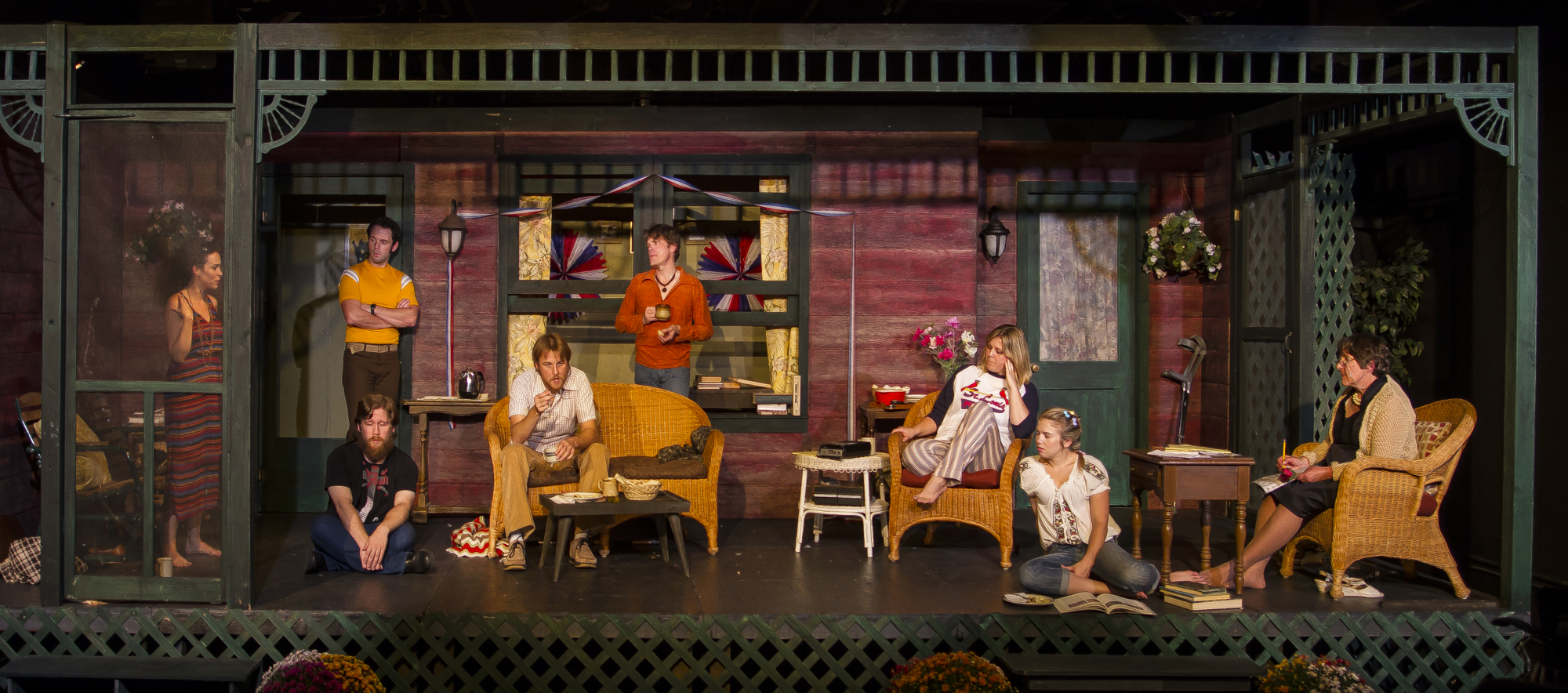
(left to right) Meg McLynn, Alex Garnett, Zach Sanders, Chris Shea, Tom Stewart, Megan Ahiers, Rachel Sedwick, and Mary Machala

(left to right) Meg McLynn, Alex Garnett, Zach Sanders, Chris Shea, Tom Stewart, Megan Ahiers, Rachel Sedwick, and Mary Machala

When he was ready to realize his dream of launching a new theater company in Seattle, director, actor, and teacher Corey D. McDaniel chose a play that centers around rich and complex ensemble acting for their first outing. Theatre22‘s declared mission to serve as “a meeting ground” emphasizes the power of artistic collaboration. And the company’s inaugural production of Fifth of July unquestionably puts its values to the test.

Lanford Wilson’s landmark play from 1978 is a richly textured meditation on the ties and tensions between a circle of highly individual characters coping with the emotional scars of disillusionment – and, in the case of Kenny Talley, a vet who lost his legs in Vietnam, the physical scars as well. Ken has taken temporary refuge in the now-rundown family homestead in rural Missouri which is his inheritance. Kenny’s lover Jed, a creative gardener, is painstakingly restoring the surrounding landscape, but the impulse toward stability Jed represents is countered by the events of a long Independence Day’s journey into night.
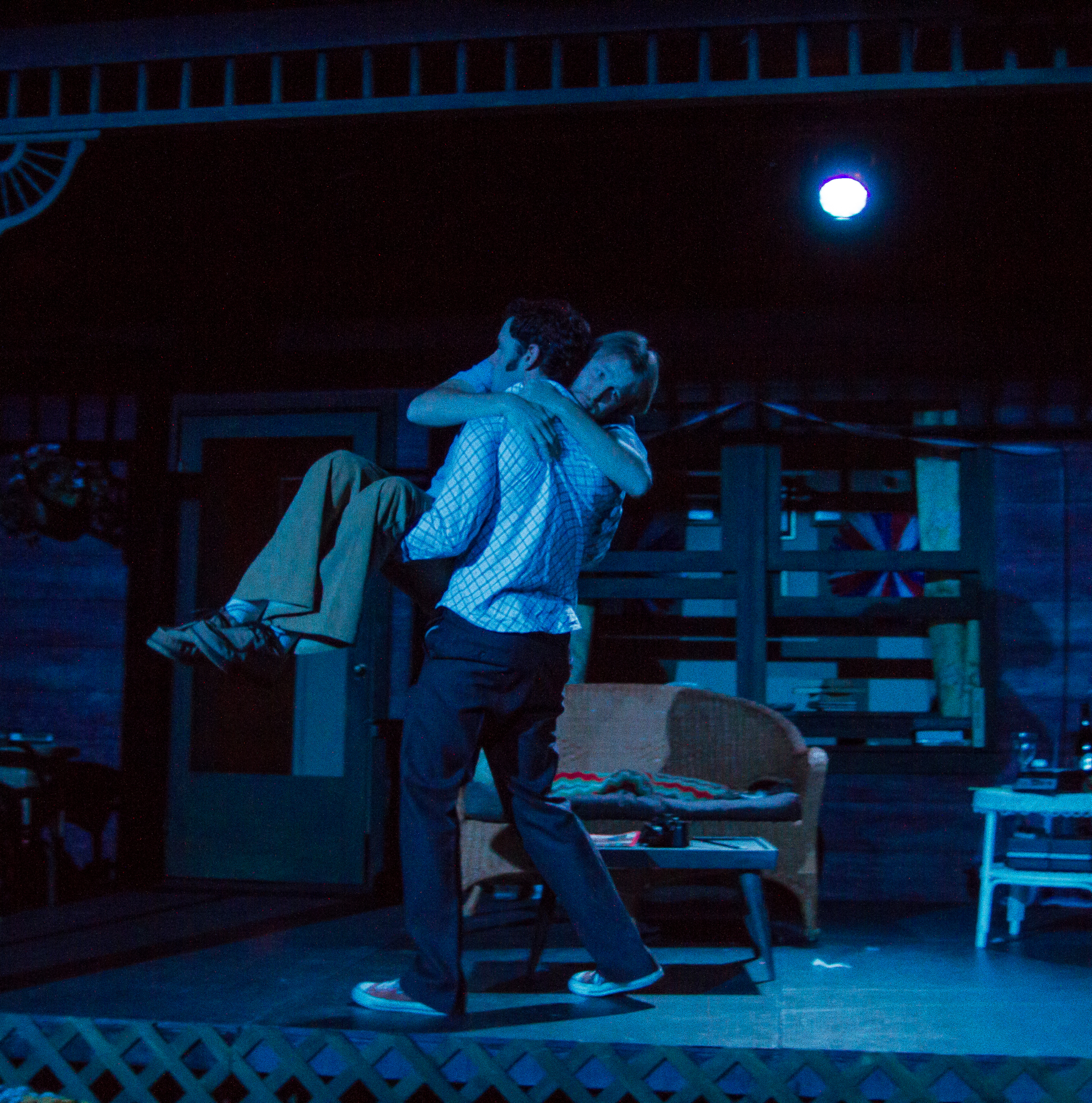
Chris Shea and Alex Garnett as Kenny and Jed

Chris Shea and Alex Garnett as Kenny and Jed

Among the holiday guests are Kenny’s sister June and her precocious teenage daughter, their Aunt Sally, and friends from their shared past as erstwhile radical students at Berkeley in the 1960s: the smooth-talking John Landis (who was sexually involved with brother and then sister) and his wealthy wife Gwen, whose big business trust fund didn’t prevent her from accessorizing trendy ’60s-style Marxism back in the day. Now, though, Gwen’s dreams have turned toward a career as a country singer, and her trusty guitarist Wes has accompanied her for the visit.

Borrowing a framework from Chekhov, Wilson establishes dramatic stakes that outwardly revolve around the proposed sale of the Talley home. John and Gwen hope to buy the farm to transform it into a commercial recording studio. But its metaphorical significance – the symbol of Ken’s unrealized potential and also of the past, of the collective memory whose meaning is up for grabs – intensifies the moral weight of the outcome. (Wilson, who died just two and a half years ago, went on to expand his drama of the Talleys into a trilogy, writing two more plays about the Talley family’s past, which take place in the 1940s.)
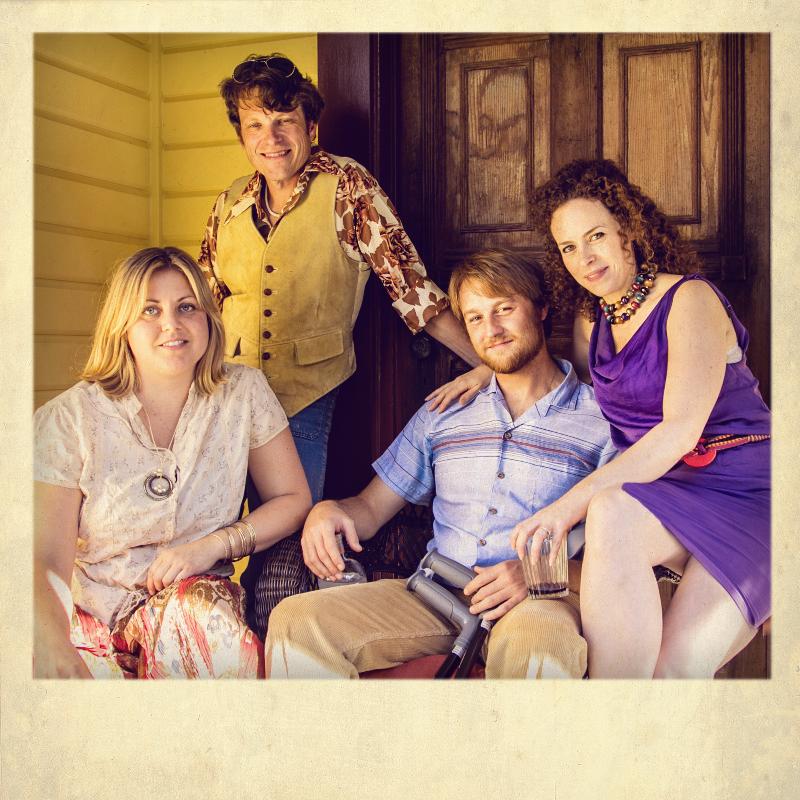
Fifth of July cast: Megan Ahiers, Tom Stewart, Chris Shea, and Meg McLynn; photo by Robert Falk

Fifth of July cast: Megan Ahiers, Tom Stewart, Chris Shea, and Meg McLynn; photo by Robert Falk

Director Julie Beckman is well attuned to the musical method of Wilson’s writing: like a tapestry of solo instrumentals emerging from the ensemble, different characters unexpectedly detach and come into the foreground to riff on a particular – not necessarily related – theme, only to gently recede while the focus turns elsewhere. A persistent challenge is making these transitions plausible and seamless: at times the production makes them feel too abrupt. There’s a lot of sensitive attention to detail in these monologues, and to their alluringly poetic blend of pathos and eccentric humor. The overall pacing, though, especially in the first act, has a tendency to slacken. As with Chekhov, finding the right tempo for Wilson is an extremely subtle undertaking.

Yet the connections and frustrations that are key to Fifth‘s momentum are vividly realized by the cast. Chris Shea, while tending toward a one-note approach to Kenny’s bitterly ironic tone, is genuinely moving in the final scene when – with beautiful symmetry – he is persuaded to stay by Gwen (a gloriously larger-than-life fuck-up in Meg McLynn’s portrayal). As his boyfriend Jed, Alex Garnett is the force that grounds Kenny, but he also underlines the significance of his rapport with Aunt Sally – and thus is the linchpin who holds this fragile family together. Megan Ahiers conveys sister June’s lingering insecurity; as her uber-curious daughter Shirley, Rachel Sedwick toggles between bratty tantrums and wise-beyond-her years remarks.

Aunt Shirley is meant to embody the contradictions that define the Talley family – or the braver exemplars of the clan – and the link to a past whose meaning has become painfully dubious. Mary Machala shows her as a dreamy eccentric, bruised in her own way and thus in league with her nephew Kenny. Tom Stewart emphasizes John’s sleazy swagger, but he comes off a tad too nice for the cutthroat competitor who has apparently shucked his Age of Aquarius idealism with no qualms. Zach Sanders has a few show-stealing moments as the space cadet Wes – including his famous monolog about the ill-fated Eskimo family.

The fine black box space of Fremont’s West of Lenin underscores the intimacy of this production and the details of Michael Mowery’s picture-frame unit set and Jordan Christianson’s spot-on costuming (complete with unironic bell-bottoms sported by John). Tim Moore’s sound focuses on the music – mostly a blast from the past – though I would’ve also welcomed some environmental sounds for a sense of place. Robert Falk’s lighting traces the first act’s woozy trailing off into memory as the national holiday fades into night, followed by the uneasy promise of the morning after.

It all makes for an impressive inaugural production. And Theatre22 has mapped out some ambitious plans for later in the season: in February comes a new musical titled The Hours of Life by Paul Lewis, based on Edgar Allen Poe, which will be directed by Corey McDaniel; and Terrence McNally’s The Lisbon Traviata is slated for this coming June, directed by Gerald B. Browning.

If you go: Fifth of July plays through October 26 at West of Lenin in Fremont. Tickets online

Corey McDaniel (producer) and Julie Beckman (director); photo by K. Lindsay
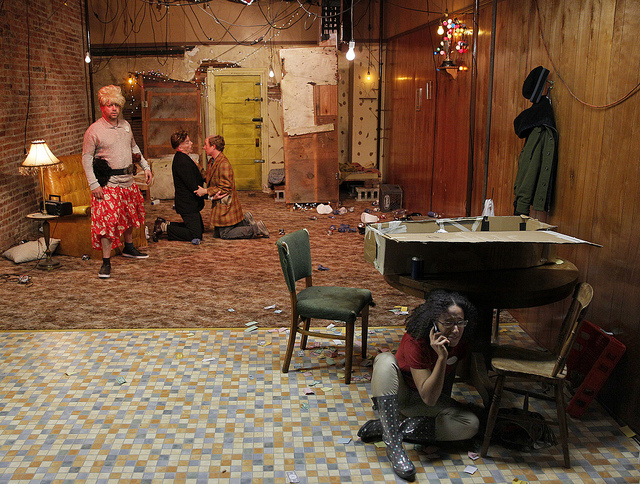
Corey McDaniel (producer) and Julie Beckman (director); photo by K. Lindsay

Filed under: review, theater

What a Story: Enda Walsh’s Walworth Farce

NCT's "The Walworth Farce"; photo by Chris Bennion

NCT’s The Walworth Farce; photo by Chris Bennion

For its fall production, Seattle’s enterprising New Century Theatre has chosen Enda Walsh’s The Walworth Farce. Here’s my review for Crosscut:

Talk about a repetition compulsion: For the first half of The Walworth Farce, New Century Theatre’s latest adventure, a father and his two grown sons run through the lines of the play they reenact day after day – an absurd, antic ritual involving a mock procession with a cardboard coffin, constant prop swaps, dizzying identity changes and a hidden “fortune” of shredded Monopoly money.

In the confines of their squalid South London council flat, Dinny (Peter Crook) is the paterfamilias and dictatorial writer-director of the script he and his sons Sean (New Century Theatre artistic director Darragh Kennan) and Blake (Peter Dylan O’Connor) perform day after day. Dinny keeps his boys’ eyes on the prize, egging them on to compete for a chalice-like trophy that will go to that day’s “best actor.” But snafus inevitably occur, and the ritual has to be reorganized.

Dinny’s play is the thing that’s supposed to keep them all safe. It recounts the story, fable repeated until it’s taken as fact, of how this insular family unit was forced to abandon their idyllic home back in Cork. We also learn how Mother was killed in a bizarre accident involving a dead horse. They’ve been living as exiles ever since, surrounded by “savage” Londoners and holed up on the top floor of a grimy, stairless high-rise.
“What are we without our stories?” wonders Dinny by way of justifying the outrageous fiction he’s used to paint over what actually happened – and the real world kept at bay by a half-dozen deadbolts on the flat’s front door.

continue reading

Filed under: playwrights, review, theater

george WASHINGTON

Roger Reynolds, 2005

Roger Reynolds, 2005

Despite the recent government shutdown, this month’s world premiere of george WASHINGTON by the National Symphony went ahead as scheduled. Here’s the essay I wrote for the program:

“I believe all things will come out right at last, but…the people must feel before they will see.” These words of George Washington (1732-1799), observes Roger Reynolds, might serve as the epigraph for his new composition. They occur in the final section of the libretto for george WASHINGTON, which Reynolds carefully selected and assembled from the diaries and letters of the iconic figure. In comparison with Washington’s relatively “wooden” speeches, which represent a “publicly constructed persona” intended to shield his imposing image, these more intimate sources proved to be a wellspring: “I was staggered by his wisdom, his sensitivity, even his ability to be poetic and to make emotively potent statements.”

The priority of experience as the gateway toward true understanding, Reynolds adds, is an idea that recurs in Washington’s writings, but it also expresses the composer’s own goal for the work. He envisioned george WASHINGTON as a multimedia amalgam of orchestral music, narration, visual projections, and computer-processed “surround” sound. All of this elaborate technical apparatus, in the end, is meant to provide an immersive experience that can “provoke the imagination and arouse in the audience some sense of their own relationship to Washington as a human being. It’s not about giving a history lesson but about trying to enter into Washington’s world.”

continue reading

Filed under: commissions, music news, new music, orchestras

Remembering Toby Saks

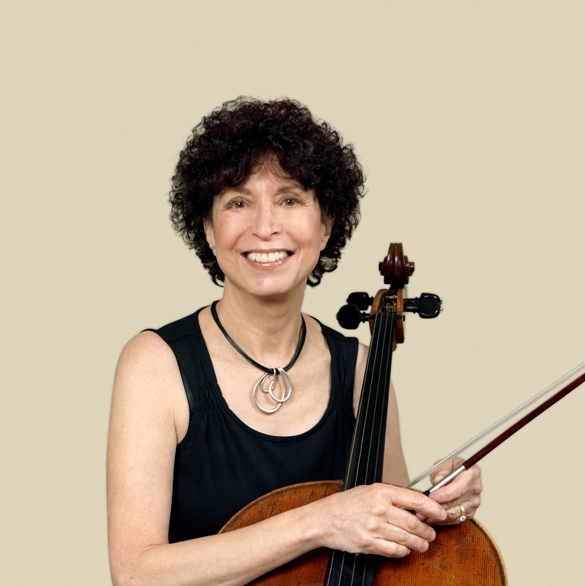
Toby Saks

Toby Saks

Yesterday evening Seattle’s Benaroya Hall was the gathering place for a large crowd of musicians, music lovers, friends, and members of a very extended family who were there to commemorate Toby Saks. She died two and a half months ago, just after a particularly successful edition of the annual summer Seattle Chamber Music Society Festival, her baby, had come to an end.

Toby Saks’s legacy as a cellist, educator, festival organizer, champion of new talent, and overall remarkable human being was recalled last night from many different angles. There were moving personal anecdotes from her circle of friends and peers. Most significantly, the event centered around performances featuring a combination of local musicians and others traveling from around the country — over 60 musicians, all told. They made it clear that it is through living music most of all that Toby would want to be remembered.

Quite a few were wearing buttons custom-made with a photo of the cellist smiling and the inscription “I’m Here for Toby.” The official program was framed by excerpts from Toby’s extensive archives — performances restored from reel-to-reel tapes and converted to digital format by her brother, Jay David Saks, a musical producer for the Metropolitan Opera.

Toby Saks - (c)Seattle Chamber Music Society

Toby Saks – (c)Seattle Chamber Music Society

One of the restored pieces listed in the program was of the Dvořák Cello Concerto as recorded by Toby at 19 with the Kol Yisrael Symphony Orchestra (in Jerusalem, 1961). Gerard Schwarz, the Seattle Symphony’s conductor laureate, spoke eloquently of the first time he had heard her playing, which happened to be this very work. It took place at the High School of Performing Arts in New York – her alma mater, where Schwarz was then studying – as Toby as en route to participating in and winning the Pablo Casals Competition in Israel.

Schwarz reminded us that Toby was among the very first women cellists of the New York Philharmonic and noted the many ways in which her musicality continued to astonish and inspire him throughout their decades together in Seattle. Schwarz himself led a string orchestra (some Seattle Symphony players with mostly SCMS associates) in a rich-voiced account of the “Elegia” movement from Tchaikovsky’s Serenade for Strings to open the celebration. For all the sense of loss and the meditative, even solemn character of most of the musical selections, that’s exactly what the event was: “This is a celebration of life,” her husband, Dr. Martin Greene, reminded everyone. “It’s not about mourning.”

Greene introduced a video tribute looking back over Toby’s 30 years heading the Chamber Music Festival she had founded in 1982. Her fellow musicians competed to outdo each other with their praise and gratitude for how much she had influenced their lives, their careers, converging on a shared theme of “Mama Tobs” as an insatiably generous and passionate advocate for music. Violinist James Ehnes, who took over as artistic director of SCMS two years ago, described what a vital force she had been, operating a complicated network and interacting with hundreds of musicians through the years. Robin McCabe, director of University of Washington’s School of Music, recalled Toby’s “feisty” vitality and fierce love of her students.

Of the many remarkable musicians who were on hand to perform in Toby’s honor, cellist Robert deMaine’s performance of the Largo from Chopin’s Cello Sonata (with pianist Jon Kimura Parker) struck me as especially heart-felt, to the point that his warmth of phrasing seemed to be speaking directly to Toby – cello to cello, as it were.

Toby Saks

A particularly notable moment was the premiere of a new piece, spontaneously composed in memory of Toby Saks by Lawrence Dillon as soon as he learned of her passing. Dillon had gotten to know her only recently in connection with the chamber work he was commissioned to write for this past summer’s festival. His Passing Tones, for three cellos and violin (Ehnes and deMaine, Jeremy Turner, and Andrés Díaz). This compact, elegiac essay carried a poignant reminder of the principles of ensemble and the individual voice, the creative tension between them, that’s at the heart of chamber music making – and about which Toby was so passionate.

Martin Greene introduced the closing number, remarking there could be no better way to end than with a composer his wife especially loved, rendered by an orchestra of her favorite instrument, the cello. And so 19 cellists took the stage, with Schwarz again conducting, to play the arrangement by Heitor Villa-Lobos of Bach’s Prelude No. 8 in E-flat minor from Book One of the Well-Tempered Clavier. A prelude, not a postlude, speaking worlds about the enduring ways in which Toby touched the lives of those around her.

Filed under: chamber music, new music

Pick-Up Poetry

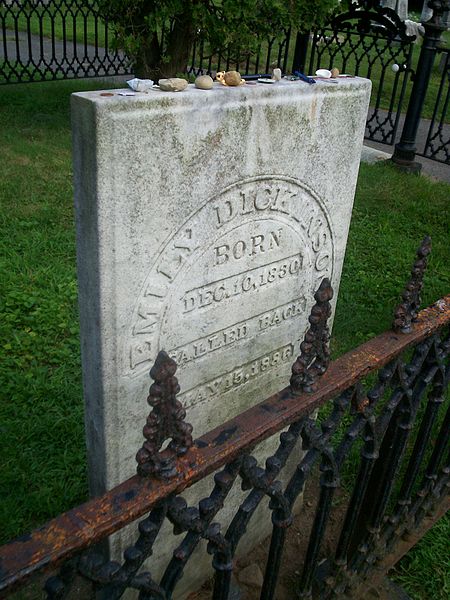
"Back from the cordial grave I drag thee"

“Back from the cordial grave I drag thee”

Poetry’s ties with romance are ageless, but nowadays the connection tends to evoke sappy clichés and, at worst, Hallmark card-style confections. So why not add some panache by filling your quiver with lines from the great poets?

Or maybe not… Over at The Hairpin, Lizzy Straus recently compiled a list of first lines from Emily Dickinson poems not likely to be very useful as pickup lines. These especially should probably be excluded from your speed-dating repertoire:

144 – I never hear the word “Escape”
260 – I’m nobody! Who are you?
303 – Alone I cannot be
332 – Doubt me! My dim companion!
336 – Before I got my eye put out
339 – I like a look of agony
407 – One need not be a chamber to be haunted
456 – A prison gets to be a friend
591 – I heard a fly buzz when I died
1050 – I am afraid to own a body
1649 – Back from the cordial grave I drag thee

See Lizzy’s complete list here.

But then, what about that epitome of the love poem, the Shakespearean sonnet? Would these lines from the Bard do any better than Emily Dickinson’s?

As fast as thou shalt wane, so fast thou grow’st
Thy glass will show thee how thy beauties wear
I grant thou wert not married to my Muse
Whilst I thy babe chase thee afar behind
Sin of self-love possesseth all mine eye
In faith I do not love thee with mine eyes

Filed under: poetry

Preserving America’s Sonic History

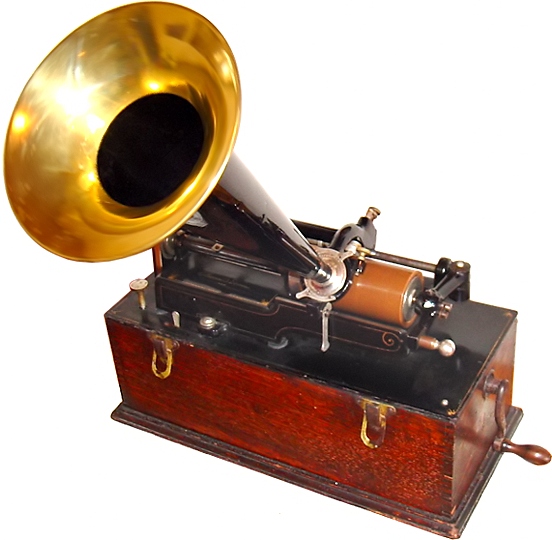
Edison home phonograph, c. 1899

Edison home phonograph, c. 1899

William Hochberg takes a look at a new initiative to preserve important American musical documents that have fallen between the cracks as recording technology continues to evolve:

In this era where cultural products seem to live forever digitally, the fear of music becoming lost to time may seem distinctly outdated. But efforts to preserve America’s audio history have never been more active than they are right now. Jack White has become the public face of these efforts, recently donating $200,000 to the National Recording Preservation Foundation, affiliated with the Library of Congress. He sits on the board with producer T. Bone Burnett, Sub Pop label founder Jonathan Poneman, legendary engineer George Massenburg and other music luminaries. What, exactly, are they trying to save? Turns out, a lot: Their ambitions are nothing smaller than protecting the entirety of America’s sonic history.

…Untold tons of original recordings have fallen into the dumpster of history since Thomas Edison perfected the phonograph 125 years ago. “There are stories of early phonograph companies taking apart the masters used to press wax discs so they could be sold as roofing shingles,” White says. “They didn’t think a recording was a document of anything cultural. It was just a way to sell phonographs.”

…As Voyager 1 speeds away from our solar system carrying a gold-plated disc with music of Mozart and Blind Willie Johnson among others, the NRPF goes about its mission back on Earth. “We are charged with looking over the entire nation’s recorded history, and not only music, but interviews, radio news broadcasts, anything that’s ever been committed to a recordable media,” says NRPF executive director Gerald Seligman.

Filed under: recording industry, technology

Will Get Fooled Again: Verdi’s Humanist Farewell

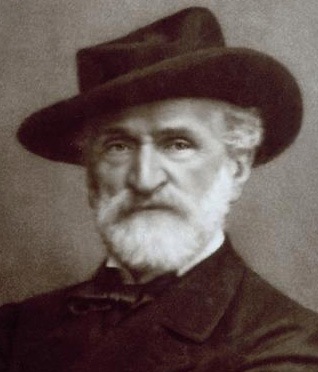
Giuseppe Verdi

Giuseppe Verdi

At least we know Giuseppe Verdi was a Libra. But no one knows for sure whether his actual birthday 200 years ago was October 9 or 10 — and why shouldn’t he get two birthdays in this year celebrating his legacy?

For my own little tribute, here’s an essay I just wrote for Los Angeles Opera’s upcoming production of Falstaff:

Whoever laughs last, laughs best—or, in the more elegant formulation by Arrigo Boito, author of Falstaff’s libretto: Ma ride ben chi ride / La risata finale. And in more than half a century of writing for the stage, Verdi has the last laugh with the ultimate joke: a fugue, that emblem of a fuddy-duddy, old-fashioned, academic, Teutonic sensibility, a virtual non-sequitur vis-à-vis the Italian operatic tradition he had inherited.

Yet the fugal capstone to Falstaff is a perfect and ingenious choice, theatrically and musically. After Sir John has been punked and had his drubbings, he’s the one who leads off the fugal chain reaction, as the entire ensemble joins to celebrate our shared humanity. Itamar Moses’ 2005 play Bach at Leipzig attempted to dramatize the fugue’s inherent theatricality—the way it wrests reconciliation from entanglement—but Verdi’s merry pranksters buoyantly sail free of any regrets, proving the power of his art to set the world right (at least for the illusory moments until the house lights come back on). Jester and jest become one. The rigorous form morphs into a bubbly champagne, ending with the orchestra’s zippy final chords. If Verdi alludes to the choral setting-things-straight culmination of Don Giovanni, he also seems to hint at the clear blue skies of Mozart’s “Jupiter” Symphony—albeit his is a punch-drunk Jove.

continue reading

Filed under: opera, Verdi

Alan Ayckbourn in Seattle with Sugar Daddies

Ayckbourn_copyright_Tony_Bartholomew

My recent interview with Alan Ayckbourn for Crosscut.com is up. Here’s a fuller version with some extra material that got cut in editing:

Since 1976, ACT Theatre has produced ten plays by Alan Ayckbourn – and that’s just a fraction of the 74-year-old English playwright’s catalogue. But this fall’s production of Sugar Daddies (2003) brings Seattle not only the honor of a North American premiere, but the presence of Sir Alan himself in his West Coast debut as a director. (He was knighted in 1997.)

Like most of his work, “Sugar Daddies” premiered at the Stephen Joseph Theatre in Scarborough (on the coast in North Yorkshire). Ayckbourn has maintained close ties there since early in his career, writing for its theatre-in-the-round configuration – a staging style he prefers. He stepped down as artistic director at the end of 2008 but lately appears to be busier than ever at the SJT with his projects as visiting director.

Ayckbourn’s breakthrough hit came with the London production in 1967 with Relatively Speaking, a fresh, hilariously constructed twist on the well-worn gag of lovers caught in a web of mistaken identity. (“The critics were shocked to see French windows instead of the kitchen sink – it seemed slightly reactionary,” he jokes.) Here already was the characteristic Ayckbournian touch, with its preoccupation with role playing and marital discontent. Some claim him to be one of “the world’s most-performed living playwrights,” though Ayckbourn’s own website points out “there is actually no plausible way to prove this statement.”

But what sets him apart is that his undeniably widespread – and sustained – popularity goes hand in hand with his untiring experimentation with theatricality and stagecraft.

And while he is usually thought of first and foremost as a comic master, Ayckbourn’s plays have become significantly more complex over time. Sugar Daddies in particular mingles satire and clever dialogue, taking a dark slant on a youth and beauty meets age and power scenario.

Emily Chisholm; photo by Nate Watters

Emily Chisholm; photo by Nate Watters

Set in the contemporary London flat shared by half-sisters Sasha and Chloé, the play explores how they are affected when the younger, naïve Sasha is befriended by the elderly Val (old enough to be her grandfather). His extravagant gifts and nights out to the opera distract her from asking too much about Val’s sinister background – even when she’s warned by Ashley, their one-eyed neighbor and a former cop whose own past connection to Val is veiled in mystery. Ayckbourn’s absurd yet meticulously crafted symmetries resemble a cautionary retooling of Cinderella, where sudden shifts in fortune prove too good to be true.

I met up with Sir Alan during a break from rehearsal to talk about Sugar Daddies, his remarkable career and the future of theatre.

TM: How were you persuaded to come to Seattle – and what made you choose Sugar Daddies in particular to show audiences here the director side of your career?

AA: It has been brewing for some years. When [ACT artistic director] Kurt Beattie came over to visit me in England, he slid me a schematic of the Allen Theatre, which is not so far removed from our own theatre in the round in Scarborough. [The 404-seat Stephen Joseph Theatre.]

The ethos [of ACT] is very close to it. Both are interested in new writing, but are also very egalitarian – not like the old style, where the stage management were below stairs, the actors upstairs. And much more friendly. I’ve gotten asked dozens of times in England, “Why are you going to Seattle?” And I said, “Because they asked me!”

I chose “Sugar Daddies” as a play that hasn’t been done here and that I would like to revisit. From my knowledge of working in the States, it’s the sort of play American actors could embrace. Some of my plays are so English you’d spend most of the rehearsal period explaining the class system. We are doing [Sugar Daddies] as set in England, but nonetheless it’s fairly universal in its concerns.

TM: It’s probably a bit of a surprise to many who love your plays that you actually spend much more of your time on directing than writing. Yet somehow you’ve managed to remain a wildly popular and prolific writer (77 full-length plays and counting).

AA: I’ve had three careers in theatre: I started as an actor and then took, as I call it, the “poison chalice” of directing. Once you feel you’re in control as a director, it’s harder to go back to acting. The directing career developed quite independently from my writing career at first. Then the two almost inevitably merged, but quite later on.

The rehearsal room can be quite a hostile place … if the actors suspect you don’t know what you’re doing. It takes quite a lot of experience before you can confidently handle a whole room of actors – particularly because they are often rather eccentric and extraordinary individuals. I do spend more time in the rehearsal room than at my computer these days.

Over the last few years I’ve tended to direct a minimum of two plays a year, one of which is always a revival from my back catalogue. And I’ll use the revival as a pro forma for the new play. Last year I did a revival of Absurd Person Singular, and on the back of that I wrote a new six-handed play, Surprises [both plays call for 3 men and 3 women].

TM: In a sense, Sugar Daddies is about the art of theatre itself, the way we’re constantly playing roles, whether we are aware or want to or not.

AA: I was fascinated at the way we pretend, we select. It’s best summed up by when you’re very young and you meet a girl and the inevitable moment comes when you want to take her back to meet the parents. And then you’re thinking, “How am I going to look against the backdrop of my parents, who still look at me as 8 years old?” And she’s thinking the same thing: “My whole illusion of myself is going to be shattered.”

People like Sasha respond to other people she senses have an expectation of her. She in turn has an image of old people as being friendly. “Uncle” Val is trying to put a very dark past behind him, and Sasha presents him with an edited version of herself. It’s not a deliberately deceitful thing – though I think, in Uncle Val’s case, it may be. For most of us, it’s a presentation of ourselves, which we sense the other is expecting.

For example: as a director, actors don’t want to meet you socially if you’re rolling drunk. Not that they actually think you are infallible, but they like to assume a state of infallibility. If you go out of your way to encourage that, with a confident manner, it helps.

TM: So no drunk Tweeting once rehearsals have started! But what you describe sounds almost like the same dynamic you show Sasha experiencing. She’s looking for some kind of approval and validation from her Sugar Daddy Val.

AA: It touches on the old Faust legend of selling your soul to the devil. A lot of the play is set up so you’re asking, is she going to go down the path of eternal damnation with Uncle Val or is she going to find a way out? Fortunately, there is a turning point and a momentary glimpse of the monster. It’s not that Sasha doesn’t know about that [part of him], but she chooses not to know about it. The pleas of ignorance – we do a lot of that; it’s a considerable human characteristic.

TM: One recurring idea in critiques of Sugar Daddies is the issue of the play’s tonality. Critics have seemed confused by its mixture and want to have it both ways: a dark, confectionless, yet somehow entertaining play. For the ACT production, you’ve even decided to rewrite the final scene between Sasha and her half-sister Chloé.

AA: Rereading the play, I thought Sasha goes through this experience pretty well unscathed. She escapes with just a singe. I wanted those last few moments to show that there’s part of Uncle Val that’s been left with her. If you’ve supped with the devil, you’ve probably burnt your tongue.

John Patrick Lowrie as ex-cop Ashley; photo by LaRae Lobdell

John Patrick Lowrie as ex-cop Ashley; photo by LaRae Lobdell


Val is probably the most evil character I’ve written. For some reason all my evil characters seem to begin with V: Uncle Val, Vic [Man of the Moment], Vince [Way Upstream]. It’s a strange little motif. The man playing it in Scarborough said, “This must be the most evil man I’ve ever played.” He comes from that old-style East End gangster mode; he’s a capo, a don.

There is a sense that Sasha is refreshingly clear-eyed at the beginning, the “country mouse” who has come into the city, while Chloé is an exaggerated “town mouse” — probably one of those people in the media who are always competing furiously. But she has a sort of mistrust of human nature by the end – something you see in children growing up. Sasha’s not quite the girl she was at the beginning; there is a sort of ruthlessness about her.

TM: Among other modern playwrights, who would you single out as the great “bards” who will last?

AA: I’m a great admirer of David Hare and Alan Bennett. One of the writers that had the most profound effect on me, when I was directing other people’s plays, was Arthur Miller. The great thing about being a writer directing other people’s work is that as a director, you’re more or less compelled to take the play apart in order to put it together again with the actors. You see the mainspring here, the cogs there. Miller was a terrific craftsman and had a brain on him the size of Britain.

I was very lucky I grew up at the crossroads for English drama. So I absorbed a lot of the old-fashioned, well-made plays, and then came [John] Osborne and [Harold] Pinter, who was an enormous influence of me. I even acted in an early production of The Birthday Party, which he directed. He was an extraordinarily unique voice. So I’m influenced by the Chekhovs through to the Pinters really. I was blessed with a double upbringing.

TM: You’ve remained remarkably loyal to theatre as an art form, while so many of your colleagues – not to mention younger writers – have gone over to the commercial payoff of TV, Cable, film. What does the future of theatre look like to you?

AA: There’s a bright curve of new dramatists coming up in England. I do think, because of the non-encouragement of new writers, there’s a danger in our theatres now of [these writers] not addressing the challenges of theatre, but of trying to adapt television and film ideas. I used to sit at my desk and read 3 or 4 plays a week. My heart used to sink if there was a play with 26 scenes: Where’s the conciseness of theatre?

And there is a veering towards monologue, which is quite popular now — not just as a dictate of economics, but a preference of dramatists. When I was teaching, I used to try to point out all the colors of the theatre palette. My mentor Stephen Joseph told me, “Yeah, break the rules, but first of all you’ve got to know what they are!” So he sat me down and made me write a well-made play. At least I’d been through the process, and I’ve been breaking the rules ever since.

Filed under: playwrights, theater

A Little Piece of Mexico

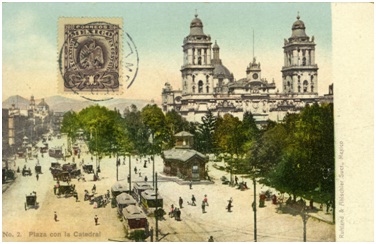
Plaza con la Catedral

Plaza con la Catedral

At the main Civic Center location of the San Francisco Public Library the other day, I chanced upon this exhibit:
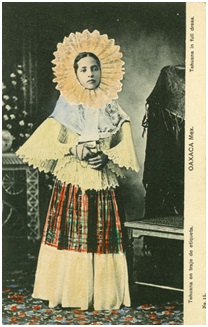
A Little Piece of Mexico: The Postcards of Guillermo Kahlo and His Contemporaries. On display is an intriguing range of images from the private collection of San Francisco’s poet laureate Alejandro Murguia. They make it clear why Mexico proved so attractive to photographers and other artists seeking a fresh perspective around the turn of 19th/20th century — like German immigrant Guillermo Kahlo (father of the artist Frida Kahlo).

The enormous new market for postcards left a de facto visual record of Mexico right before the upheaval of the revolution in 1910. These postcards were sold at the tourist sites, of course, but they were also easily obtained at cafes, bookstores, even bus stops. The exhibit’s introduction explains what makes them unique:

Mexico in the early 1900s was practically unknown territory, rich in a diversity of people, customs, and ethnic dresses and a place of conflicts and wars, generals and traitors, beautiful women and dangerous men, stunning landscapes, volcanoes, rivers, baroque architecture and thousand year old pyramids. All of it engaging to the eye and the camera.

As old-fashioned written letters and postcards become increasingly obsolete, these tokens of the past acquire an additional aura that would have seemed so odd when they were just everyday, mass-produced objects.

Tehuana in Full Dress

Tehuana in Full Dress

Filed under: art exhibition

Peter Lieberson’s Final Word: Shing Kham

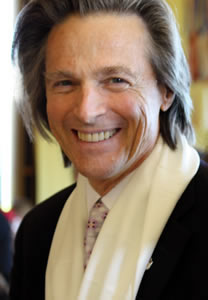
Peter Lieberson

Peter Lieberson

I can’t believe it’s been over two years since the passing of Peter Lieberson, a truly wonderful human being and a highly gifted artist. He had so much still to say when he left us.

For the posthumous Los Angeles Philhamonic premiere of Peter’s percussion concerto, Shing Kham, I had the unique privilege of being able to write about his final — but unfinished — word as a composer. I’m so grateful to Peter’s widow Rinchen Lhamo and the marvelous percussionist Pedro Carneiro for sharing their memories and insights regarding what Peter was thinking about when he worked on the score up until his untimely death in Tel Aviv on 23 April 2011.

Here’s the note I wrote for the LA Phil’s concerts:

For Peter Lieberson, working on what would be his final composition “was a life-sustaining and joyful activity,” according to the writer Rinchen Lhamo. She adds that it’s likely Pedro Carneiro’s “unique capacities as a percussionist had something to do with this: something brand new for Peter to wrap his mind around.” Lhamo was Lieberson’s wife when he died from complications of lymphoma in April 2011. Although he had been in treatment for some years, she recalls that her husband anticipated being able to complete Shing Kham up until his last bout of illness, which arrived suddenly and unexpectedly. Several other projects on the horizon – including an orchestral song cycle he planned to compose to poems by Lhamo – additionally indicate the resurgence of creative energy that accompanied work on the percussion concerto.

continue reading

Filed under: music news, new music, spirituality

Archive

Enter your email address to follow this blog and receive notifications of new posts by email.