Composer James Newton Howard (Eric Charbonneau / Invision / AP)
For The Seattle Times: my look at the Seattle Chamber Music Society’s commission for the 2018 Summer Festival: a new piece by veteran film composer James Newton Howard:
It would be hard to underestimate how pervasively film composers shape the general public’s image of what classical music “sounds like.” …
Such sad news today of the death of Oliver Knussen, only 66 years old. This prodigious, spectacular, generous, multifaceted genius left a mark that will endure.
“Besides definitive interpretations of his own music, he must surely have given more first performances than any other conductor, alongside an outstanding body of recordings. He was the central focus of so many activities, and an irreplaceable mentor to his fellow composers, who constantly sought and relied on his advice and encouragement.” Colin Matthews inThe Guardian
“’He has had a fertilizing and energizing effect on the whole of British music for the last 40 years,’ the composer George Benjamin, a longtime friend and colleague, said in a telephone interview. ‘We have a lively and varied contemporary music world here in the U.K., and a lot of it is owed to him, because of the immensely generous encouragement he gave to generations and generations of composers.'” (from the New York Timesobituary)
Faber Music’s summary of Knussen’s career is here.
Haunted by this work now, which was positioned in the middle of last night’s Summer Festival of the Seattle Chamber Music Society — in an enthralling performance by Seattle Symphony principal cellist Efe Baltacıgil and pianist Adam Neiman.
The program also included Beethoven’s “Spring” Sonata (Augustin Hadelich and Alessio Bax) and a winning account of Schumann’s E-flat major Piano Quintet (Andrew Wan, Benjamin Beilman, Jonathan Vinocour, Astrid Schween, George Li).
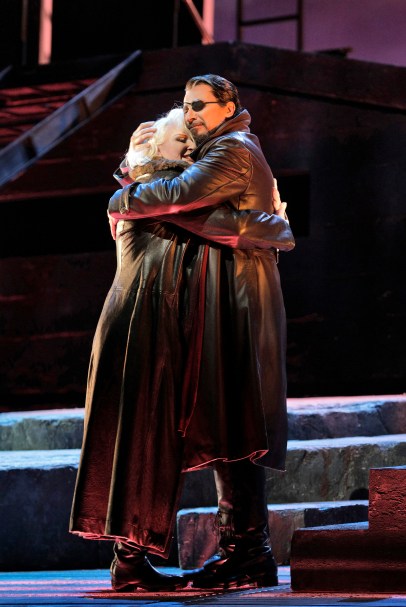
Iréne Theorin as Brünnhilde with members of the San Francisco Opera Chorus in Wagner’s “Götterdämmerung.” Photo: Cory Weaver/San Francisco Opera
Here’s the final installment of my coverage for Musical America of San Francisco Opera’s extraordinary Ring cycle.
SAN FRANCISCO—If Siegfried highlights Zambello’s ability to tease out vital, three-dimensional characters from a deceptively simple surface, Götterdämmerung shows her clarifying the most complex component of the entire cycle–an installment which introduces an entire generation of characters new to the Ring–with a gripping theatrical momentum. The night/day dichotomy of the Prologue aptly summed up the diametrical viewpoints of this staging…
Daniel Brenna as Siegfried and David Cangelosi as Mime in Wagner’s “Siegfried.” Photo: Cory Weaver/San Francisco Opera
Continuation of my coverage of San Francisco Opera’s Ring for Musical America:
SAN FRANCISCO—From an emotional force akin to Greek tragedy to the straightforward exploits of a superhero: for a director, one of the main challenges posed by the Ring’s third evening is how to bridge that gulf, all the while clarifying the stakes in Siegfried so that the audience will buy into the return to full-on tragic mode in the cycle’s mammoth finale….
continue [behind Musical America‘s paywall — but will be open access Friday afternoon]
Part 1 here
What a coup for Zurich Opera: Gianandrea Noseda has accepted Andreas Homoki’s invitation to become chief conductor at Zurich Opera, following the travail at Teatro Regio in Turin, Italy, which led Noseda to resign his post there.
According to Michael Cooper for the New York Times: “Mr. Noseda thought it over, and decided that the chance to conduct Wagner’s epic Ring cycle for the first time, in a new production, was impossible to refuse.”
And so lured by the Ring, Noseda will start his post in 2021 as general music director in Zurich, succeeding Fabio Luisi (himself off to take the reins at the Dallas Symphony). The Ring will follow in the spring of 2022.
Christian Wildhagen has published a very interesting interview for the NZZ (in German). The maestro explains at greater length what, in addition to the prospect of doing a Ring, is so attractive about the post (my translation):
The “Ring” remains the central challenge for every opera conductor and every major house — one of the greatest challenges ever. But overall I am also tempted by the opportunity to work with the musicians of the Philharmonia intensively on the so-called German repertoire. I already did a “Tristan” at my previous house, the Teatro Regio Torino, as well as “Salome” by Richard Strauss and, three years ago, a “Lohengrin” in St. Petersburg. The opportunity to expand on these explorations in Zurich, in the center of German-speaking Switzerland, makes the invitation particularly appealing to me. All the more so since the timing for this artistic development seems to coincide with my personal journey.
Iréne Theorin as Brünnhilde and Greer Grimsley as Wotan in Wagner’s “Die Walküre.”
Photo: Cory Weaver/San Francisco Opera
Here’s Part 1 of my review for Musical America of San Francisco Opera’s Ring, directed by Francesca Zambello and conducted by Donald Runnicles:
SAN FRANCISCO—One sure gauge of a successful Ring production is when it consistently leads you to a liminal state: to a kind of hovering between rapt focus on the moment and deliberation about what it all implies. Over the course of San Francisco Opera’s Ring, I found myself taking that threshold for granted, encouraged to ponder the connections, musical and dramatic, that are essential for Wagner’s project to make its desired impact.
The wonderful American composer George Walker turns 96 today. And he’s still very much at work, with a symphonic world premiere coming up in the new Seattle Symphony season: Sinfonia No. 5, in which he reflects on the massacre at a Charleston church in 2015.
The clip above is from a 2012 interview, just before George Walker reached the age of 90.
Happy Birthday, George!