

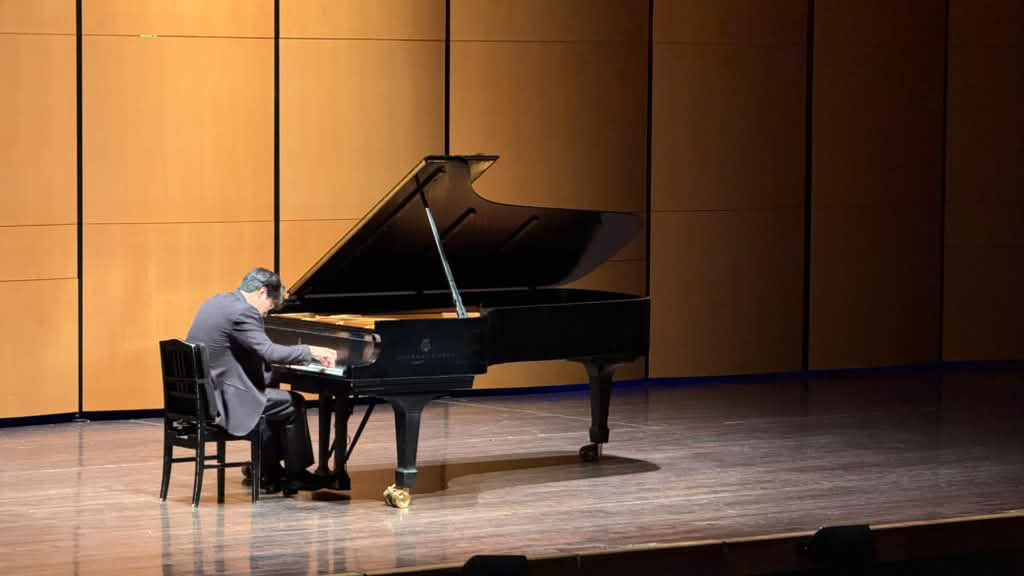
What an astonishing recital Bruce Liu gave Tuesday night at Meany Performances. Playing from a chair rather than a piano bench – which initially looked a little uncomfortable, though Liu soon seemed entirely at home – he combined incredible dexterity and control with extraordinary refinement and intelligence, all applied to a program that ranged widely without ever seeming random.
Which was part of the fun. Threads kept surfacing and disappearing: Spain viewed from within and without, through Ravel, Mompou, Albéniz and Liszt; flashes of French Impressionism; Beethoven’s C-sharp minor “Moonlight” followed by Chopin’s Nocturne in the same key and then its enharmonic major, D-flat. The connections were there, but Liu didn’t harp on them.
Ligeti’s Fanfares was a terrific opener, witty and kinetic, and Liu went straight from it into the “Moonlight” without a break. The transition immediately put Beethoven in a different light. Liu’s remarkable ability to separate strands of texture – to let you hear every line, every note within a chord – set an ultra-familiar sonata in a freshly revealing light.
Only the first movement left me wanting a little more – it seemed somehow too subdued. But that, I realized, was me adjusting to Liu’s distinctive personality. The little Allegretto had real character of its own, its syncopations gently weighted, rather than a way station to the stormy finale – and Liu resisted every temptation to overplay the latter. No pounding, no melodrama. The lightness of his touch actually made the turbulence more gripping.
The two Chopin Nocturnes, Op. 27, are obvious territory for the 2021 Chopin Competition winner, and they showed off one of Liu’s greatest strengths: incredible filigree that never loses the long line. There is delicacy in his playing, certainly, but “delicate” doesn’t begin to cover it. The refinement comes with astonishing control and agility. Then there’s the joy. Ravel’s Alborada del gracioso crackled with wit, rhythmic bite, and deliciously mercurial changes of character.
After intermission Liu set up another surprise. He crafted another de facto Beethovenian prelude with Debussy’s brief early Rêverie from 1890, allowing it to flow directly into the “Waldstein” (again, before applause could break the spell). For me, the “Waldstein” was the high point of a very high evening. Liu’s gravity-defying nimbleness and crystalline articulation made me rethink all those heavy “heroic Beethoven” associations. His account had an architectonic grace that managed to be buoyant and probing at the same time – and always brilliantly clear.
The Introduzione mirrored the interludial role of the “Moonlight” Allegretto, in a darker mood, and Liu made its transition into the finale feel weirdly surprising while still inevitable. He brought a rainbow lightness and clarity to the last movement that left me giddy.
Mompou’s Glossa sobre “Au clair de lune” from 1946 (a spare fantasy on the familiar French folk tune) was wonderfully plainspoken after all that invention, and Isaac Albéniz’s 1905 El Puerto (from Iberia Book I, evoking the bustle and dance rhythms of Cádiz) burst into extroverted rhythmic life.
The recital’s capstone was the huge Rhapsodie espagnole composed around 1863 from Spanish material he had first explored after his 1845 tour of Spain and Portugal – a virtuoso fantasy on La Folia and the Jota aragonesa. By this point, all those French and Spanish colors heard earlier in the evening seemed to feed into it. Liu had the firepower for Liszt’s most extravagant demands, obviously, but he made the piece glitter rather than thunder with virtuosity, all refracted through the clarity and rhythmic ingenuity that characterized his playing all evening.
Liu’s stage manner was strikingly modest and retiring, shy of the vociferous applause. Yet he kept returning, offering a generous lagniappe of four encores, including two Chopin Études (“Aeolian Harp” and “Black Key,” if I’m not mistaken) and Philip Glass’s Étude No. 6.
Filed under: Beethoven, Maurice Ravel, Meany Center for the Performing Arts, pianists, review, Chopin, classical-music, music, pianist, piano


