MEMETERIA by Thomas May

Music & the Arts

Richard III, Rock Star

I was very fortunate finally to have a chance to catch up with Thomas Ostermeier’s acclaimed production of Richard III the Schaubühne — not in Berlin, but at the Edinburgh International Festival.

Much has been made of Ostermeier’s highly original direction as a saturated, intensified portrait — a Machiavellian mirror — of the title anti-hero. That of course has been facilitated by the exciting, controversial translation/adaptation/condensation of the German text prepared by company dramaturg Marius von Mayenburg.

One of the most brilliantly effective choices — apparently a spontaneous decision arrived at during the course of rehearsal, according to Ostermeier — was to streamline the litany of climactic battles into a sequence of Richard fighting with himself, up to his inglorious demise.

This portrait approach was also made possible only through the weird, cultish charisma and electrifying stage presence of Lars Eidinger as a maniac-depressively embittered Richard. Not an “evil” character, according to Ostermeier, so much as one who makes the workings of power and its aggrandizement theatrically  transparent, naked.

“The play is not about evil as such,” says Ostermeier, “but about participation in power, the exclusion of an outsider and the manipulation of others’ antipathies. In this respect it does have significant political implications.” 

Eidinger’s matchless account requires intense physical acting, stamina, singing, and clownish, stand-up improv with the audience — the humor was particularly well-pointed, not a cop out (with a delightful exchange accusing a prematurely exiting patron of being rude when he claimed he was heading “to the toilet”).

But that’s not to shortchange the contributions of the rest of a stupendous ensemble cast. Percussionist Nils Ostendorf  contributed an excellent, live-wire score, which interpolated some fascinating touches (like an intensely repeated loop that segued in and out of Laurie Anderson’s “O Superman”).


Filed under: directors, Schaubühne, Shakespeare

What Use Is Religion? Bayreuth’s New Parsifal

“…where Religion becomes artificial, it is reserved for Art to save the spirit of religion by recognizing the figurative value of the mythic symbols which the former would have us believe in their literal sense, and revealing their deep and hidden truth through an ideal presentation.” –Richard Wagner (Kunst und Religion)

The 2016 edition of the Bayreuth Festival began today with a new production of Parsifal, staged by Uwe Eric Laufenberg (Intendant of the Hessisches Staatstheater Wiesbaden) and conducted by Hartmut Haenchen (following the controversial withdrawal of Andris Nelsons).

Laufenberg on the relevance of Wagner’s final stage work for an era beset by religious fundamentalism:

This piece basically focuses on the religion of Christianity. On one hand, the grail knights in “Parsifal” inhabit a realm of charity, empathy and sympathy, and they come to the aid of the needy. Then there’s the other side: a crucified God, blood rituals and military symbolism.

I believe that Wagner wanted to bring out the factors of benevolence and mystery in this work. Not to openly criticize religion, but to enable one to experience it. That’s interesting in our own times of widespread religious fundamentalism – but also in times of a Pope Francis, who has been de-emphasizing the institutional side of the Catholic Church and stressing the factors of mercy, grace and benevolence.

It’s always been pertinent to ask: What are religions doing, and are they allowing themselves to be abused for ideological purposes? What do they really stand for?

Laufenberg on setting Parsifal in the Middle East:

Wenn es um ein Stück ginge, das in Syrien oder Saudi-Arabien spielt, würde ich mich keineswegs um eine Auseinandersetzung mit dem Islam drücken. Wagner hat den „Parsifal“ in den Pyrenäen verortet, wir bringen ihn in den Nahen Osten, Richtung Syrien, Irak oder vielleicht Jerusalem, wo die monotheistischen Religionen einen Wahnsinnskampf gegeneinander führen. Im „Parsifal geht es aber um die Frage: Was ist uns die Religion wirklich wert? Wo berührt uns die Religion eigentlich noch? Was bedeutet das Mysterium des gekreuzigten Gottes?“

Hartmut Haenchen on conducting Parsifal:

BR-KLASSIK: Sie haben in einem Gespräch in Bezug auf “Parsifal” gesagt: Man muss erzählen und nicht zelebrieren. Was heißt es konkret?

Hartmut Haenchen: Wagner hat das Werk ja auch nicht “Oper” genannt – aus gutem Grund. Die Handlung des Stückes ist vor allem im ersten Akt beschränkt. Es wird erst Mal 45 Minuten lang erzählt. Und wenn ich das zelebriere, dass die Texte auseinander fallen, dass man die Textzusammenhänge nicht mehr verstehen kann, weil man Tempi wählt, die Textverständlichkeit unmöglich machen – dann wird es zelebriert, aber nicht erzählt. Und ich lege großen Wert drauf – und da stützte ich mich natürlich auf die Quellen – dass die Geschichte erzählt werden muss. “Der Fluss der Sprache bestimmt das Tempo”, – das hat Wagner selbst gesagt. Und dem muss man sich grundsätzlich unterordnen.

From a 1906 lecture by Rudolf Steiner:

Wolfram von Eschenbach wrote an epic on “Parsifal.” It was inartistic, but it sufficed for his time; for there were in those days men who had a measure of clairvoyance and could accordingly understand Wolfram. In the Nineteenth Century it was not possible to make clear to man the deep meaning of that great process of initiation in a drama. There is, however, a medium through which man’s understanding can be reached, even without words, without concepts or ideas. This medium is music. Wagner’s music holds within it all the truths that are contained in the Parsifal story.

 Complete cast list from Bayreuther Festspiele

Complete libretto (German/English)

More background on Parsifal

Filed under: Bayreuth Festival, conductors, directors, Wagner

SF Opera Carmen: Bieito’s U.S. Debut as Gockley’s Swansong

_F2A3305

Irene Roberts (Carmen) and Brian Jagde (Don José) ©Cory Weaver/San Francisco Opera

My review of Calixto Bieito’s Carmen — his official U.S. opera debut, in a production revived at San Francisco Opera — has now been posted on Musical America (behind paywall):

SAN FRANCISCO—An icon of iconoclasm, Calixto Bieito has been alternately demonized and deified for the challenges his stagings pose to business as usual. Kudos to San Francisco Opera, in this final hurrah from outgoing general director David Gockley, for becoming the first North American company to give the Catalan director’s work a platform. “Carmen,” which both opened and will close SFO’s 2016 summer season (with a free “opera at the ballpark” live simulcast on July 2), marks Bieito’s absurdly belated U.S. opera debut — a dozen years after his Abduction From the Seraglio at the Komische Oper Berlin sparked outrage and international headlines.


Filed under: Calixto Bieito, directors, review, San Francisco Opera

Gluck’s Revolution: Orphée in Seattle

sheehanphoto: tenor Aaron Sheehan, who sings the role of Orphée (credit: Kevin Day)
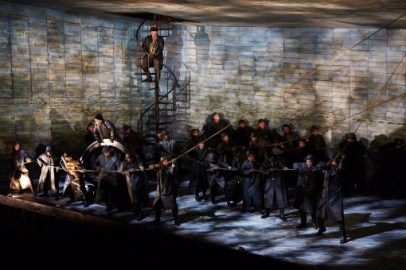
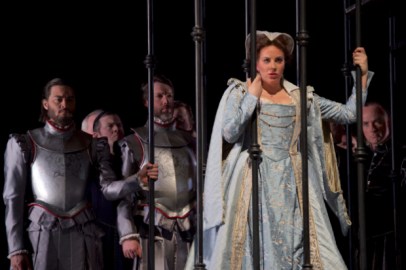
Here’s my story for The Seattle Times on the new production of Gluck’s French version of his epochal Orpheus opera, which Stephen Stubbs and Pacific MusicWorks are performing this weekend.

In May of 1774, 15 years before the French Revolution, the 18-year-old Marie Antoinette ascended the throne as queen of France. Less than a month before that, German composer Christoph Willibald Gluck, her former music teacher — and the son of a gamekeeper — made his debut in Paris with his opera “Iphigénie en Aulide.”

continue reading

Filed under: directors, Gluck, Pacific MusicWorks, Seattle Times, Stephen Stubbs

Flying Dutchman at Seattle Opera

39204-flying-dutchman-seattle-philip-newton-resized

© Philip Newton

My review of Wagner’s Dutchman at Seattle Opera has been posted on Bachtrack:

Though the legend of a seaman doomed to sail forever was already hackneyed by the time he took it up, it was through his idiosyncratic treatment of this material that Richard Wagner first found his authentic voice. “Do you fear a song, a picture?” sings the heroine Senta in her first confrontation with Erik, her hapless suitor.

But Wagner was well aware of the dangerous potential art possesses when the goal is no longer escapist entertainment. So is director Christopher Alden, whose production (originally created for Canadian Opera Company two decades ago) mirrors the young composer’s sense of thrilling new horizons beyond routine and convention.

continue reading

Filed under: directors, review, Seattle Opera, Wagner

Hidden Handel

Director Trevore Ross on staging Handel’s oratorios for the LA Master Chorale. First in their five-season-long project is Alexander’s Feast.

Filed under: choral music, directors, Handel, Los Angeles Master Chorale

Maria Stuarda at Seattle Opera: Donizetti Fever Rages on from Coast to Coast

36225-16_mary_stuart_jl_029

Joyce El-Khoury in the title role of Maria Stuarda; image credit: Jacob Lucas

My review of Maria Stuarda at Seattle Opera — where soprano Joyce El-Khoury has made a spectacular company debut — is now posted on Bachtrack:

Tudormania continues its invasion of America. Later this month at the Met, Sondra Radvanovsky will have added the third and final jewel to her Donizetti crown when she sings Elizabeth in Roberto Devereux. And across the continent, Seattle Opera has been presenting its company debut of Maria Stuarda (1835).

continue reading

Filed under: bel canto, directors, Donizetti, review, Seattle Opera

Feurig and Fiery

I can’t get enough of Barrie Kosky:

Filed under: Bayerische Staatsoper, directors, Prokofiev

New Artist of the Month: Director James Darrah

James+Darrah

Finding a suitable label to encompass James Darrah’s artistic practice is not easy. He has directed operas in more or less conventional spaces, yet this represents only one sliver of his work. You’re also likely to experience Darrah’s art in the concert hall. Indeed, seeing the multimedia staging of Beethoven’s Missa Solemnis this past June by the San Francisco Symphony and Michael Tilson Thomas brought me one of the year’s most lasting revelations.

continue reading

Filed under: directors, music news

Hopscotching

Although I didn’t have a chance  in Los Angeles to experience the Hopscotch opera phenomenon firsthand, I’m trying to catch up vicariously. My colleague Alex Ross has written extensively and enthusiastically about this mobile opera, even calling it “a high-tech work of Wagnerian scale.”

Ross explains that the title “was taken from Julio Cortázar’s 1963 magical-realist novel, which invites the reader to navigate the text in nonlinear fashion.” As for its impact, he declares that Hopscotch “triumphantly escapes the genteel, fenced-off zone where opera is supposed to reside.”

At The Wall Street Journal, Heidi Waleson writes that “the experience is atmospheric rather than narrative, with each chapter a surprise and a plunge into the emotional character of the moment.”

Hopscotch‘s director Yuval Sharon, founder of the experimental opera group The Industry, “has broken the fourth wall with a vengeance, not merely freeing opera from the opera house, but making its heightened expression the sound of real, everyday and inner life,” Waleson concludes.

Mark Swed’s Los Angeles Times review, on the other hand, is more hesitant about what he views as a “hyped” production: “‘Mobile opera’ and ‘city pieces’ have been around for a while,” he reminds us. “…Operas with multiple composers and librettists, like Hopscotch, go back to the Baroque.”

“The actual experience of the opera is to be lost,” notes Swed. And indeed the complexity of the jigsaw puzzle fragments that are part of the whole story as well as “the engineering feat of making it all work are all part of the cool factor that has given the opera international attention. I, however, found nothing cool about riding around in a limousine through economically disadvantaged parts of L.A. These appallingly tacky vehicles are designed to keep you far removed from your environment.”

Swed’s proposed solution for the “self-involved, isn’t-this-cool response” Hopscotch has been eliciting?

I never thought I’d say this, but the first epic L.A. opera requires not artificial immersive reality but virtual reality. Let the Industry assemble all the episodes as transmitted to the Hub, all the animations and all the expendable material together online (or on an app or disc), and Hopscotch will surely and with irresistible suitability become the first exceptional hyperopera.


Filed under: directors, new music, opera companies

Archive

Enter your email address to follow this blog and receive notifications of new posts by email.