This weekend brings the next installment in the National Symphony Orchestra’s current NEW MOVES: symphony + dance festival. I enjoyed researching this material to write the program essays for all three programs, which are being conducted by the Omaha Symphony’s Thomas Wilkins. Each program pairs classic American rep with music by living composers.
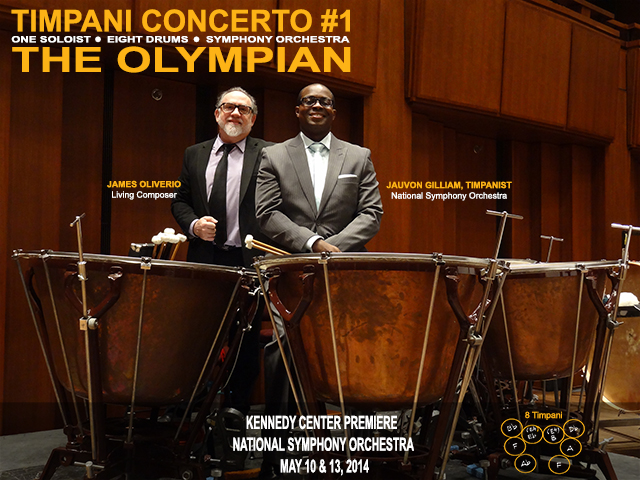
This second of the three programs features the Timpani Concerto No. 1 (“The Olympian”) by James Oliverio. Here’s a bit of my intro to his work:
The composer, educator, and new media producer James Oliverio (now based in Florida) has been redefining what it means to be a creative artist in the 21st century. “As composer there are two main ‘instruments’ that I work with: the symphony orchestra and the digital media studio,” he says, envisioning a music of the future that bridges the gap between traditional acoustic instruments and our rapidly evolving digital world. “Ultimately I want to unite them — to remove the distinction between my digital and orchestral endeavors,” adds Oliverio, an acclaimed pioneer of globally synchronized performing arts collaborations. (The rest can be found here.)
More on the amazing Jauvon Gilliam, principal timpanist of the NSO, from Andrew Lindemann Malone’s blog post. Writes Malone:
Not everyone who attends orchestral concerts knows that the timpani is not a fixed-pitch instrument; drummers tune them through the use of a foot pedal. So to play the right notes, you have to have both your hands and your feet in the right spot. With the typical orchestral complement of four timpani, this is challenging enough; as Gilliam says, “it’s like a choreographed dance. You can overshoot it, you can undershoot it, it’s just like if you do a pirouette.” To really master the instrument, “you almost have to have four different brains or have your brain in four different compartments.”
[…]
It’s an unusual role for an instrument that normally sits in the back and makes everything sound fuller and more forceful, but Gilliam doesn’t mind the change. “My job is to support people. I really enjoy that, that’s what I love about my job,” he says, but performing a solo is a “different way of doing things, and it allows me to expand my talent. It allows me to be a better musician.”
The concerto is also, he says, “the hardest thing I’ve ever played” — a challenge worthy of the title “The Olympian,” and a summit only scalable for a man who’s sure on his feet.
Here’s Jauvon Gilliam’s own blog post on “The Olympian.”
And here’s a radio interview WETA’s Nicole LaCroix conducted with Wilkins (beginning), Gilliam (6:15), and Oliverio (at 9:15).
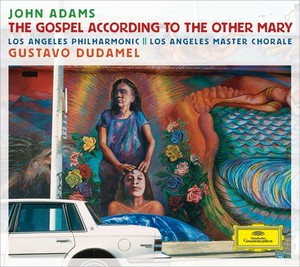
Since my essay is included in this recording, I have to recuse myself from offering a review, but I can say that I consider The Gospel According to the Other Mary among John Adams’s most profound accomplishments. It certainly probes new ground for this ever-evolving, brilliant musical mind.
As for the critical reactions I have seen, nothing yet has come to my attention that seriously grapples with the full complexity of this score.
A curious note: Gospel was among this year’s Pulitzer finalists. I think it’s a safe bet that this year marks the first time two composers sharing the same last name were up for the same prize, which in this case was taken by John Luther Adams for Become Ocean.
If you haven’t had a chance to explore this Adams/Peter Sellars collaboration, do yourself a favor.
And the winner is … John Luther Adams. This is especially exciting news, since Ludovic Morlot and the Seattle Symphony will be taking Become Ocean, the large-scale work they recently commissioned from Mr. Adams, to Carnegie Hall next month as the centerpiece of their Spring for Music program.
The Pulitzer Prize citation states:
Awarded to “Become Ocean,” by John Luther Adams, premiered on June 20, 2013 by the Seattle Symphony, a haunting orchestral work that suggests a relentless tidal surge, evoking thoughts of melting polar ice and rising sea levels (Taiga Press/Theodore Front Musical Literature).
In his review of the world premiere last June for The New Yorker, Alex Ross memorably wrote:
Anyone who has gone down a stretch of road and then reversed course knows that a landscape does not look the same when viewed from opposite directions. One mystery of “Become Ocean” is how different the material often sounds during the second half of the [overall] palindrome [structure]. The section after the first climax is thick with minor chords, particularly in the brass. Somehow, as these chords loom again in the buildup to the final climax, they take on a heavier, more sorrowful air. There is a sense of unwinding, of subsiding, of dissolution… That a piece constructed with such fanatical rigor can convey such potent emotion is the greatest mystery of all.
In an interview from 2011 with Molly Sheridan of NewMusicBox, Mr. Adams explains that his music is “never about representation or reproduction” but about “authentic personal experience, about the primary experience of being there and paying attention.”
Music is not what I do; music is how I understand the world. I hope that if I find myself in a singular place: wilderness, urban, indoors, outdoors, real, imaginary—doesn’t matter—if I find myself in a real place, a true place, and I am paying attention, then maybe I hear something that becomes music. If that happens, then I hope the music floats away, takes on a life of its own, and becomes something else to you when you hear it. What I may have experienced, what I may have been reading, or looking at, or listening to, or thinking about when I was in that place working on the music really doesn’t matter. What matters is the music and how it touches you.
My preview of Wayfinders, Holcombe Waller’s biggest show to date and coming to On the Boards this week, is now live on CityArts:
“Pushing boundaries” and “defying genres” are among the most tired clichés in arts writing these days. But along comes a visionary like Holcombe Waller, who manages to push the boundaries of the genre defiers, and genuinely eye-opening things happen. Seattle audiences have a chance to experience Waller’s most ambitious—and decidedly boundary-ripping—project to date when Wafinders comes to On the Boards for its fully staged premiere on April 10-12.
There’s no real point trying to caption Wayfinders with a label—song cycle, music theater, video space opera?—since Waller’s new work maps out a region of its own, synthesizing these elements into a deliriously hypnotic performance experience.
“Ultimately it’s about the evolution of consciousness that we see happening in connection with our technology,” Waller explains. “Wayfinders imagines a distant future where our conscious and technology merge and become interdependent.” In that headspace, how do we navigate a sense of identity? How do we connect with others while our own reality changes as we become increasingly entangled in and dependent on our technology?
My latest concert review is now live on Bachtrack:
The music of Alexander Raskatov remains relatively little known in the United States. Smart concert programmers, though, should take note of the effectiveness of his new Concerto for Piano and Orchestra, “Night Butterflies”, as demonstrated in this performance by Tomoko Mukaiyama and the Seattle Symphony. With these concerts, Ludovic Morlot gave the work a persuasive American premiere, fully alert to the score’s psychological fascination. The SSO co-commissioned Night Butterflies with Het Residentie Orkest Den Haag, which presented the world première in the Netherlands last May.
UPDATE on Saturday 22 March, 9:42: I just learned that Richard Taruskin will not be at the Conference to give the keynote speech; he’s prevented from traveling on account of illness. The lineup given here appears to have just been updated.
Living in exile, crossing borders, starting over—are there any experiences more definitive of the modern era? Along with their concrete political and social consequences, these experiences have shaped cultural expression. What, for example, does it mean to be a “Russian” composer today? Does it even make sense to keep referring to national musical styles in this century of instant global connectivity?
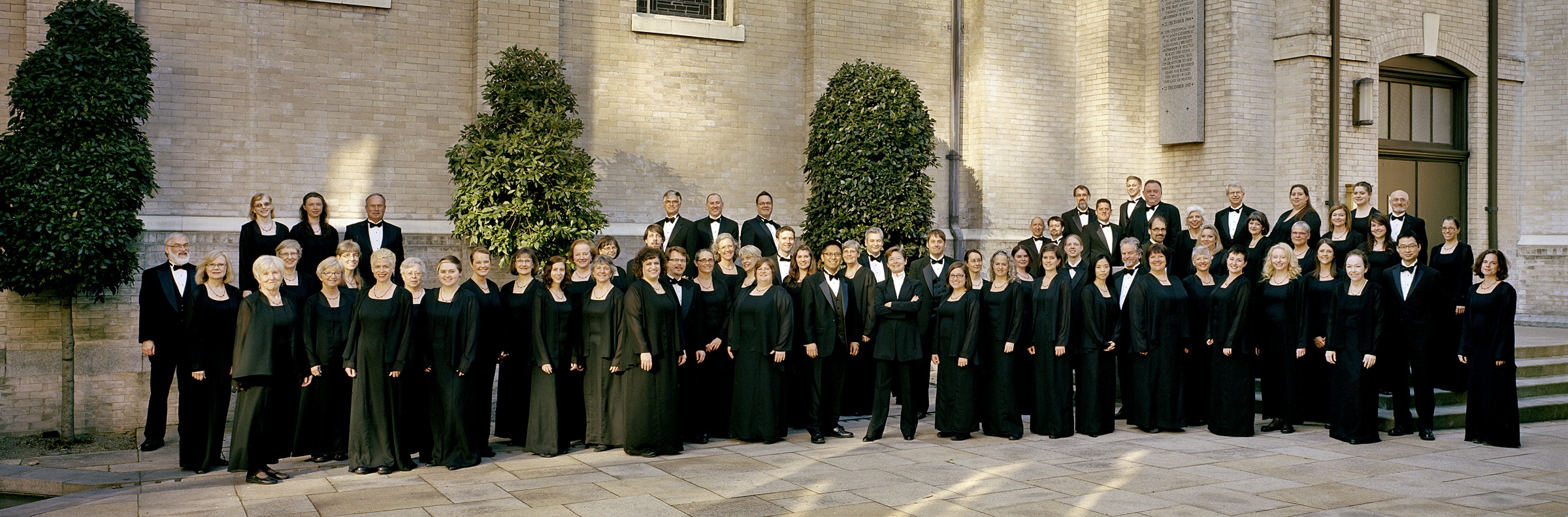
I’ve always admired the quality and imagination of Karen Thomas’s programming for Seattle Pro Musica, but their upcoming program, titled Passio: Light in Darkness, has me champing at the bit, to put it frankly.
“The concept for Passio is music related to Lent and the deep human emotions this season has inspired composers to explore,” says Thomas, who not only directs Pro Musica but is herself a composer. And that can also take the form of completely secular works like the little match girl passion by David Lang, which draws on models from Medieval mystery plays and J.S. Bach’s Passions to retell a children’s story of searing, tragic simplicity.
The fact that Pro Musica will be presenting match girl (in the area premiere of the choral version) is by itself enough of a sell: this just happens to be one of the most haunting and inspired choral compositions by an American composer in recent years. But the program also includes a “re-discovered” rarity from the Russian choral rep: Passion Week by Rachmaninoff contemporary Alexander Gretchaninoff (1864-1956). Plus, there will be sprinklings of music by Benjamin Britten, Thomas Weelkes, and living composers like Paul Mealor and Kay Rhie. All of these selections, in different ways, highlight the special strengths of Seattle Pro Musica — and of the smaller ensembles comprising the company.
Seattle Pro Musica
Lang, an LA native now based in New York (and known as one of the co-founders of the innovative Bang on a Can new-music outfit), has fast forwarded the American maverick lineage into the 21st century. Lang is also an adventurous collaborator who has worked with the likes of photographer William Wegman and the film director Jonathan Parker (scoring the 2009 indie comedy (Untitled). But for the little match girl passion, which won the Pulitzer Prize in Music in 2008, Lang engages in a remarkably original “collaboration” with sources you don’t normally associate with each other. He uses the tradition of musical settings of the Christian Passion narrative as a model for his retelling of an incredibly poignant children’s story by fairy-tale master Hans Christian Andersen.
The root of the word “passion” is from the Latin term for suffering. Lang strips away the traditional religious associations of the Passion story but uses the narrative techniques that were pioneered and perfected by Bach — “commentary” passages interpolated into the ongoing story — to recount the suffering and death of the little girl in Andersen’s story who tries to sell matches on a street corner on a brutally cold New Year’s Eve. Or, another way to put it, as Lang himself does: “There is no Bach in my piece and there is no Jesus — rather, the suffering of the little match girl has been substituted for Jesus’, elevating (I hope) her sorrow to a higher plane.”
There have been many musical adaptations of Andersen’s tale — TV musicals, operas, a synthpop video by Erasure, a concept album by The Tiger Lillies. But nothing I know comes close to the gut-wrenching impact of Lang’s treatment. His post-Minimalist score is deceptively simple, in keeping with the story. Spare harmonies and other archaisms evoke the starkness of early Medieval chant (think Perotin — that far back); tiny gestures generate maximal emotional response.
“There’s an extremely intimate quality to it,” Thomas explains. “Lang’s music has an immediacy and at the same time a kind of emotional reserve about it, because of the way he writes for the voices to evoke the Evangelist in a Bach Passion or a Greek chorus. So there’s a certain coldness and detachment as well that makes the tragic story that much more poignant as a result.”
Over the past two weeks, in concerts featuring the same vocal soloists, I’ve taken advantage of the rare opportunity to experience and compare the two great Passions by J.S. Bach that survive. (Pro Musica also performed the St. John Passion two seasons ago.) So it should be especially fascinating to encounter Lang’s piece, which I’ve long treasured since on recordings, with this context fresh in mind. Yet on its own terms, match girl is an immediately gripping and effective work, a mix of modern morality play and music theater — but with none of the preachiness that can sometimes creep into, say, a performance of Brecht.
Alexander Gretchaninoff in 1910
As for Gretchaninoff’s Passion Week, Karen Thomas points out that it will beautifully complement the pared-down sound of Lang’s little match girl passion by taking us to another extreme of lushness and blooming choral texture. Premiered in Russia in 1912, Passion Week sets texts from the Russian Orthodox liturgy that are used as prayers during the week that culminates in Easter. Gretchaninoff, a student of Rimsky-Korsakov, was part of the Renaissance of Russian choral music in the early 20th century that’s also represented by Rachmaninoff’s beloved Vespers (1915).
“In Gretchaninoff’s setting you can hear the influence of early Russian music and chant even more clearly,” says Thomas. “And he writes even more extensively for the low range of the basses than Rachmaninoff. This will sound especially compelling when heard in the acoustic space of St. James.”
Thomas adds that the prayers Gretchaninoff sets combine mystical and liturgical texts. They tend to be “more of a personal reflection” on the events of Good Friday, for example, than the librettos Bach set for his Passions. But this music fell into oblivion in the wake of the Soviet Union’s official crackdown on the Russian choral movement that had begun to take flight. Gretchaninoff himself stayed for a time but finally emigrated to the U.S. in 1939. His Passion Week wasn’t revived until the 1990s. Thomas believes these may be the first Seattle area performances.
An additional note: Yet another composer involved in the Russian choral movement — and another Rimsky student — will be in the spotlight next month when Cappella Romana presents the recently rediscovered Passion Week of Maximilian Steinberg, “the last major sacred work composed in Russia before Stalin’s 1932 crackdown (April 11 and 12).
Seattle Pro Musica’s Passio – Light in Darkness concerts take place on Saturday and Sunday, March 8 and 9, both evenings at 8 pm at St. James Cathedral. Tickets here.
On the road: after being in the spotlight in Madrid for the Orquesta Nacional de España’s Carta Bianca Festival, John Adams is being celebrated this week by the Toronto Symphony with the New Creations Festival. The festival culminates on Friday with one of Adams’s most fascinating recent works, Absolute Jest. Here’s the essay I wrote for the original version of Absolute Jest on the occasion of its world premiere by the San Francisco Symphony and the Saint Lawrence String Quartet in 2012:
More than three decades have passed since the San Francisco Symphony gave its first world premiere of music by John Adams (the choral-orchestral Harmonium in 1981). The event marked the beginning of a longstanding relationship between composer and orchestra that has resulted in the commissioning of several landmark works: Adams’s breakthrough orchestral composition, Harmonielehre (a new recording of which the SFS has just been released), El Dorado, the millennial “nativity oratorio” El Niño, the opera A Flowering Tree, and My Father Knew Charles Ives.
Seattle Chamber Players (SCP) just concluded Icebreaker, its biennial two-day festival of new music. This year’s edition, the seventh in their history, was titled open source, with a focus on high-tech music-making.
Artistic director Elena Dubinets — a key figure responsible for the Seattle Symphony’s smart programming — organized a stimulating and provocative program of five compositions spread over two evenings at Seattle’s terrific On the Boards space. SCP’s core members consist of Laura DeLuca (clarinet), David Sabee (cello), Mikhail Shmidt (violin) — all members of the Seattle Symphony — and Paul Taub (flute).
Their ranks were supplemented by a chamber orchestra of fine colleagues, with Alastair Willis conducting for the majority of the two concerts. (The requirements for some of these pieces should count as training for a certification in air traffic control — that’s how nerve-wrackingly intricate they are.)
open source ranged far and wide in terms of ambition, scope, and attitude. There was room for pieces featuring cheeky allusions and playful “rewiring” of musical codes as well as epic-scale updatings of the Gesamtkunstwerk meme and its goal of a total-immersion experience.
Pieces like Spam! by the Portuguese composer Luís Tinoco (on hand as this year’s guest composer) offered a sardonically comic take on the flotsam and jetsam of spam email in our procrastination-information culture. Another type of saturation provided the impetus for a music-and-video piece by the German composer Michael Beil, the title of which did double duty as the name for the festival itself.
The ideal of “open source” culture touches on utopian attitudes of sharing and pooled creativity. In Beil’s retooling of the hypnotic barcarolle from Jacques Offenbach’s Tales of Hoffmann, it also suggested a new angle on Walter Benjamin’s notion of the “aura” for this era of hyper-reproducible artifacts. In practice, though, open source turned out to be rather less fascinating than in the abstract, on paper.
The Greek composer Yannis Kyriakides also started with a promising concept in his recent Karaoke Etudes, to which this observation by Douglas Coupland serves as an epigraph: “21st-century life is karaoke — a never-ending attempt to maintain dignity while a jumble of data uncontrollably blips across a screen.” And this time, in practice, the interplay of pop-culture artifact, memory, improvisation, and oblique visual cues — with its mix of beguiling innocence and bemusement — cast a charming spell.
The two highlights of open source — a concerto-with-film by Michel van der Aa and a psychedelically tinged “video-opera” by Fausto Romitell — were substantial, visionary pieces featuring extremely complex and sophisticated media synchronizations. (The once-ubiquitous “multi-media” really has started to sound like a quaintly old-fashioned term — something like “mimeograph” or “xerox.”)
And both of these therefore represent one-of-a-kind works. It was a real coup for Elena Dubinets and SCP to score the Northwest premiere of the Dutch composer Michel van der Aa’s Up-close, which had its West Coast premiere in the Los Angeles Philharmonic’s Green Umbrella series just last month. I’ve recently written aboutUp-close — scored for solo cello, string ensemble, and electronic soundtrack — and its radical reimagining of the concerto format as a hybrid of film and live theater.
Simply put, it was thrilling to experience this significant new composition in live performance. As the solo cellist, Julie Albers also had to perform a scripted part in tandem with the images from van der Aa’s filmic counterpoint — a mysteriously never-explained narrative involving an older woman and her traumatic memories (having to do with coded messages, communication, and an implicit backdrop of the Dutch Resistance in the Second World War).
I found Albers’s stern, grainy, edgy sound extremely effective and dramatically compelling. Her phrasing captured the desperation of her “character” with a deeply felt immediacy. I also admired how alert she was to the amazing spectrum of nuances van der Aa has written into the part.
To be able to present a contemporary composition as significant, as cutting edge, and as emotionally engaging as van der Aa’s Up-close underscores the value of SCP’s Icebreaker festivals. Seattle audiences would benefit from more of this kind of boldly planned and executed new work — an undeniable peak of this edition of the festival.
So, too, was the big work on the first night: An Index of Metals by the Italian composer Fausto Romitelli, who died a decade ago (only in his early 40s). Romitelli’s video-opera for soprano and ensemble turned out to be case in which what’s “on paper” pales by comparison to the live experience in real time.
Fausto Romitelli in 2001
Dubinets neatly summarizes Romitelli’s part-sculptural, part-industrial preoccupation with sound, which he thought of as “material to be forged”:
Anything but a formalist composer, Romitelli did not shy away from hybridization, breaking down the barrier between art music and popular music. Distortion, saturation, psychedelic rock-inspired compositions and “dirty” harmonies were part of his musical universe…”
Romitelli’s final work, An Index of Metals, has been characterized as an artistic final testament that synthesizes everything he had developed in his process of treating sound as malleable matter. Remarking on the starting point for his compositions in general, Romitelli wrote: “The grain, thickness, porosity, density, brilliance, and elasticity are the main aspects of these sound sculptures resulting from amplification and electroacoustic treatment as well as simple instrumental writing.” He explained the guiding idea behind An Index of Metals as follows:
The aim … is to turn the secular form of opera into an experience of total perception, plunging the spectator into an incandescent matter that is both luminous and sonorous, a magma of flowing sounds, shapes, and colors, with no narrative but that of hypnosis, possession, and trance. It is a lay ritual, rather like the light shows of the the 1960s or today’s [i.e., at the millennium] rave parties in which space, having assumed a solid form through the volume of sound and visual saturation, appears to twist into a thousand anamorphoses. Rather than calling on our analytical ability, like most contemporary music, “An Index of Metals” aims to take possession of the body with its over-exposition of senses and pleasure.
Granted, that could merely amount to a lot of gobbledegook signifying nothing. But the incredibly meticulous planning that went into this realization paid off: the SCP and their collaborators succeeded in conveying the re-enchanted performance dynamic that has to be there for Romitelli’s magic to work.
In one sense, you could say Romitelli’s rejection of the “analytical” in favor of Dionysian immersion and sensory overload — what the composer calls “the fusion of perception” and “the henceforth limitless body in the furnace of a ritual mass of sound” –makes for a contemporary reincarnation of Romanticism.
Certainly Index recalls the psychedelic Romanticism of groups like Pink Floyd (whose “Welcome to the Machine” from their 1975 album Wish You Were Here gets sampled at the start), but aspects of early-20th-century modernist fusions enter the mix as well. On top of all that, Romitelli uses high tech to fuse sound, image, and spatial perception into a delirious feedback loop of continual “translation.”
The video elements comprise three separate films (created by Paolo Pacchini and Leonardo Romoli), while a solo soprano, accompanied by 11 amplified instruments, sings a text by the Solvenian writer Kenka Lekovich (translated into English).
As the soloist, the Polish soprano Agata Zubel was mesmerizing and indeed “elemental.” (Zubel and SCP have recorded an album together — Cascando — which took a prize in the Polish equivalent of the Grammies in 2011.)
And what an assignment the soprano is given — to project musical-emotional sense from the foggy, twilit timbres of Romitelli’s soundscape. To the fluid stream of video images she sings Lekovich’s texts of “Hellucination.” It all induced a state of awe — an awe both majestically terrifying and ecstatic.
As Romitelli writes, he wanted Index to present “a violent, abstract narrative, denuded of all operatic artifice, providing an intiaiton rite of immersion and a trance of light and sound.”
Quite happy to see Tom Adès take the Best Opera Grammy for The Tempest. I had the opportunity to write this essay for the Met when the production staged by Robert Lepage first appeared there:
When The Tempest opened at London’s Royal Opera House in February 2004, the anticipation couldn’t have been more intense. Composer Thomas Adès—only 32 at the time—had already been thrust into the international spotlight in the previous decade and found himself having to live up to recurrent comparisons with his similarly precocious compatriot and predecessor Benjamin Britten. Despite all this pressure, the overwhelming, almost unanimous response to Adès’s second opera seemed to confirm the parallels. “Only time will tell whether the first night of The Tempest in 2004 was a moment to set alongside the first night of Peter Grimes in 1945 in the history of British music,” wrote The Guardian the day after the occasion. “But it felt that way in the theatre.”
Time has proved that the initial verdicts weren’t idle hyperbole. The Tempest belongs to that rare group of contemporary operas whose critical acclaim is matched by the ultimate practical test of stage-worthiness. In fact, The Tempest—still less than a decade old—can already boast an astonishing track record of five different productions: the original Covent Garden staging (which was revived in 2007 and recorded for EMI’s award-winning CD), the American premiere at Santa Fe Opera in 2006, two separate productions in Germany, and now the opera’s premiere at the Met, which promises to be among the highlights of the new season.
Robert Lepage’s staging is a co-production of the Met, Opéra de Québec, and the Vienna Staatsoper and will also feature Adès (pronounced AH-diss) making his company debut as conductor. Reprising his performance as Prospero is baritone Simon Keenlyside, whose combined vocal and physical presence were widely admired as ideally suited to the role he created at the Royal Opera House.
The once-obligatory references to Britten became a kind of shorthand for English critics eager to spell out the high expectations pinned on Adès. In fact, he is an artist whose voice is unmistakably and audaciously original. Many gifted young composers demonstrate an eclectic, anxiety-free facility when it comes to claiming elements from the musical past for their own creative tool kit, but what was especially striking about Adès, while he was still just in his twenties, was the uncanny confidence with which he forged a rich, complex, allusive language with a coherence all its own.
Even more, before the millennium Adès had already found exciting ways to develop his flair for formal, abstract structures, vivid orchestration, and spirited detail while also demonstrating a compelling theatrical instinct. His range was apparent, whether in writing for a large Mahlerian orchestra (the symphonic Asyla, commissioned for the Berlin Philharmonic, for example) or in his first work for the stage, the chamber opera Powder Her Face (1995).
The latter, which used the scandalous story of an aristocrat’s fall from grace to ironically turn the mirror back on a tabloid-saturated culture, also revealed Adès’s extraordinary feel for portraying characters in music. With the far vaster canvas of The Tempest, he progressed to a mature mastery of his art, taming the often volatile energy found in his youthful scores into a sustained, emotionally gripping arc.
Shakespeare’s beloved final romance, remarks Adès, “is famously full of references to music, while the intangibility of some of its characters has always inspired music.” Purcell, Tchaikovsky, Sibelius, and Berio are just a few of the many composers who have fallen sway to its spell; even Mozart, near the end of his life, may have contemplated turning The Tempest into an opera. Yet instead of finding himself daunted by the weight of associations bound up with the source material—above all by the sheer power and poetry of Shakespeare’s language—Adès discovered a fresh approach to “translating” the Bard’s vision into opera.
The composer collaborated closely with librettist Meredith Oakes, an Australian-born playwright and poet whose talent for evoking traditional poetic patterns through “a very specific, archaistic style” felt particularly appropriate. Oakes distilled the original verse into pithy, condensed couplets that echo the play’s most famous passages in eminently singable phrases—instead of competing with them. Many of the couplets take the form of half-rhymes or slant-rhymes that acquire an extra charge by being ever so slightly off. The result, Adès says, “is a translation of Shakespeare into modern English, to be all the more faithful and concentrate the drama.”
Yet the three-act opera remains remarkably true to the arc of Shakespeare’s story and the spirit of his characters, while at the same time opening up the creative space necessary for Adès to add the unique perspective of his musical imagination. “I want it to be The Tempest. I want it to be Shakespeare and to bring that vision into the opera house as faithfully as possible,” the composer points out. “We actually started further away from the play than we ended up but found ourselves going back to Shakespeare’s structure much more.” But to achieve such fidelity—as opposed to a pale imitation—Adès and Oakes determined early on that they needed to swerve away from dogged, literal re-creation.
The most striking shift involves the opera’s conception of Prospero, the former Duke of Milan who, in the back story, has been usurped by his brother Antonio and shipwrecked on an island with his young daughter, Miranda. Prospero’s desire for vengeance is more pointed in the opera, as is his related assertion of control over the island’s indigenous creatures—Ariel and Caliban—and over Miranda’s emerging emotional autonomy as she falls in love with Ferdinand, his enemy’s son.
The libretto provided Adès with clearer “musical emotions” that motivate the dynamics of enslavement and liberation in the story as well as the transforming power of love and compassion. The real turning point, observes the composer, comes when Ariel tells Prospero that the suffering he has caused his enemies to endure would soften Ariel’s own heart if he were human. “And it’s the moment when Prospero realizes he’s gone too far and has to stop.”
Lepage, familiar to Met audiences for his stagings of Berlioz’s The Damnation of Faust and Wagner’s Ring cycle, praises the opera for capturing the “magic” of what is often considered the playwright’s final artistic testament. Not surprisingly for this wizard of theatrical illusion, the figure of Prospero has long fascinated Lepage, who has directed numerous productions of Shakespeare’s play. Each time he returns to it, he uncovers new insights. For his own concept of the opera, Lepage has expanded its aura of magic into a metaphor for artistic performance itself, envisioning Prospero as an 18th-century impresario of La Scala, the opera house in Milan, which he has recreated on the island of his banishment as a reminder of home.
“In those days, La Scala was a very magical place to set operas because it had all of the new state-of-the-art machinery,” Lepage explains. “The beach where everybody is marooned is actually a stage that’s been planted there and constructed by Prospero.” Lepage adds that each of the three acts presents a different perspective—from the stage itself, from the auditorium, and what goes on behind and off stage—to encompass this “opera-within-an-opera house.”
Members of his creative team will be making their Met debuts: Jasmine Catudal designed the sets, and the costumes are by Kym Barrett (known for her collaborations with Baz Luhrmann and her work on The Matrix films). The overall look will marry a sense of the island’s “native, aboriginal culture” with the Italian Baroque sensibility imported by the European interlopers.
Lepage’s mastery of both traditional stagecraft and its most up-to-date technological forms provides an ideal complement to the composer’s unique fusion of a classic play with a contemporary vision of opera. In his musical characterizations of the five leads, for example, Adès developed wonderfully effective alternatives to the vocal type casting that might have tempted a less-imaginative composer. While Ariel, a male character played by a soprano, sings in a stratospheric tessitura (frequently perching on Ds, Es, and Fs above high C, even reaching to G), “this isn’t a way of expressing high emotion and shouldn’t feel like the top of the singer’s range. That’s where she lives.”
Ariel is an elemental force of nature who—in another alteration of the original source—sings the final airborne phrase and becomes the wind again. Her island counterpart, the “monster” Caliban, is depicted not as a “lumpen, earthy brute” with a bass voice but is a lyrical tenor. “He’s often described in the play as being like an eel or a fish, and I suddenly thought he could be more like one of those exotic, wonderful voices from the East, with a weird elegance. And of course he is an aristocrat, not only in his own mind,” says Adès, who gives Caliban one of the most radiantly beautiful passages in the score: his aria reassuring the shipwrecked newcomers not to fear the island’s “noises.”
As for Prospero, the composer created a fully dimensional baritone role (with shades of Verdi’s and Wagner’s authoritarian father figures) who nevertheless defies the stereotype of the wise old sage. Adès was especially inspired by crafting the role for Keenlyside. “Simon’s a terrifically physical performer who projects youth. In a way, it’s that characterization, as much as the extraordinary voice, that was on my mind. I don’t think of Prospero as an old man. This is the only play of Shakespeare which observes the classical unities of happening in one place, in one day. When Prospero meditates on the evanescence of life, my feeling is actually it’s not that he does that every day and has been doing it for years and he’s an old bore. It’s that he’s just realizing it at that exact moment. That’s the first time he’s thought this.”
While Adès writes for the voice with great character, his score is also distinguished by its symphonic intricacy and architecture. This quality provides the opera with a richly satisfying cohesion and unity. Adès achieves this not through conventional leitmotif technique but by expertly manipulating his uniquely evocative harmonic language. He explains: “The music has its own internal logic of relationships; it doesn’t just do what it wants to do because the characters suddenly decide to go somewhere. It’s a tissue that’s woven in, so that everything is related in the music, and all the elements create a view of the world that’s whole, a sphere.”







 MEMETERIA by Thomas May