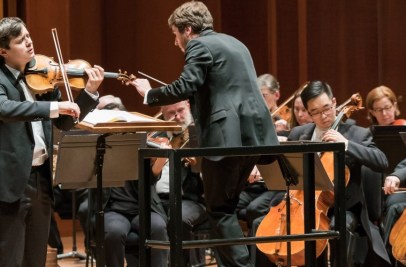
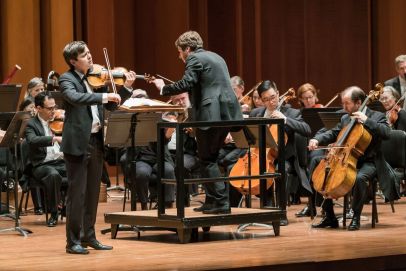
Violinist Aleksey Semenenko, with Pablo Rus Broseta conducting the Seattle Symphony; photo (c)Brandon Patoc
My review of Seattle Symphony’s remarkable, two-part Shostakovich Concerto Festival is now available on STRINGS:
The Seattle Symphony just offered a rare chance to hear all six of Dmitri Shostakovich’s solo instrumental concertos back-to-back in a two-day marathon (January 19–20) featuring three young virtuosos, all led by the ensemble’s associate conductor, Pablo Rus Broseta.
Juilliard’s Focus! Festival for 2017 is devoted to the music of Latin America. Complete schedule and programming here.
Longtime Juilliard professor, conductor, and scholar Joel Sachs, who organized the entire festival, writes:
In the fall of 1992, I was offered the directorship of MoMA’s Summergarden, then a two-month long festival of new music. Since the museum was preparing a major show of Latin American art, I was asked if my first Summergarden in 1993 might explore Latin American music. I assented, not realizing the challenge of finding the best music of a high swath of the world whose composers were hardly known. I quickly learned that the resources were huge.
As my knowledge of the music of Latin America has increased in the ensuing years, so has the number of composers. A Latin American Focus! festival seemed badly needed, even if six concerts could only scratch the surface. I wanted to emphasize composers still living in their home countries, but could not exclude the Latin America diaspora – composers who went abroad for education, opportunity, and in many cases, to escape the persecution and violence of the 20th century military regimes.
For months I have consulted extensively with composers in Latin America and elsewhere, assembling lists especially of young composer. The quantity of composers is truly staggering, and I have had to create limitations, favoring the living and those who remain in their home countries, while including some émigrés. Three of the pioneers are heard on the opening and closing programs.
Above all, I want to illustrate the stylistic diversity that makes to term ‘Latin American composer’ difficult to define other than geographically. The breadth of styles is truly amazing. The audience should not expect only ‘Latin-sounding’ folklore-based compositions. Since the primary aim of Juilliard’s Focus! festival is to give Juilliard students opportunities to extend their experience and skills, I have excluded purely electronic music, or music requiring indigenous instruments.
My Seattle Timesstory on Cappella Romana’s upcoming Rautavaara program:
It’s the oldest instrument we’ve got.
Yet the musical possibilities of the human voice remain inexhaustible. And when a group of singers joins together a cappella — without the “props” of any other instruments for accompaniment — they can produce soundscapes as vivid and enveloping as what you might hear from the most sophisticated orchestra.
Soloist Aleksey Semenenko with the Seattle Symphony and Pablo Rus Broseta conducting; (c) Brandon Patoc
The Seattle Symphony’s Shostakovich Concerto Festival started off last night with a powerful program covering half of the Russian master’s six concertos for solo instruments.
It’s a fascinating opportunity to hear, compare, and contrast each of the pairs of concertos for piano, violin, and cello in a two-evening marathon. Ditto the three young artists appearing as the soloists: pianist Kenvin Ahfat, violinist Aleksey Semenenko, and cellist Edgar Moreau. Leading the Seattle Symphony is its marvelously talented associate conductor, Pablo Rus Broseta.
I’ll have a report on the whole festival later on in Strings magazine. In the meantime, based on the caliber of the performances — not to mention the new relevance of Shostakovich at the dawn of an era of profound political and cultural angst — I highly recommend Part Two this evening. On the program tonight: the Second Piano and Cello Concertos and the First Violin Concerto.
La traviata director Mika Blauensteiner, in rehearsal at Seattle Opera
This familiar story of Violetta, her love, and death is the world’s most-performed opera. With new staging that marks the North American debut of the German director Peter Konwitschny, Seattle Opera hopes to shed fresh light on Verdi’s 1853 masterpiece.
My cover story for the February 2017 issue of Strings is now online:
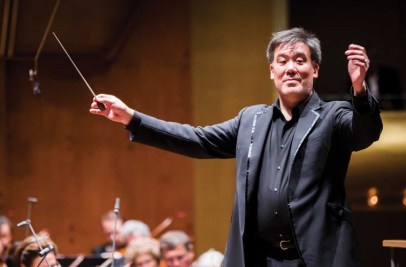
Two years ago, in February 2015, Alan Gilbertannounced his surprising decision to step down from his position as music director of the New York Philharmonic…
In their first program of the new year, Ludovic Morlot, the Seattle Symphony and guests offer an inspired pairing of Beethoven’s immortal Ninth and the spiritually attuned music of Olivier Messiaen.




 My
My 


