MEMETERIA

Icon

Arts writing by Thomas May

The “Glassy, Cool, Translucent Wave” of Milton

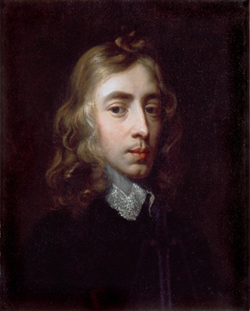
Portrait of Milton attributed to Sir Peter Lely

Portrait of Milton attributed to Sir Peter Lely


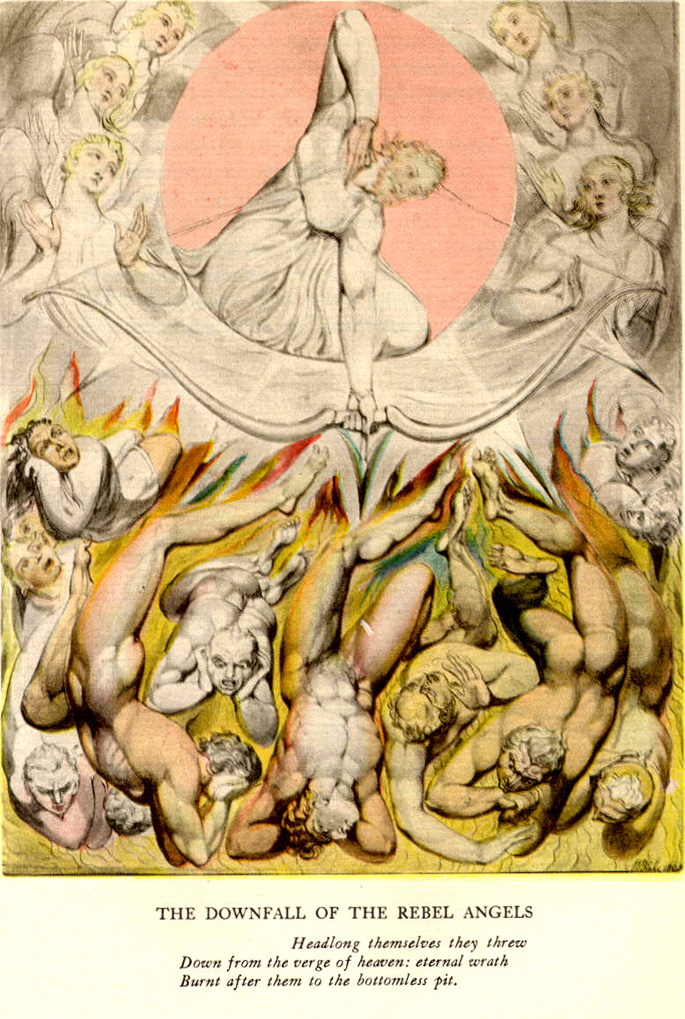
In honor of John Milton’s 405th birthday today, the New Republic pulled out this paean to the poet by Allen Tate, dating from October 1931. Tate uses the occasion of the first complete Milton edition – a project undertaken by Columbia University – to address “the place of poetic fiction in the modern mind.” Tate argues that Milton can serve as an important measure:

Milton does not ask us to believe his heavenly fictions in any sense that he did not believe them; Lucifer needs the same quality of belief as “old Damcetas.” He does ask us to exercise as much philosophical insight, passively, as he actively puts into his poetry. His philosophy is neither right nor wrong; it is comprehensive. It covers and puts in its philosophical place the modern shortsightedness that we shortsightedly call the revolution of the human mind, which is said to have made Milton’s poetry obsolete.

There has never been a revolution of the mind: There are only styles in fiction. Milton’s fiction is not in our style, and it seems inadequate to the solution of our problems. It is not diverting; it has no personality. We do not like it because it lacks these modern features; because it is creative in the purest sense. I think it was [Thomas] Warton who said that “Lycidas” was the absolute test of the sense of poetry; it still is. It is well to have one fixed criterion, for there is no abstract formula under the glassy cool translucent wave.
Milton2

Meanwhile, in an essay for the London Review of Books last spring, a skeptical Colin Burrow pondered the “unanswered” question: “How is it possible to like Milton?”:

There is certainly a great deal to dislike. Most people would think of him as an overlearned poet who combines labyrinthine syntax with a wide range of moral and intellectual vices. His views on sex and women, for example, were mostly gruesome….Miltonophiles also have to overcome his regrettable tendency to present himself to the world as a prig.
[…]
The best place to begin to like Milton is with his volume of Poems both English and Latin (1645). This was described by its publisher Humphrey Moseley as ‘as true a Birth as the Muses have brought forth since our famous Spenser wrote’ when it appeared in what we now call January 1646….

Why is the retrospective volume of Poems the best place to start if you want to like Milton? The answer is that it shows not Milton turgidulus, or Milton the sage and serious defender of republican learning, or Milton the achieved polymath, or Milton the heretical crank. It shows Milton in the making. In this volume you can hear the swirl of literary influences running through his mind. At this point Milton is willing to ravish the senses rather than simply to suspect them.
[…]

Learning to hear how hard Milton is working in these early poems is a big part of learning not just how to like but (for me anyway) to love the cussed old so and so. I have talked metaphorically of his ‘editing’ together different poetic voices, but this is slightly more than a metaphor, since Milton was a compulsive tweaker and editor of his own writing. He needed to prod his own imagination on, and sometimes (rather like his keenest student, Wordsworth) he felt the need to tell it severely to back off.
Cambridge University site for Milton’s 400th anniversary

Filed under: Milton, poetry

A (Re)Look at van Gogh

van Gogh, The Road Menders (1889), The Phillips Collection

van Gogh, The Road Menders (1889), The Phillips Collection


Another gem of a discovery during my recent trip was the Van Gogh Repetitions exhibit at the Phillips Collection, one of my old haunts in D.C. My initial reaction, I admit, was to wonder what kind of hook yet another van Gogh show could have, but the premise to this one really is intriguing.

Surprisingly, Repetitions is the first-ever exhibit devoted to van Gogh alone in the history of the Phillips, whose permanent collection boasts some very fine examples of his work. Its focus is not the usual one of the artist’s evolution over a span, punctuated by those highly dramatic episodes of his last years that are central to the van Gogh mythology. Repetitions instead invites the viewer to ponder the artist’s recurrent interest in certain subjects, setting multiple versions of a composition side by side for close comparison and contrast.

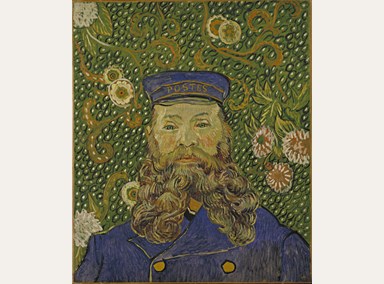
The Postman (1889) from the Kröller-Müller Museum, Otterlo

The Postman (1889) from the Kröller-Müller Museum, Otterlo

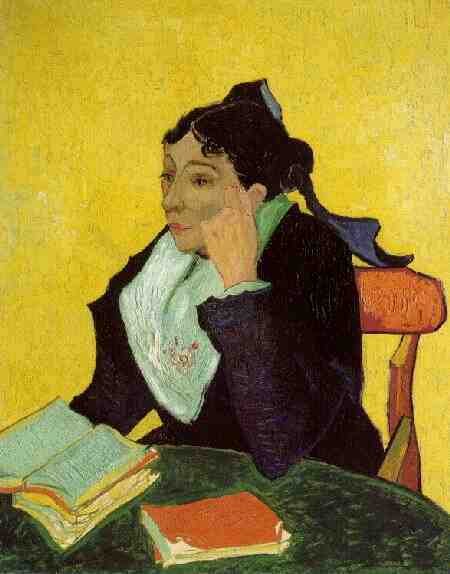
Van Gogh, we are told, himself used the term “repetitions” to describe his habit of returning to subjects such as Joseph Roulin (the famous “postman” of Arles) and the rest of his family, or Madame Ginoux (aka “L’Arlésienne”).

I would have liked a few of the missing pieces for fuller comparison (only three of his six versions of the Postman are actually gathered here). Still, the exhibit in general is attractively sized, with a total of just 35 portraits and landscapes — paintings and works on paper — and thus all the more conducive to intimate close-up viewing and “repetitions” of the viewer’s gaze.

THe Postman (1889), The Museum of Modern Art, New York

The Postman (1889), The Museum of Modern Art, New York

The differences trigger a cascade of questions about van Gogh’s process, technique, aesthetic criteria, and inspiration in general. It’s fascinating, for instance, to see his presentation of his friend Roulin morph between “Northern” naturalism and more abstract, post-Impressionist patterns – or even to compare the echoing decorations he devises for the background.

By juxtaposing examples of spontaneity – as in the version of Madame Ginoux the painter said he “knocked off” in just an hour — against a more painstakingly calculated return to the same subject, Repetitions encourages the viewer to set aside the cliches still clinging to van Gogh’s public image (above all of the mad, self-mutilating genius).

L'Arlésienne (1888), version in the collection of the Metropolitan Museum, New York

L’Arlésienne (1888), version in the collection of the Metropolitan Museum, New York

Since I’ve been listening obsessively of late to the Goldberg Variations (for an upcoming piece on Jeremy Denk’s recent recording), I was drawn to the analogies with what composers do in mutating themes or similar motivic material – how changes in tempo, harmonic emphasis and color, or rhythmic articulation can reveal an unsuspected dimension to what we’ve encountered in another form. It’s perhaps nitpicky, but that’s exactly what these (re)visions of the same subject offer – not literal repetitions.

Van Gogh himself likened his process to varying musical interpretations of a score. The curator’s notes also draw attention to the musical qualities he associated with his theory of “color harmonies” – as in the changes introduced to the flowers in the background of La Berceuse (Madame Roulin rocking an invisible cradle), of which he produced five versions.

La Berceuse (1889), Museum of Fine Arts, Boston

La Berceuse (1889), Museum of Fine Arts, Boston

What of the music van Gogh’s paintings have inspired? Somehow I have a feeling that the late Henri Dutilleux’s Timbres, espace, mouvement (1978) gets us a bit closer to the complexity that is van Gogh than Don McLean’s sweet but sentimental “Starry, Starry Night.”

Filed under: art exhibition

A Tragedian Turned Comic Master

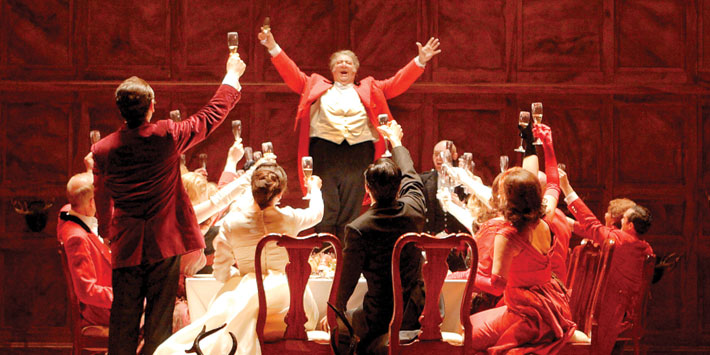
Ambrogio Maestri as Falstaff

Ambrogio Maestri as Falstaff


The Met’s new production of Falstaff, opening tonight, replaces the long-standing Zeffirelli production with a staging directed by Robert Carsten – and it brings James Levine back to the pit for what he has declared to be his favorite Verdi opera.

I was fortunate to have another opportunity to write about this crowning glory of Verdi’s career. Here’s my essay for the Met’s program:

“The great dream has come true,” wrote Arrigo Boito, the librettist of Verdi’s Otello and Falstaff, shortly before the former opera was unveiled in 1887. Otello‘s premiere was an internationally feted success, bringing to fruition a proposal that had started eight years earlier when it was tentatively broached over the course of a dinner conversation.

Boito refers to Verdi’s dream of creating a new opera based on his beloved Shakespeare, but he might just as well have marveled at the feat of luring the aging composer out of his self-proclaimed retirement from the opera stage. Otello didn’t just represent a late-career comeback: it marked the summit of Verdi’s achievement as the greatest of Italy’s operatic tragedians.

Verdi had become so identified with the tragic genre that Otello must have seemed the perfect culmination of his life’s work. Yet Boito was determined, as he put it in a letter to a friend, “to make that bronze colossus resound one more time.” Verdi, for his part, had long harbored a desire to prove that the scope of his art extended beyond the dramas of gloomy passion with which he had built his reputation.

continue reading (starts on p. 12)

Filed under: Metropolitan Opera, program notes, Verdi

The Vanishing

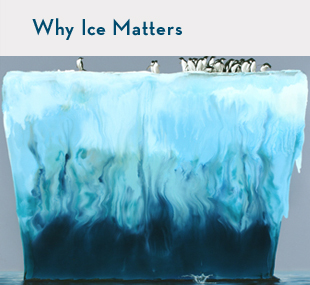
Alexis Rockman: Adelies (2008); collection of Robin and Steven Arnold

Alexis Rockman: Adelies (2008); collection of Robin and Steven Arnold


A new exhibit at the Whatcom Musuem in Bellingham, Washington, examines the specter of disappearing glaciers in this era of climate change:

“Vanishing Ice” … in its array of various mediums, conveys the beauty of alpine and polar regions—the pristine landscapes that have inspired generations of artists—at a time when rising temperatures pose a threat to them.

As the exhibition’s narrative tells, ice has captured the imaginations of artists for centuries. The very first known artistic depiction of a glacier dates back to 1601. It is a watercolor depicting the topography of the Rofener Glacier in Austria by a man named Abraham Jäger. But, in the 18th and 19th centuries, it became more common for artists, acting also as naturalists, to explore glaciated regions, fleeing the routine of everyday life for a jolting spiritual adventure. Their artistic renderings of these hard-to-reach locales served to educate the public, sometimes even gracing the walls of natural history museums and universities…The recent art tends to illustrate the disheartening findings of climate experts.
[…]
Patricia Leach, executive director of the museum, sees “Vanishing Ice” as a powerful tool. “Through the lens of art, the viewer can start thinking about the broader issue of climate change,” she says. “Believe it or not, there are still people out there who find this to be a controversial topic. We thought that this would open up the dialogue and take away the politics of it.”

Filed under: art exhibition, environment, science

Damage Control at the Hirshhorn

Landing: detail of photograph by Thomas Demand

Landing: detail of photograph by Thomas Demand


My first trip back to the Hirshhorn after an absurdly long hiatus was well rewarded: I could have easily spent many more hours exploring the exhibition Damage Control: Art and Destruction Since 1950.

Harold Edgerton’s landmark films of the U.S. government’s nuclear tests in the 1950s launch the show. They set its underlying tone of dizzying terror mixed with a paradoxical beauty. The aftertaste this leaves – uniquely disturbing yet fascinating – is comparable to the old-fashioned aesthetic rubric of “the sublime,” as the critic Philip Kennicott aptly points out in his excellent Washington Post review:

Most visitors, conventionally secure in the magical belief that these weapons will never again be used, will find them beautiful in a limited, purely visual way. And that isn’t particularly strange: Since the 18th century, we have had an aesthetic category for this — the sublime — into which we place and contain things that are awesome, boundless, incomprehensible and beyond imagining. There is even a measure of old-fashioned pride in our love of the sublime: Look what man has wrought.

The end of the Second World War was seen to mark the “zero hour” – and the start of something ominously new after so much destruction and nihilism – yet no doubt in the coming year we’ll encounter many reminders of how consciousness was radically changed by the earlier cataclysm that erupted in 1914. And many of the exhibit’s works provoke comparisons with the recurrent theme of revolution and overthrow that has shaped modernity itself.

One of Raphael Montañez Ortiz’s notorious piano destructions appears in the vicinity of the films of nuclear detonation. The aftermath evidenced by these ruins of twisted wire and axed wood encourages the viewer to try to make sense of the rubble – perhaps even to imagine the sounds that could now be elicited from it. It’s ultimately a romantic gesture, an echo of the rock gods of the ’60s and the sacrificial offering of their instruments at the climax of a performance: as if to signify a point of extreme expression and release, after which …only noise or silence can rule.

One of the most profoundly unsettling uses of musical imagery occurs in Christian Marclay’s Guitar Drag from 2000, a video piece viewed within a narrow gallery space. It shows the artist roping a Stratocaster guitar to the back of his pickup truck and dragging it mercilessly across a rural Texas landscape. The soundtrack consists of the instrument’s tormented screams, amplified from speakers strapped to the back of the truck. Marclay’s reference to the horrendous contemporary lynching of James Byrd is beyond chilling.

The natural life cycle of music – the birth and death of sounds – is distorted in ways that underline how utopian is the illusion of the artist’s control of material. I also found myself repeatedly thinking of the principle of entropy and the natural decay of order. Here and in many of the other installations, videos, photographs, and concept pieces, the glorification of violence from earlier in the twentieth century is turned on its head, forcing us to rethink the facile acceptance of destruction as part of the pattern of “progress.”

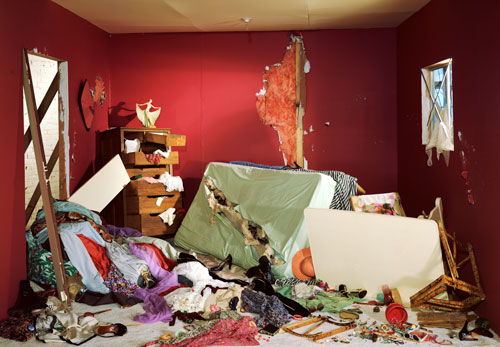
Jeff Wall, The Destroyed Room (1978)

Jeff Wall, The Destroyed Room (1978)

Kennicott reflects on the ambivalence of destruction as metaphor and the political claims of art:

There is no readily agreed upon contract for when it is okay to destroy things in the name of art, but there are degrees of transgression and limits to the acceptability of consequences. There is a big difference between Rauschenberg’s asking for and receiving permission to erase a drawing by de Kooning and the vandalism of the brothers Jake and Dinos Chapman, who painted cartoon clown and animal faces onto an original set of Goya’s 1810-1820 “The Disasters of War” etchings. In no conceivable universe is the loss of these Goyas compensated for by the trivial graffiti the Chapmans have added, which not only defaces them but further victimizes the victims of war Goya originally depicted.

One can generate elaborate justifications for vandalism to put it into seemingly acceptable art terms. Ai Weiwei may have destroyed an ancient urn (given what we know about China’s art market, there’s no certainty it wasn’t a fake), but only in the name of calling attention to the Chinese government’s systematic destruction of ancient neighborhoods and historical sites (and as a further criticism of the crazy, commercial race to own and exchange antiques). And the Chapmans may have been satirizing some underlying sadism in Goya’s work and perhaps the aestheticization of war through art as well.

Those arguments mean something only within the insular and deeply provincial space of the art world, where people still have an inflated sense of art’s power and often believe it can effect direct and revolutionary change in the world. The worst of what is on display in this exhibition is driven by the false belief that art can somehow compete with political power if it finds images or ideas or gestures that are stark enough, violent enough, to cut through the noise. In fact, compared with people who have real power — over armies, economies and the means of entertainment — artists have virtually none at all and are too often driven to a kind of futile rage through a vague sense of their own impotence.

Filed under: aesthetics, art exhibition, art history

People Who Need People

Carthage in Berlioz's Les Troyens: ROH production by David McVicar (photo: Cooper)

Carthage in Berlioz’s Les Troyens: ROH production by David McVicar (photo: Cooper)

The science journalist Ed Yong sums up two recent studies showing the significance of social interconnection:

Now, two teams of scientists have independently shown that the strength of this cumulative culture depends on the size and interconnectedness of social groups. Through laboratory experiments, they showed that complex cultural traditions — from making fishing nets to tying knots — last longer and improve faster at the hands of larger, more sociable groups.

Psychologist Joe Henrich, lead author of one of the studies, brings up the implications of these findings for the Internet era:

“Innovations like literacy, writing and mail allowed us to access the thoughts of people in distant places and times,” says Henrich. “Extend that to the Internet, and things should only speed along even more.”

Jong points out an additional issue suggested by the two studies: “a large population size may be necessary for the evolution of cumulatively complex cultures, of the sort that distinguishes modern humans from other primates.”

For example, Henrich notes that many anthropologists assumed that Neanderthals were less intelligent than humans even though their brains were the same size, because they built less complex tools. “Another possibility is that they lived in scattered groups without much interconnectedness,” he says. They lacked the large groups that ratchet culture to new heights.

But [primatologist Lewis] Dean notes that human culture is more sophisticated than these experiments allow. We help one another with complex tasks, teach each other and provide feedback. “I think the experiments risk underestimating what all groups, including small ones, can achieve,” he says.

Is it too far-fetched to try to extrapolate from this a model for the evolution of musical thought vis–à–vis sophisticated ensembles such as the string quartet or modern orchestra?

Filed under: science, sociology

William Kentridge and The Refusal of Time

William Kentridge: >i>The Refusal of Time: Dickensian "Elephant"

William Kentridge: The Refusal of Time: Dickensian “Elephant”


After the Met’s recent revival of The Nose, I was eager to see The Refusal of Time, a 30-minute-long video installation by Kentridge currently being exhibited at the other Met. It was first unveiled at Documenta 13 in Kassel, Germany (2012). Rumor has it that The Refusal of Time may feature in SFMOMA’s grand reopening in 2016.

The installation includes the “surround-video” effect of five films moving across the space of three screens, all enhanced by Philip Miller’s score of menacing tuba drones, breathing sounds, ululation, and what resembles an army of madly hammering Nibelungs. The soundtrack is projected through looming old-fashioned movie-set megaphones. The films involve images of relativistic metronomes, Kentridge’s characteristic animations and charcoal figures, and an eccentrically parade-dance of vaudevillean silhouettes.

The center of the space itself is dominated by a wooden contraption, a “breathing” machine-sculpture – part Victorian-industrial fantasy, part There Will Be Blood oil drill – that Kentridge explains was inspired by a description in Charles Dickens’s Hard Times of a factory machine “[moving] monotonously up and down, like the head of an elephant in a state of melancholy madness.”

The installation’s title – it reminds me of a moralizing Baroque drama – meanwhile draws together reflections on the collision between “progress” and colonialism, automation, and the physics of time in the early 20th century. From the accompanying text:

Kentridge’s recent interest in the nature of time was given focus through the work of Peter Galison, a Harvard-based historian of science. Galison studied a 1905 paper on relativity in which Albert Einstein hypothesized that, due to the delay in signals relayed via telegraph wire, peripheral railway stations synchronized on a centralized clock were forever fated to operate seconds behind schedule.

Einstein’s nascent theories about the relativity of time converged with French mathematician Henri Poincaré’s development, as president of the Bureau des Longitudes, of global time zone maps at the dawn of the twentieth century. Both scientists faced the radical idea, in a newly industrialized and interconnected world, that time is not absolute but relative and resistant to control.

Kentridge1

On the occasion of the opening in Kassel, Margaret K. Koerner published an interview with William Kentridge and Peter Galison. Kentridge explains how the work is linked to his recent Norton Lectures at Harvard:

The sixth Norton lecture took the process of making “The Refusal of Time” as an example of what the lectures had been talking about: of thinking through material, of allowing the impulses of an image or a piece of work to hold sway and see where they led. Live music was allowed to come into the lecture form at the end of the sixth lecture. The lectures, which started with Plato, end with a black hole. Even though we weren’t starting with Plato in “The Refusal of Time,” the shadow procession came back as well, and it also ends with a black hole…. The image you see at the end, those white holes going down and down, that’s the roll from a player piano. It is both music and information….

[“The Refusal of Time”] starts with: Is a black hole the end of time? As Peter [Galison] was saying, that is one of the questions that physicists consider. But as soon as you say, right, let’s start having things disappear into a black hole, it is an immediate jump to that being, as it were, a metaphorical description of death. Is any trace left when you are gone? Is there any information, attributes of you that still float around the edge? So it is both from the psychological, or the lived sense of, what is the balance between the finality of death and the continuation of attributes of people afterward?

Filed under: art exhibition, film, social criticism, video art, visual art

Reflections on Shadow

Anne Schwanewilms as the Empress, Torsten Kerl as the Emperor, and Scott Weber as the Falcon; photo by Ken Howard

Anne Schwanewilms as the Empress, Torsten Kerl as the Emperor, and Scott Weber as the Falcon; photo by Ken Howard

I’m still ruminating on the recent peak experience I had at the Metropolitan Opera: this season’s revival of Richard Strauss’s Die Frau ohne Schatten, directed by the late Herbert Wernicke (which I had missed when it was unveiled in 2001).

The world of Strauss and Hofmannsthal has long felt very familiar to me, but there’s no question that Frau emits a strangeness that veer perilously toward the overly precious or the downright obscure if all its elements aren’t carefully balanced.

But when they are – as they were for this overall superb production – the rewards defy comparison with just about any other opera experience I can summon. Frau doesn’t merely reaffirm the excellence of opera as an art form: it suggests an entirely new dimension of operatic possibility rarely hinted at even by many acknowledged masterpieces.

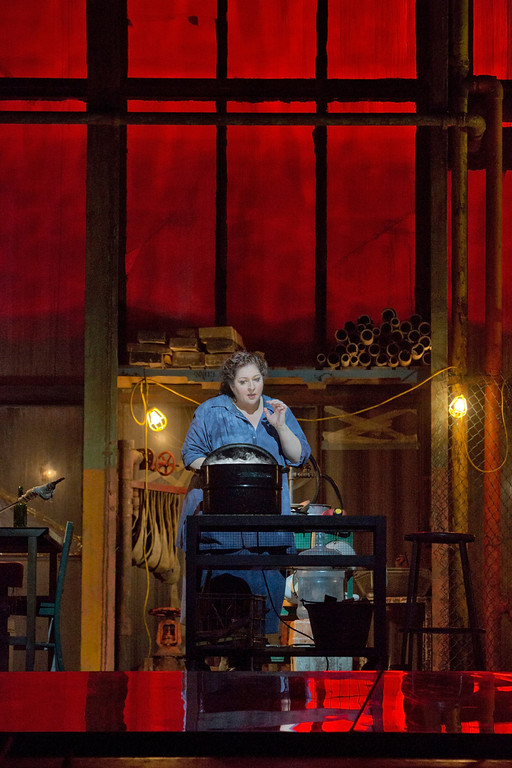
Christine Goerke as the Dyer’s Wife; photo by Ken Howard

Christine Goerke as the Dyer’s Wife; photo by Ken Howard

Not everything is perfect in the Met’s production, not all the questions this phantasmagoria of Hofmannsthal and Strauss leaves you wrestling with get answered, or even clarified as questions (are they even meant to?). Some of these are mundane, some of key relevance to the opera’s meaning: Why do we occasionally see the Empress’s shadow (or were those reflections?)? Why are Barak and Keikobad the only characters with names? Why does Keikobad relent in a Sarastro-like reversal of the way he’s been introduced to us? What really drives the Nurse? And on and on….

Here’s a little collage from some of the more interesting reviews of the recent revival:

John Yohalem:

Herbert Wernicke’s 2001 production, now revived and revised, is a fine, gaudy bit of stagework. The walls of mirror for the magical realm, enhanced by projections, doubles, torches and the Met’s underappreciated stage elevator (absolutely silent as the four- or five-story set slithers back and forth, in and out, up and down!) make a dandy backdrop for multidimensional show, and the mirrors conceal inopportune shadows until the story is ready to receive them. The seamless flow of stage-high trickery in Act III should tickle any theatrical fancy.

Ildikó Komlósi as the Nurse; photo by Marty Sohl

Ildikó Komlósi as the Nurse; photo by Marty Sohl

Micaela Baranello

Wernicke’s Met production is a great success, and actually lives up to the music’s energy and atmosphere…The design—all by Wernicke—is the primary attraction. The world of the Empress, Emperor, and Nurse is a mirrored box, whose transformations are seen in various dramatic flickering lighting effects. In contrast to this glamour, the Dyer’s house is in a gritty sewer or subway, located below the box and connected by a fire escape staircase…The upper level is timeless and mythic, the lower contemporary and realistic…

The upper level is timeless and mythic, the lower contemporary and realistic (Act 1 ends with the dyer Barak poignantly staring into an open refrigerator). The implication is vaguely Marxist: the Empress (surrounded by narcissistic mirrors) is exploiting the literal underclass, for whom she gradually learns compassion. The finale is Brechtian–or lieto fine-ian—with the lighting scaffold descending to reveal the stage mechanism and the singers addressing the audience directly. Since the music does not follow suit in any way, I found this gesture a little ineffective, but overall this is a very strong and convincing production.

James Jorden:

[Frau] represents the Met at its peak: Every element melds into an overwhelming artistic experience. It’s how you dream opera ought to be. The Woman without a Shadow even feels like a dream or rather a nightmare one might have dozing off while cramming for a final exam on Advanced Jungian Analysis….

In an interview published at the time of the production’s premiere, [Wernicke] declared, “The shiny, mysterious realm of spirits and the poor, low-class world of the Dyer, Barak—that’s just like New York’s lofty Central Park West apartments, in their harsh contrast to the underworld of poor people and outcasts and the subways, where the homeless fight over leftovers with the rats.”

 Christine Goerke as the Dyer's wife) and Johan Reuter as Barak; photo by Ken Howard

Christine Goerke as the Dyer’s wife) and Johan Reuter as Barak; photo by Ken Howard

Eric Simpson:

In Wernicke’s concept, the Emperor and Empress rule over an ethereal plane represented on the stage by a mirrored tunnel. It is remarkable how much is accomplished here using only scrims and lighting (it’s hard to remember a time when computer projections weren’t the industry standard). In the mirror-world, the various characters have strongly evocative auras that light up the set. The stunning pink-and-blue diffusion that accompanied the Empress’s first entrance gave the audience a sense of what life might be like on the inside of a jellyfish.

When the time comes to journey into the mortal realm, the entire set rises up to reveal a dreary warehouse that serves as the dyer Barak’s home and workplace. The contrast between the two settings is striking—where the upper plane is blindingly radiant but physically spare, the dyer’s workshop is fully and realistically furnished but lit only by overhead factory lights.

Martin Bernheimer:

It began – and ended – in 2001. Herbert Wernicke startled the basically conservative Met with an astonishingly progressive production of Richard Strauss’s magnificently bloated Die Frau ohne Schatten. He actually made theatrical sense of Hugo von Hofmannsthal’s high-minded, hopelessly convoluted libretto.

Serving as his own designer and lighting magician, Wernicke played the spiritual scenes in a surreal hall of mirrors. For the mundane episodes, he created a contemporary milieu resembling an industrial warehouse. For the ultimate resolution, he introduced neo-Brechtian imagery. He dealt in revelations at all levels.

I tracked down a full program (in German only) from Robert Carsen’s production for the Wiener Staatsoper, which is brimming with information and fascinating essays.

Meanwhile, Krzysztof Warlikowski’s production of Frau for Bayerische Staatsoper will be streamed live this coming Sunday (December 1), starting at 6 pm CET. Be careful: this is heavily addictive stuff.

Filed under: Metropolitan Opera, opera, Strauss

New Uses for the Old Story: NBA Poetry Winner Mary Szybist

Incarnadine

Congratulations to Mary Szybist, who was chosen last week as winner of the National Book Award for Poetry for Incarnadine, her second book of poetry, cited by the NBA jury as a collection that “probes the nuances of love, loss, and the struggle for religious faith in a world that seems to argue against it” and “a religious book for nonbelievers, or a book of necessary doubts for the faithful.”

Shara Lessley interviewed Szybist for the National Book Foundation, asking her about her imaginative reconsideration of the Annunciation motif and her ability “to locate the Virgin Mother in so many unlikely places.” Szybist responded:

The poem that most haunted me while writing the book is W. B. Yeats’s “Leda and the Swan.” By emphasizing the terror of the event, the brutal indifference and power of the god, he suggested something about the character of the era that unfolded from it. It is with a nod to Yeats’s strange vision of history and his idea that every two thousand years the world’s temperament changes as the result of an encounter between human and divine that I am reflecting on the kinds of encounters happening around us. What counts as the sacred now? What kinds of encounters are we witnessing? And what are those encounters engendering? By offering a multitude of Annunciation possibilities, I wish to unsettle and, to some extent, take leave of the old story, even as I try to find new uses for it.

In an essay on Incarnadine and the work of the poet Charles Wright, Lisa Russ Spaar writes:

Smart, unflinching, beautiful, the poems in Incarnadine embrace the paradoxes of love: love of being beheld, of being beholden, of being “done unto,” and of what it means to care for what we make of what we are given, or not given, of what it means to “see annunciations everywhere,” in disasters, tragedies, moments of grace and miracle….

In “To Gabriela at the Donkey Sanctuary,” Szybist writes, “It’s not enough to say the heart wants what it wants.” Maybe not. But readers can be grateful to Wright and Szybist (two “solitaries…calling”) for believing that the world, with its hard news, its complicated incarnations, is nonetheless “made of more than all its stupid, stubborn, small refusals.” Among that “more” is the work of these two important and soul-nourishing poets.

You can find a recent podcast about Szybist’s “On Wanting to Tell [] about a Girl Eating Fish Eyes” here.

Filed under: American literature, poetry

The Two Cultures and the Idea of Beauty

Large Hadron Collider at CERN being constructed

Large Hadron Collider at CERN being constructed


The Science Museum in London currently has an exhibition on the Large Hadron Collider on view. In connection with the exhibition, The Guardian invited theoretical physicist Nima Arkani-Hamed and novelist Ian McEwan to engage in a conversation about the rapport between science and the arts.

The chemist and novelist C.P. Snow coined the phrase “the Two Cultures” in his Rede Lecture in 1959 to characterize the seemingly unbridgeable divide between the sciences and the humanities that had come to replace the omnivorous appetite for knowledge of the Renaissance. Arkani-Hamed observes:

It’s an asymmetry that doesn’t really need to exist. Certainly many scientists are very appreciative of the arts. The essential gulf is one of language and especially in theoretical physics, the basic difficulty is that most people don’t understand our language of mathematics which we use to describe everything we know about the universe. And so while I’m capable of listening to and intensely enjoying a Beethoven sonata or an Ian McEwan novel it can be more difficult for people in the arts to have some appreciation for what we do. But at a deeper level there’s a commonality between certain parts of the arts and certain parts of the sciences.

He also observes that the idea of “beauty” is at its core something shared by science and the arts, explaining that “what we mean by beauty is really a shorthand for something else. The laws that we find describe nature somehow have a sense of inevitability about them.”

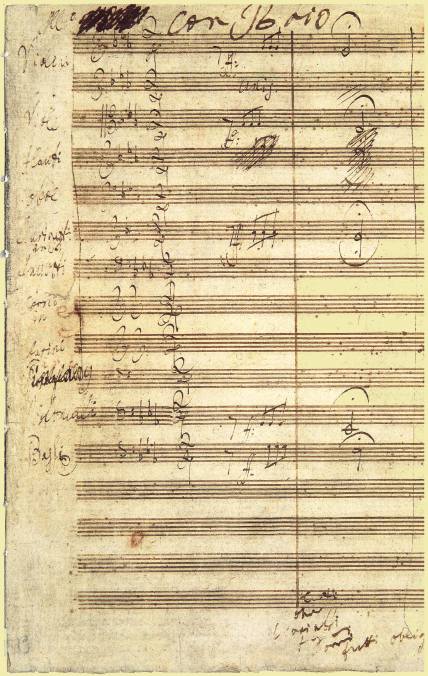
Beethoven's working MS for the opening measures of his Fifth Symphony

Beethoven’s working MS for the opening measures of his Fifth Symphony

A year ago I ran into this great lecture on YouTube by Leonard Bernstein about the first movement of Beethoven’s Fifth. And Bernstein used precisely this language – not approximately this language – exactly this language of inevitability, perfect accordance to its internal logical structure and how difficult and tortuous it was for Beethoven to figure out. He used precisely the same language we use in mathematics and theoretical physics to describe our sense of aesthetics and beauty.

Filed under: aesthetics, science

Archive

Enter your email address to follow this blog and receive notifications of new posts by email.