MEMETERIA

Icon

Arts writing by Thomas May

A Ceremony of Britten

Benjamin Britten and Peter Pears

Benjamin Britten (r) and Peter Pears (l)

And so we arrive at the last of the big three composer anniversaries this year – the anniversaries that not so long ago seemed to loom on the other side of the apocalypse said to be awaiting us in 2012. November 22 – Saint Cecilia’s Day, the patron saint of music, as it has become obligatory to point out – marks the official centenary of the birth of Benjamin Britten.

I wish I could come up with something a fraction as eloquent as my colleagues to pay tribute to the creative genius of this endlessly fascinating figure, but my recent essay on the War Requiem will have to do the honors:

Ruin and Renewal: Britten’s War Requiem

“I was completely absorbed in this piece, as really never before, but with considerable agony in finding the adequate notes for such a subject (and such words!), and dread discovering that I’ve not succeeded.” So Benjamin Britten confided to a friend not long before the War Requiem‘s premiere in May 1962.

Britten’s agony produced not only one of the landmark compositions of his career but a testimony to the power of art to confront humanity’s failings and at the same time to offer hope. As for the dread of not succeeding, the War Requiem stands out as a rare instance in 20th-century music of a new work that was greeted with overwhelming approval by critics and audiences alike.

“The composer’s duty, as a member of society,” declared Britten in his famous speech accepting the Aspen Award in 1964, “[is] to speak to or for his fellow human beings.” From first note to last, the War Requiem holds true to this conviction of the role of music in society. The ethical perspective of the lifelong pacifist who had been a conscientious objector in the Second World War converges with the remarkable gifts that made Britten one of the supreme musical dramatists of the past century and a master of large-form architecture.

At the same time, the imperative to communicate by no means requires adhering to safe, comfortable formulas. In taking up one of the most tradition-laden texts of Western music, the Latin Mass for the Dead, Britten challenges and reinvigorates the very meaning of this ritual.

After the Second World War, the composer had actually considered Requiem-like works to commemorate the victims of the atomic bombings of Japan and, later, the assassination of Gandhi, but these plans never crystallized. Earlier, in 1940, he had written a purely instrumental Sinfonia da Requiem, but that work exists in a category all its own. The commission to supply a new score as part of the upcoming consecration of the newly rebuilt Coventry Cathedral provided Britten with the stimulus he needed at last to embark on a large-scale choral-symphonic composition.

Winston Churchill visits Coventry Cathedral in ruins after the bombing of 14/15 November 1940

Winston Churchill visits Coventry Cathedral in ruins after the bombing of 14/15 November 1940

Carpenter suggests that the composer’s sadness over the recent suicide of a former friend who had survived the war but struggled with depression may have also occasioned the need to compose the War Requiem as a more private response to tragedy. This may explain Britten’s puzzling statement: “That’s what the War Requiem is about; it is reparation.” In his recently published Benjamin Britten: A Life for Music, the biographer and journalist Neil Powell notes that “a work which had originated as a very public commission was increasingly concerned with a very private subtext.”

Bombing raids by the Luftwaffe during the blitzkrieg in 1940 had nearly destroyed the industrial city of Coventry in the West Midlands, including the Gothic Cathedral of St. Michael dating from the 14th century. The Scottish architect Basil Spence designed a new modernist structure, but not merely as replacement: he decided to retain the roofless, ruined shell of the earlier church, whose spire had been left standing, and link it to the new building.

The consecration ceremony thus offered an occasion to reflect on the destruction wrought by the war – at the height, it will be recalled, of the Cold War that was threatening outright annihilation of humanity. Just a few months after the War Requiem‘s premiere, the Cuban Missile crisis would bring the West to the brink of apocalypse.

Wilfred Owen

Wilfred Owen

Britten wasn’t interested in a reassuring but simplistic idealism about the sacrifices of war that whitewashed or forgave war’s inherent atrocity. The War Requiem – the title itself suggests an uneasy juxtaposition – thus combines the traditional Latin texts (with one telling change, in the Agnus Dei) with the mordantly ironic antiwar poetry of Wilfred Owen, a victim of the First World War. (His brother Harold sent Britten a letter praising the War Requiem and expressing joy “that Wilfred’s poetry will forever be a part of this great work.”)

The implicit homoeroticism of Owen’s poetry also resonated with Britten, who had already set his words to music alongside several other poets in the song cycle Nocturne (1958); its sound world in fact foreshadows parts of the War Requiem. As an epigraph to the latter, Britten quoted a passage by Owen that mirrors his own vision here as a composer: “My subject is War, and the pity of War. The Poetry is in the pity. All a poet can do is to warn.”

To anchor his antiwar message, Britten taps into a tradition of sacred music which carries a plea for peace amid contemporary turmoil. Well-known examples from the sacred music canon are Haydn’s Missa in tempore belli and Beethoven’s Missa solemnis. Britten’s mixture of Latin liturgical texts with secular poetry is likewise not without precedent. Yet he juxtaposes the poems of Owen so that they become a provocative commentary on the familiar Requiem. The result is a complex yet ingeniously lucid six-movement structure in which is embedded an ongoing song cycle for tenor and baritone.

In a sense, this fusion of the ancient and the modern to underscore both the “pity” and the poet’s warning – the secondary level that comments on the primary, ritual, archaic level – might be interpreted as the composer’s musical and textual counterpart to Spence’s bold architectural design.

In his Aspen speech, Britten refers to the importance of suiting the music to the setting: “The best music to listen to in a great Gothic cathedral is the polyphony which was written for it, and was calculated for its resonance: this was my approach in the War Requiem. I calculated it for a big, reverberant acoustic and that is where it sounds best.”

But it’s more specifically Spence’s conflation of ruin and renewal that is replicated in Britten’s unique structure, which at several points subverts the expected biblical truths. This happens to especially devastating effect, for example, in Owen’s dark retelling of the sacrifice of Isaac, which intervenes in the Offertorium and inverts its message with terrible irony.

Immediately following this is the shockingly triumphant Sanctus, with its echoes of both ceremonial gamelan music and Monteverdi; this in turn is countered by Owen’s poetic denial of the afterlife’s consolation in the baritone’s solo. The apocalyptic and the personal, the archetypal pattern and the concretely, painfully historical moment – these are the different planes which intersect in fascinating ways throughout the War Requiem.

Britten’s vast array of performing forces further points to the architectural and spatial aspects of his conception. The scoring is divided into three groupings that are perceived to emanate from three distinct spheres. There is the conventional sound world of the full orchestra (including enlarged brass and percussion sections) and mixed chorus, which sings only the Latin texts, and the soprano solos.

If these performers are the world of humanity in general, facing our mortal condition, the boys’ choir, accompanied throughout by organ or harmonium, exists suspended beyond it as the voice of eternal, angelic innocence. (Britten specifies that their sound is to be “distant.”) The third level, with its reduced satellite orchestra and two male soloists, is closer to the world of art song and chamber opera. This is the real world of violence and meaningless death, not ideals – the plane on which innocence is corrupted.
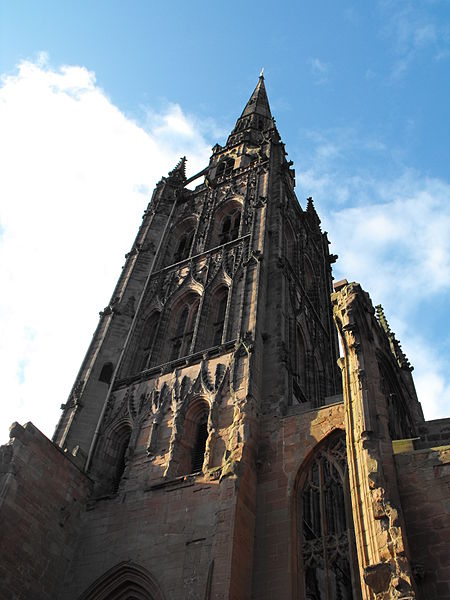
Spire of Coventry Cathedral

Spire of Coventry Cathedral

Mediating among all these spheres is the core harmonic idea of the War Requiem: the interval of the tritone (heard at the outset as C pitted against F-sharp), whose instability highlights the pervasive feeling of ambivalence. “There are very few easy resolutions in Britten’s later work,” writes Powell, “and ease, when it is attempted, is always troubled by ambiguity.”

This is how Powell reads the composer’s statement near the end of his life about the effect on him of witnessing Belsen and other former concentration camps during a tour he and Yehudi Menuhin undertook shortly after the Second World War. Britten said “that the experience had colored everything he had written subsequently,” as his partner Peter Pears disclosed.

In his unforgettable setting of the final Owen poem, Britten dissolves the scene of immense pathos of the former enemy soldiers meeting after death. As they choose eternal peace and oblivion, Britten leads us into the final Latin prayer In Paradisum, where, for the first time, he joins all the performing forces together. The chorus repeats the harmonic sequence that had concluded the first movement, but the composer forces us to wonder: is this merely the reboot of humanity’s eternally recurring pattern?

(C) 2013 Thomas May. All rights reserved.

Filed under: Britten, choral music, requiem

Da Vinci’s Viola Organista

Sketch from Leonardo da Vinci's Codex Atlanticus

Sketches from Leonardo da Vinci’s Codex Atlanticus


Just ran across This Is Colossal‘s report on the Polish pianist Slawomir Zubrzycki’s realization of one of tne wildly imaginative hybrids Leonardo da Vinci dreamed up in his notebooks. Sketches for this “viola organista” – a mating of the principles of stringed and keyboard instruments – are found in da Vinci’s massive collection of sketches known as the Codex Atlanticus.

Zubrzycki demonstrated his new version of this invention at the recent International Royal Cracow Piano Festival. The Colossal‘s story links to this more-detailed account at The History Blog of the background of the viola organista and attempts to realize it, including this early one:

Almost a hundred years [after the da Vinci sketches] in 1575, church organist Hans Hyden of Nuremberg created the first functional bowed keyboard instrument operated by a foot-treadle. He used gut strings (later switched to metal when the gut strings failed to say in tune) and five or six parchment-wrapped wheels which, when turned by the treadle and a hand-crank at the far end operated by a helper, would be drawn against individual strings determined by which keys were played. Hyden claimed his instrument could produce crescendos, diminuendos, vibrato and sustain notes indefinitely solely through finger pressure on the keys. He even said it could duplicate the voice of a drunk man.

He called it a Geigenwerk (meaning “fiddle organ”) which is the German translation of da Vinci’s name for it, but although some sources imply or claim he based his design on da Vinci’s, I have serious doubts about that. Leonardo was hugely famous in his lifetime and after, but it was for his art, not his notebooks. Bequeathed to his friend and apprentice Francesco Melzi, the notebooks were sold off piecemeal by the Melzi family after Francesco’s death in 1579. Pages were scattered to courts and collectors all over Europe. Some of Leonardo’s notes on painting were published in 1651, but the bulk of the notebooks only made it into print in the 19th century. I don’t see how Hyden could have had had access to them.

None of Hyden’s Geigenwerks — he’s reputed to have built as many as 32 of them although only two are thoroughly documented — have survived. The details of its operation and the sole surviving illustration of the instrument have come down to us from German composer and music theorist Michael Praetorius who included one of Hyden’s original pamphlets describing the machine and a woodcut of it in the appendix to the second volume of his Syntagma Musicum, published as the Theatrum Instrumentorum seu Sciagraphia in 1620.

Hat tip: Benjamin Lukoff (Twitter @lukobe)

Filed under: da Vinci, instruments, music news

Lawrence Brownlee, Tenor of Grace

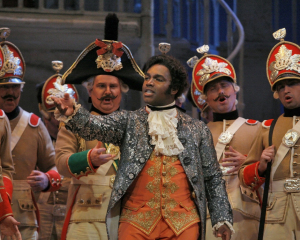
Lawrence Brownlee as Almaviva in Barber, one of his signature roles; photo by Ken Howard

Lawrence Brownlee as Almaviva in Barber, one of his signature roles; photo by Ken Howard

The marvelously gifted tenor Lawrence Brownlee makes his Los Angeles Opera debut as Tamino this coming weekend in the Barrie Kosky production of The Magic Flute. Here’s a profile I recently wrote about Larry for Seattle Opera, where he appeared last month as Tonio in The Daughter of the Regiment:

Nowadays no American tenor is more in demand than Lawrence Brownlee when it comes to the bel canto repertoire. And it’s easy to imagine the impression Brownlee’s voice—with its signature combination of sweetness, warmth, and flexibility—would have made on Gaetano Donizetti, or any of the bel canto composers. With their elegant melodies and deeply felt emotions, they were writing, it seems, specifically to Brownlee’s strengths, and he has proved that he has the versatility to excel in the distinctive styles developed by each member of bel canto’s famous triumvirate: Donizetti, Bellini, and Rossini.

“People always tell me I sound like an old-school singer,” Brownlee remarks, “but that’s not something I consciously try to do. That’s just the way my voice is made and constructed, so it naturally fits this repertoire…. I think of myself simply as a bel canto tenor.”

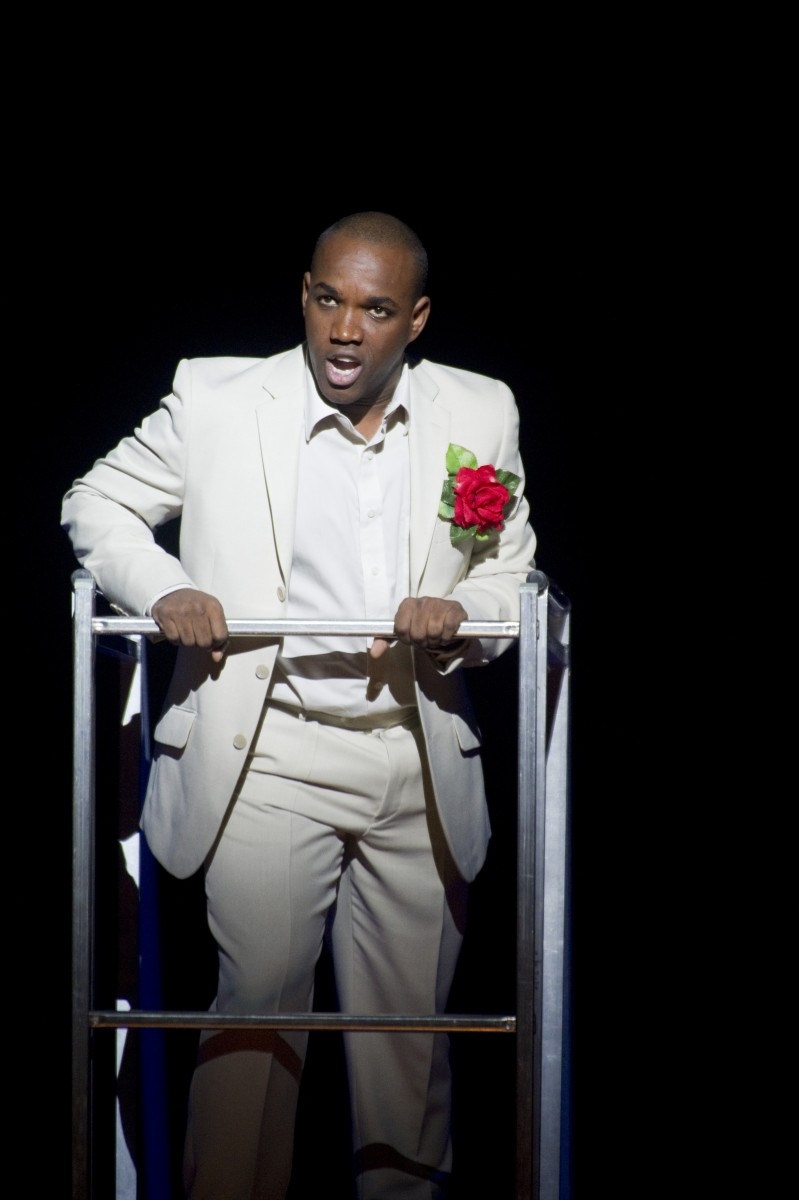
Larry offstage; photo by  Derek Blanks

Larry offstage; photo by Derek Blanks

The star tenor is speaking by phone from a hotel room in Berlin during a rare day off in late summer, before heading to Palermo to sing Rossini. His next stop: Seattle, to sing Tonio in The Daughter of the Regiment. Anyone who meets Larry Brownlee in person can attest to the down-to-earth, uncontrived modesty that likewise comes naturally to this son of the rustbelt city of Youngstown, Ohio.

While Brownlee’s international reputation is particularly associated with his interpretations of Rossini, Seattle audiences have had the opportunity to hear and see him put his stamp on major roles by Bellini and Donizetti as well.

Brownlee made his mainstage debut at Seattle Opera in 2002 in the opera buffa Don Pasquale as Ernesto, singing another of Donizetti’s lovestruck comic heroes. And his uncompromising rendition of the high-wire vocal line assigned to the male protagonist Arturo in Bellini’s I puritani in 2007—including a full-on F above high C, not falsetto—now belongs to company legend. This coming spring Brownlee will sing the role at the Met for the first time.


“You can’t even find that on records!” says General Director Speight Jenkins, whose capacious memory-archive of a lifetime of performances can rekindle the live excitement of those Bellini nights apparently at will.

Yet what’s really impressive here—as in Brownlee’s taking on the notorious “Everest” of nine high C’s his character Tonio must sing early on in The Daughter of the Regiment—isn’t just the technical ability to produce these notes with such reliable accuracy. That’s simply the starting point. The accuracy is one thing, Jenkins points out, “but rarely do you hear the beauty of those upper tones.”

“To be able to sing Tonio’s nine high C’s always amazes people, but that’s what the voice Donizetti was writing for is supposed to do,” explains the tenor, director, and teacher Peter Kazaras, who shares the stage with Brownlee in Daughter playing the haughty Duchess of Krackenthorp in drag in Seattle Opera’s production. “The reason people were so awed when Pavarotti did it [in his career-defining performance at the Met in 1972] is that he was a lyric tenor, not the light, leggiero tenor these roles were conceived for. There are a few people who can sing this kind of repertoire, but what sets Larry apart is that he sings it and the voice is actually beautiful.”

Brownlee as Tonio in the Met's Daughter of the Regiment; photo by Ken Howard

Brownlee as Tonio in the Met’s Daughter of the Regiment; photo by Ken Howard

Jenkins, renowned for his ability to recognize the potential in young singers with startling accuracy, remembers the thrilling experience of hearing Brownlee in a rehearsal room back in his days in the company’s Young Artists Program, which he joined in 2000. It became immediately clear to Jenkins that the tenor (at the time only in his late 20s) could have a major international career.

“So many things happened for me as a result of going to Seattle early on,” Brownlee says. “I do consider Seattle my home away from home. Speight opened up a lot of doors for me and really invested in my career. Seattle Opera has given me a chance to do such a range of roles, from traditional productions to modern things like [Daniel Catán’s] Florencia en el Amazonas.”

Brownlee with Renée Fleming in Rossini's Armida at the Met; photo by Ken Howard

Brownlee with Renée Fleming in Rossini’s Armida at the Met; photo by Ken Howard

To this day, Brownlee—himself a very young-looking 40—thinks of Seattle Opera as a place that attracts a vibrant young audience. When he was here, he became especially attuned to the presence of a young audience the company fosters through its BRAVO! Club and innovative social media networks. “I’ve gotten a chance to interact with them quite a bit, and many of those people I still keep in touch with via Facebook. They knew me before I started to do other high-profile things like singing opposite Renée Fleming [in Rossini’s Armida at the Met] and they really care about me.”

The Seattle production of Daughter presents the opportunity for a family reunion of sorts. Peter Kazaras had directed Brownlee in the 2011 The Barber of Seville, and Sarah Coburn, as Marie in Daughter, once again plays the object of Brownlee’s determined love. The two also appeared together in the Seattle Opera Young Artists Program’s La Cenerentola in 2002 and in the 2011 Barber, with Brownlee singing his signature role as Rossini’s Count Almaviva.

“I feel honored and blessed each time I have the opportunity to sing with Larry,” says Coburn. “I have also come to consider him a good friend and mentor. He has given me fantastic advice many times and has the added perspective of work-family balance. He understands the challenges of family life, especially in light of constant travel.”

Brownless and Coburn as Tonio and Marie in Daughter at Seattle Opera; photo by Elise Bakketun

Brownless and Coburn as Tonio and Marie in Daughter at Seattle Opera; photo by Elise Bakketun

As a husband and father of two small children (Zoe and Caleb), Brownlee says family life “keeps me grounded. I love my job and am grateful to have the chance to perform, but my family makes me realize that it’s not all about that—everything else is relative.”

“This isn’t an easy business—I don’t know how people did it before Skype. My wife, Kendra, and I spend hours together with our Skype turned on, just to be able to share in the unsaid things of daily life.” Brownlee registers his excitement about being able to have the whole family in Seattle for Daughter, along with an extended circle of relatives.

Brownlee, who grew up with six siblings in a tight-knit working-class family, doesn’t hesitate to single out the central role they play in his life. He loves to quote pieces of homespun wisdom from his father, a retired GM auto factory worker and army veteran: “Like him, I’m a ‘glass half-full’ guy, and I’ve learned from him to worry about the things you can control: things like my weight, or how musical and expressive I can be as a performer.”

Brownlee in Rossini's L'italiana in Algeri at the Opéra de Paris

Brownlee in Rossini’s L’italiana in Algeri at the Opéra de Paris

Brownlee’s positive attitude helped him bypass what he was told by some would pose serious stumbling blocks. Though no longer so blatantly tainted by racism as it once was, the mostly-white opera world can still throw up less explicit barriers to African-American performers. Brownlee, who appears incapable of harboring grudges, refuses to dwell on the fact that he was told by some that his ethnicity would keep him from being cast in leading roles. Concerns were similarly expressed that the tenor’s stature—at 5 feet six inches—would inevitably hamper his career, no matter how extraordinary were the gifts he had to offer as a performer.

Thankfully, Brownlee refused to listen to any nay-saying. Seattle provided his first platform, and it was from this region that he was selected one of the winners—along with Sarah Coburn—of the Metropolitan Opera National Council Auditions. Only a year later, when he made his professional stage debut, he was invited to perform at La Scala, and his career kept accelerating, with major European bookings filling out more and more of his calendar.

Brownlee prefers to focus on his gratitude to all those who have inspired him on his path: from courageous pioneers like the tenor George Shirley, who paved the way for Brownlee’s generation —and whom Brownlee reveres as one of his mentors—to the colleagues he regularly refers to as if they’re all part of an extended family.

Here in Seattle, Maestro Yves Abel is also pleased about this chance to reunite with Brownlee, whom he has conducted in Europe and at the Met’s well-known current production of Daughter (relocated to World War One). “Larry is a superlative artist, extremely musical and sensitive, with an innate and varied sense of style, excellent language skills, and a doll to get along with.”

Certainly Brownlee left indelible memories of his last venture in Seattle. Along with the ravishing vocalism of that Barber production, it amply demonstrated the tenor’s considerable comic talents—his turn as Rosina’s music teacher incognito ranks as the most hilarious I’ve yet seen—and his capacity to bring out a character’s essence.

“When I was directing him as Almaviva,” says Kazaras, “I was developing a carefully choreographed language all the way through the piece for each character, and I knew I could get Larry to use his talent as an accomplished salsa dancer.” Playing on one of the Italian phrases for his type of voice (tenore di grazie), Kazaras continues, “With Larry, the watch word is graceful. He is graceful in his singing, in his stage presence, and in his life.”

But Tonio in Daughter—a role Brownlee has performed at the Met, and in Cincinnati and Hamburg—is a different kind of person from Count Almaviva. How does Brownlee strive to make such a simple comic character come to life onstage? “The most important thing is to make him come across as sincere and heartfelt. Of course, everyone thinks of the high C’s in ‘Ah, mes amis!’ when he’s on top of the world. But you have to be able to show his real pain and disappointment as well.”

“A lot of people may not realize the more difficult aria is actually the second one—‘Pour me rapprocher de Marie’—where Tonio tells the Marquise what Marie means to him. You really have to think about musicality and phrasing here and make sure not to blow it all on the first aria. I hope it will be so beautiful that people will almost forget ‘Ah, mes amis!’—but I don’t want them quite to forget it completely!”

Brownlee and  Joyce Castle (Marquise) in Daughter at Seattle Opera; photo by Elise Bakketu

Brownlee and Joyce Castle (Marquise) in Daughter at Seattle Opera; photo by Elise Bakketu

Inevitably, Brownlee’s approach to these roles is compared to that of his almost-exact contemporary, the Peruvian tenor Juan Diego Flórez. (On YouTube you can easily find a video juxtaposing clips of Brownlee, Flórez, Pavarotti, and Alfredo Kraus singing Tonio, while heated discussions over their relative merits transpire on numerous blogs and listservs.) But when he mentions Flórez, it’s impossible to imagine one of the old-fashioned singer rivalries playing out. “Juan Diego is a friend. I also think he’s a great artist, and we have mutual respect for what each other does.”

Later this season Brownlee will be back in Europe to sing Donizetti at the Vienna Staatsoper (Nemorino in L’elisir) and Rossini in Munich (for Il turco and Cenerentola). His newest recording, Spiritual Sketches, meanwhile represents an entirely different direction that he hopes to pursue further. A set of ten arrangements of traditional spirituals for voice and piano by one of Brownlee’s friends, this latest release reveals what will sound like a whole new dimension to the tenor’s art to those who know him as a bel canto expert. Yet here Brownlee looks back affectionately to his musical beginnings, recalling his boyhood singing in the church gospel choir with his family.

On the heels of his Seattle engagement, Brownlee will be making both his role and company debuts as Prince Tamino at Los Angeles Opera in the Suzanne Andrade-Barrie Kosky production of The Magic Flute, described by The Guardian as “a perfect mixture of … silent films, the cabaret of the Weimar Republic, David Lynch, and the brothers Grimm.”

“It’s my first professional role in German,” says Brownlee, “and I also hope I have some more Mozart in my future. It’s nice to do that in addition to the Italian bel canto. The goal is to continue to grow as an artist. Hopefully I’m still at the beginning of my journey and will try to keep getting better and enjoy the ride.”

(C) 2013 Thomas May. All rights reserved.

Filed under: artist profile, bel canto, opera, Seattle Opera

Melville Rejected

MS submission cover letter by Herman Melville: 9 May 1854

Cover letter for a short story submission by Herman Melville (dated 9 May 1854)

Herman Melville was 34, with Moby-Dick several years behind him, when he submitted the manuscript for his short story “The Two Temples” along with the cover letter pictured above to the publisher G.P. Putnam. His first novel, Typee, became a best-seller when it appeared in 1846, but the increasing ambition and complexity of Melville’s subsequent writings resulted in a decrescendo in sales and public interest – particularly starting with his third novel, the richly symbolic fantasy Mardi (1849).

Harper & Brothers, Melville’s publisher, rejected his (subsequently lost/destroyed) novel Isle of the Cross in the wake of Moby-Dick and the truly far-out Pierre: or, The Ambiguities, which had bombed commercially and critically.

That’s the context around his submission of “The Two Temples” to the monthly periodical Putnam’s, which began publication in January 1853. In fact founder George Palmer Putnam circulated a letter to prominent American authors, including Melville, announcing his plans to create a platform for American writers and pundits. So in May 1854, Melville submitted his manuscript for “The Two Temples.” Structured as a diptych, this story recounts the narrator’s cold rejection by a “beadle-faced man” when he attempts to enter a church; contrasting with this “excommunication” in his homeland, he takes comfort in the temple of the theater when he later finds himself a stranger in London.

Melville’s cover letter for the submission is currently being offered for $35,000. It reads:

Pittsfield May 9th [1854]

Dear Sir –

Herewith you have a M.S.

As it is short, and in time for your June number, therefore – in case it suits you to publish – you may as well send me your check for it at once, at the rate of $5 per printed page.

– If it don’t suit, I must beg you to trouble yourself so far, as to dispatch it back to me, thro my brother, Allan Melville, No. 14 Wall Street.

Yours

H. Melville

G.P. Putnam, Esq.

Booktryst contributor Stephen J. Gertz explains that Melville’s protagonist “reaches the conclusion that this theater is a true church, the other not at all.” He quotes the letter Putnam editor Charles F. Briggs sent to Melville to clarify why the magazine decided to reject this submission by such a recognized writer:

“I am very loth [sic] to reject the “Two Temples” as the article contains some exquisitely fine description, and some pungent satire, but my editorial experience compels me to be very cautious in offending the religious sensibilities of the public, and the moral of the “Two Temples” would array against us the whole power of the pulpit, to say nothing of Brown, and the congregation of Grace Church.”

Gertz believes that this very personal rejection letter was intended to minimize fallout, since Putnam’s “wanted to retain [Melville] as a contributor. Briggs is suggesting that to assuage Melville’s feelings they should buy another, more appropriate, piece from him.” As it happened, “The Two Temples” ended up with the writer’s private papers and was never published in his lifetime. Gertz further describes why this letter was important:

“Two Temples” represented the metaphysical path that Melville had begun to travel with Moby-Dick and had further bestrode, deepening his spirituality. His earlier works had been popular; $5 a page was top wage for a short story; he was still in demand. (And Melville desperately needed the money.) Beginning, however, with Moby-Dick, religious themes began to rapidly creep into his work. His readership began to slowly creep out, and from then on publishers became increasingly wary to publish Melville. “Two Temples,” so overtly theological and spiritually rebellious, was, if not the beginning of the end, a definite so long, farewell, auf wiedersehen to [the popular style of writing represented by the early] Omoo, amen.

Hat tip: Ted Goia (Twitter: @tedgoia)

Filed under: American literature, book news, literature, Melville, publishers

Protected: Stairway to Heaven: A Major Seattle Symphony Premiere

This content is password-protected. To view it, please enter the password below.

Filed under: Beethoven, composers, new music, review, Seattle Symphony

Silver Apples and Cloudless Sulphur Skies

Morton Subotnick, who at 80 looks as eager as ever to experiment with his Buchla and laptop, rolled into town recently to perform a decades-spanning program at Seattle’s Town Hall. Joining him onstage was Berlin-based video artist Lillevan. The two have been collaborating on several projects in recent years, and both are obviously so well attuned to each other’s aesthetic that they can improvise with pre-existing material. It all added up to a blissed-out gesamtkunstwerk for synth geeks and video art aficionados.

The concert’s official title – “From Silver Apples of the Moon to A Sky of Cloudless Sulphur IV: LUCY” – refers to the main sources for the prerecorded music Subotnick used to build the performance in tandem with Lillevan’s abstract imagery of fluid and fractal-like shapes in restless transformation. Subotnick describes his current process:

For each season of performances I create a new hybrid Ableton-Buchla “instrument” loaded with prepared samples from all my previous works and performances and new patches that will allow me to modify the samples while performing brand new sound gestures created especially for the new season. The work always has the same title, “From Silver Apples of the Moon to a Sky of Cloudless Sulphur IV: LUCY.” The “IV: LUCY” refers to the season number and the name given to the newest materials.

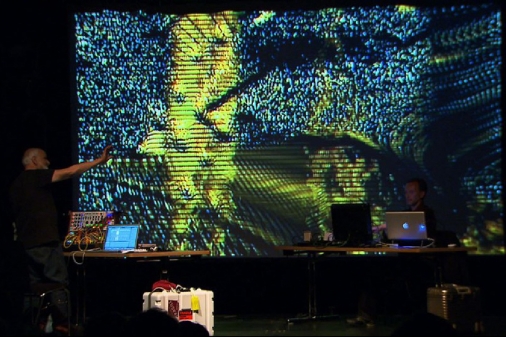
Subotnick in action

Subotnick and Lillevan in action

Subotnick’s gently processed whisperings and vocalizations – sent whirling about the surround-sound arrangement of speakers – launched this voyage of about an hour or so. Of course the act of musical performance itself tends to override ordinary clock time, to make it seem simultaneously speeded-up and in slow motion. But in this case, time seemed to become unmoored as if we were in a gravity-less environment.

The early atonalists used to worry about how to structure a piece without the old familiar signposts. Subotnick’s large-scale excursions can echo the craggy, mountainous landscapes of a Romantic tone poem, no matter how “alien” the sounds. Inevitably I found myself turning to metaphors, both from the natural world – that ubiquitous “watery” sound of electronics – and from acoustic instruments, imagining a troop of pizzing strings here, bleating woodwinds there.

Lillevan

Lillevan

Berlioz’s opium dreams, the psychedelic trips of the ’60s: why is it this intensely focused sense of isolation, of utter aloneness, much more than any Dionysian, “orgiastic” frenzy, that they so strikingly share? Above all I’m fascinated by Subotnick’s “art of transition” and his ability to steer toward heaving climaxes, only to dial the mood down within a short span, like a turntablist working the dance crowd – even though we were all passive listeners.

Just before the performance, Subotnick recollected how exciting it was to be a young composer in the late ’50s, when the introduction of the commercial transistor seemed to point the way toward a new utopian paradigm: music that could be made and performed by everyone, not limited to “the 1%” who had the training for classical music-making. Yet for all its influence on popular culture, and for all the revolutionary changes in daily life this technology has enabled, the type of electronic composition Subotnick pioneered still inhabits a rarefied world of its own.

Filed under: electronic music, new music, video art

Camus and the “Wild Longing for Clarity”

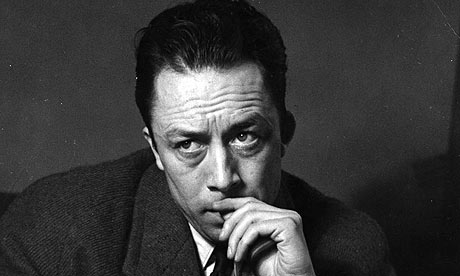
Albert Camus

Albert Camus

It’s a few days late to honor the official 100th birthday of Albert Camus (November 7), but the commemorations I’ve been seeing remind me how refreshingly pertinent the core of his thought remains to our everyday lives. Aspects of it are obviously dated, but – it seems to me – nowhere nearly as much as the grim, sour, mid-century theorizing so many of his Continental peers.

Probably a key underlying reason for that freshness is Camus’ literary gift. Jerry Delaney, who adapted La Chute for a stage production in Santa Fe in 1999, offers an especially discerning recent assessment for The American Scholar, reminding us of the writer’s claim that “all the great novelists are philosophical novelists.”

I retain strongly physical memories of my first time reading L’Étranger – of summer, the heat around me, which melded with Camus’ descriptions of the beach and the merciless sunlight. But even the more challenging essays offered little explosions of insight and recognition similar in kind to the fiction.

Delaney describes how Camus’ idea of the “absurd” could move us so profoundly:

It’s worth remembering that Camus meant something quite different from what the vast majority of people thought he was saying about the nature of absurdity. For him, the absurd was not something ludicrous or preposterous; the absurd was a confrontation between our deep-seated desire to know and an irrational world that defied knowing—in his words, “the wild longing for clarity whose call echoes in the human heart” versus “the impossibility of reducing this world to a rational and reasonable principle.”

How astonishing it is to recall that Camus wrote the epochal Le Mythe de Sisyphe while still only in his 20s. From my teenage vantage point when I first encountered this essay, it seemed the scripture of a very wise man, of someone who had lived through more than I could begin to imagine. Delaney ponders why Camus’ essay has such staying power:

Camus’ idea is not particularly profound, but he states it with a compelling lucidity and force. Unlike most philosophical insights, which slip from our grasp even as we grip to hold on, the Camus observation sticks. What Camus did was give us a language to express what our experience in life had already prepared us to accept; he gave coherence to those inchoate ideas and unspoken assumptions that were roiling deep and unspoken in our minds.
[…]

Camus legitimizes us. We may wince to acknowledge that we are not endowed with the capacity to find an ultimate answer, that certain things are beyond our reach, but we are also reassured that our experience is universal, not a cause for despair: Quite the reverse, it is fruitful and full of passion.

We discover that being loyal to the truth means being loyal to oneself, and being loyal to oneself, the ultimate consolation in life, gives rise to an unspoken sense of pride and dignity—a hard-won self-esteem that comes unbidden from taking the more rigorous but truer path. By refusing to turn away from the absurd we are able, by a mere act of consciousness, to transmogrify the question of death into an inspiration to live.

“One must imagine Sisyphus happy” is Camus’ famous formulation – an existentialist update of Voltaire’s “il faut cultiver notre jardin”? But the context for this imagined Sisyphean contentment is far more reminiscent of Nietzsche’s version of eternal recurrence (in Zarathustra and elsewhere): the ceaseless cycle of life, repeatedly infinitely, without escape, as a “fate” to be affirmed with joy.

And what of the phantom of “engagement” that preoccupied Camus and his followers? Well, the wisdom arrived at in Sisyphus “is not a conclusion but a point of departure.” Delaney refers to L’Homme révolté, the essay which followed in 1951, as the political response to that wisdom: “Just as the absurd calls upon us to face the truth, the truth calls upon us to rebel” – in contrast to the posture of revolution. According to Delaney, for Camus the difference was that “rebellion brings to light limits, moderation, mesure. Rebellion is at odds with the excess of revolution.”

Revolution treats people as a means to an end; rebellion treats people as an end in itself. Revolution is top-down; rebellion is bottom-up. Revolution leads to terror; rebellion underscores the value of dignity in each individual, everywhere. Revolution is inspired by resentment, rebellion by love.

…More than any other writer, he enables us to expand our consciousness of freedom, to appreciate more fully the sanctity of life, and to recognize the honor of revolt in the face of cruelty and injustice.

Filed under: ethics, literature, philosophy

Tosca-nizing

Tosca, Act II, from pre-1914 Met Opera staging

Tosca, Act II, from pre-1914 Met Opera staging


In honor of today’s live HD broadcast of Tosca from the Met, I decided to gather some of the critical reactions to the controversial production by Swiss director Luc Bondy when it was first introduced as the season opener in 2009.

Anthony Tomassini in The New York Times:

[T]he booing, if a little unfair, was understandable… Mr. Bondy had scoured the work, it seemed, looking for every pretense to flesh out, literally, the eroticism of the lovers and the lecherous kinkiness of Scarpia. ..Mr. Bondy seems to be after mood, intensity and emotion, not logic. And some of the acting that he draws from his cast is intricate and involving…[He] probably wanted to rid his Tosca of stock clichés, yet his heavy-handed ideas are just as hackneyed.

Anne Midgette in The Washington Post:

Bondy certainly tried to clear away the layers of encrustation from the opera, rather like a restorer trying to clear the varnish from a painting. The problem was that he didn’t always seem to have a vision of the strong underlying image he was trying to reveal. His modus operandi seemed to be to get rid of all of the Tosca traditions and start afresh, but “afresh” often involved gestures every bit as gratuitous as the ones he was trying to replace…The strongest guiding hand of the evening was James Levine in the pit, who generally offered a reminder that this opera’s music can indeed still be fresh, vital and (in a couple of solo spots in particular) absolutely ravishing.

Alex Ross in The New Yorker:

By all means, then, let’s have a new Tosca. But it needs to be good. And this is not…. [Bondy] has failed to find a clear angle on Tosca, and instead delivered an uneven, muddled, weirdly dull production that interferes fatally with the working of Puccini’s perfect contraption…The major gaffe of the night comes after Tosca kills Scarpia, when, according to the libretto, she places candles by his side and a crucifix on his chest. ..[S]omething should happen during the thirty-bar postlude that Puccini composed for the ritual. Here…Tosca murders, then dithers…While there is nobility in an ambitious failure, there is no glory in ineptitude.

Ed Pilkington in The Guardian:

There was some egregious silliness to the Bondy version, which no doubt goes some way to explain the cat calls… In act two Scarpia is being pleasured by a courtesan kneeling between his legs, a wholly gratuitous addition to Puccini’s portrayal of an evil torturer who exudes suppressed sexuality in any case.Those incongruities aside, the puzzling thing about the audience reaction last night was that in most other regards the Bondy production is striking by how safe it is, how little risk-taking and how traditional.

Justin Davidson in New York magazine:

Bondy has stripped the piece of specificity and replaced it with a grim collection of non-locales and coarse interpolations…Though Bondy has never worked at the Met before, his fashionable Euro-minimalism has become something of a house style: dim light, blank walls, black costumes, and dour abstraction….I hope the Met’s Peter Gelb is already trying to figure out how soon he can scrap this staging.

And the dependably acerbic Martin Bernheimer in The Financial Times:

Abetted by his designer, Richard Peduzzi, Bondy has turned Puccini’s sleazy masterpiece into sterile melodrama with raunchy trimmings…A different directorial gimmick cheapens the ending of each act…Bad timing, bad ideas.

Filed under: Metropolitan Opera, opera

Fascinating Boulez, Problematic Mahler 6

It’s good to have Ludovic Morlot back in town for his first Seattle Symphony program since September’s marvelous all-Ravel feast. And there’s been a lot of interest building up for this week’s offering, since – well, that’s usually the case with a Mahler symphony (even if the over-programming of Mahler in general is tempting burnout), but all the more since Maestro Morlot has been approaching this rep with understandable caution.

But first to the program’s “hors d’oeuvre,” Nos. 1-4 of the Notations by Pierre Boulez. This is prime Morlot territory: thrillingly prismatic music, brimming with intellectual and sensual complexities that complement rather than cancel each other out. The orchestra, massively expanded and crowding the entire stage to realize Boulez’s scoring requirements, played the first four of this set of miniatures originally written as a sequence of 12 for solo piano (back in 1945). Boulez began revisiting these early works decades later and so far has completed orchestral elaborations of seven of them. In their orchestral guise, they resemble lavish plants grown from the starker seeds of the piano originals.

Morlot gave a brief, excellent introduction to their concept and design and paired each of the four with renditions of the originals by pianist Kimberly Russ. I’ve never understood why some of my fellow critics kvetch about this sort of commentary from the podium during a concert. Morlot’s manner isn’t even remotely condescending, and he’s able to home in on a few pregnant details that really do enhance listening.

And Boulez is hardly a familiar quantity in Seattle. This was the first time I’ve heard the SSO grapple with music by the French maverick; is it possible Boulez has never been programmed in its history? Quel scandale! Regarding his ongoing investigation of French musical tradition with the orchestra, Morlot remarked that to overlook Boulez would be like visiting Paris “and not going to see the Eiffel Tower.”

The pieces in Notations – all related to a shared 12-note theme – are epigrammatic and fleeting, yet so frighteningly complicated in their working out (the articulation of harmonic, rhythmic, and textural layers) that it’s like a speeded-up musical Big Bang, tracing vast consequences from simple origins. Or so it seemed in Morlot’s meticulous account. Most impressive for me was his ability to convey a graspable sense of passion and drama alongside Boulez the “researcher” of sounds.

In his “Ask the Artist” conversation after the concert, Morlot mentioned that he’d initially hoped to get Boulez to come to Seattle to conduct this program himself, thus giving the SSO a direct connection to the tradition Boulez still embodies. (Now 88, the French maestro’s health essentially precludes such travel.) Yes, irony of ironies, the firebrand revolutionary of yore is one of the last keepers of a tradition connected both to French modernism from Debussy onwards and to Schoenberg and his Vienna colleagues. (Berg was particularly fascinated by the music of Mahler’s Sixth Symphony.)

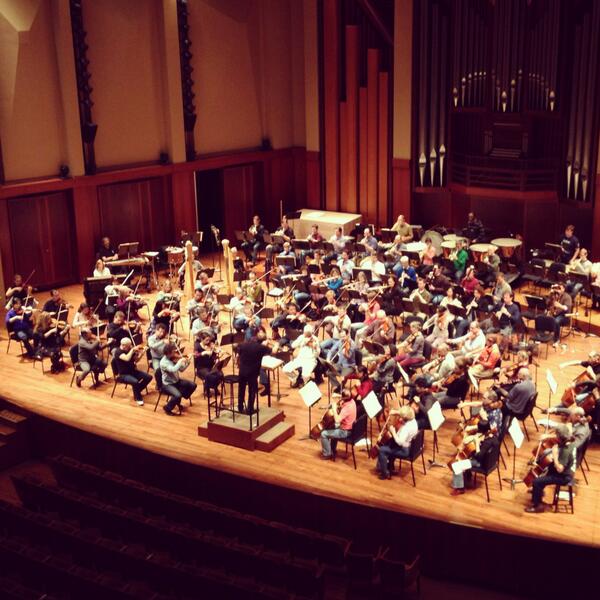
Morlot and SSO rehearsing Mahler 6

Morlot and SSO rehearsing Mahler 6

I found this interpretation of the Mahler Sixth only halfway satisfying – and, oddly, in a completely unpredicted way. Long one of the most marginalized of his symphonies, the Sixth has actually received a good deal of advocacy over the past 15 years or so. Michael Tilson Thomas inaugurated his complete cycle with the San Francisco Symphony with No. 6 (on September 12, 2001, no less), winning a Grammy. Since that year the SSO’s conductor laureate Gerard Schwarz has led two Mahler Sixths (2001, 2008).

Presenting the Boulez as an entrée results in the interesting effect of seeing the orchestra downsize a tad for the Sixth, which happens to employ the largest orchestra Mahler ever called for (in purely instrumental terms – obviously excluding the Eighth, with its ginormous choral forces). The SSO even managed to procure one of the cowbells originally used for the premiere in 1906. (I’ve got to investigate that back story.)

Yet just a few paces into the grim straitjacket march-time opening the first movement, Morlot uncharacteristically failed to achieve the sort of sonic balance you can usually count on him to effect – a tremendously challenging task in this score, to be sure. Morlot’s modus operandi in general is precisely not to go for the obvious “throughline” but to tune us in to the nuances of multiple layers and textures interacting, but too many of the accents seemed tentative, a “work in progress,” so that the players got bogged down in local details and the big picture lost focus.

Breathtaking, sensitively shaped moments awaited in the enormous development section – it’s like a dream sequence escaping from the harsh “real world” surrounding it – and, along with many admirable solos, concertmaster Alexander Velinzon’s contributions enraptured the ear. Still, as a whole the first movement lacked the persuasiveness and sheer, unrelenting terror it needs to set the symphony on course.

The Scherzo sounded even more bogged down by moment-to-moment bursts of color and emotion without a convincing larger context: all-too-careful playing that just didn’t take fire with any sense of risk. But with the Andante – Morlot chose Mahler’s original order for the inner movements – the long delay until reaching this oasis paid off. The SSO became not just thoroughly engaged, but convincing and supremely eloquent. Morlot took a relatively rapid pace, allowing the beauty of this music to breathe as simply as a song instead of relying on exaggerated distensions.

Cowbells used by Seattle Symphony (including one from 1906 premiere of No. 6)

Cowbells used by Seattle Symphony (including one from 1906 premiere of No. 6)

And then what really took me by surprise: in every live performance of the Sixth I’ve heard, it’s in the immense sound world of the finale that everyone loses steam, exhausted and struggling just to make it through. But this was the most exhilarating playing of the evening, starting with the hallucinogenic sweep of colors with which Mahler launches this enigmatic movement.

Here Morlot guided the musicians through an enthralling labyrinth of events which really did begin to cohere and connect. In the coda, the threnody of brass sustained enough mystery to hint, however slightly, at a possible hopeful outcome so that the shock of Mahler’s most tragic symphonic ending had a thrilling dramatic impact.

A quick note on the other chief musicological controversy – besides the order of the movements – which is part of the Sixth’s performance tradition. Morlot chose the version with two rather than three “hammerblows” in the finale, later explaining that withholding the third ax-like shattering intensifies the suspense. The two blows we heard were in any case both sonically and visually memorable, thanks to the impressive box and hammer percussionist Michael Werner (see video at top).

There’s one more chance to experience this program live: on Saturday, 9 November 2013, at 8.00 pm. Tickets here.

(C) 2013 Thomas May. All rights reserved.

Filed under: Mahler, review, Seattle Symphony

The Score to Ancient Greece

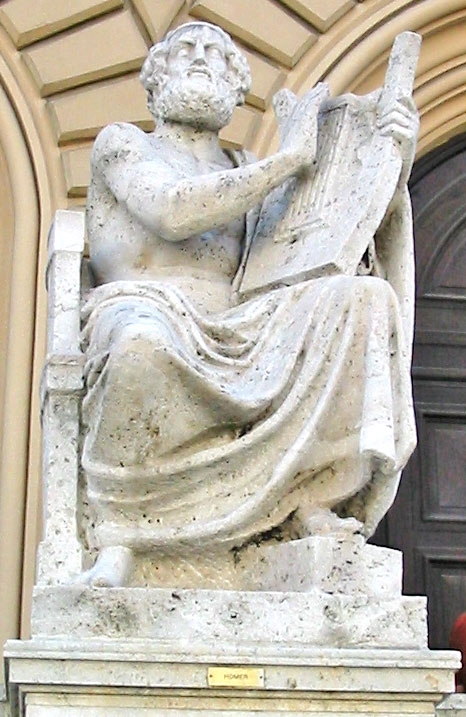
Statue of Homer at the Bavarian State Library in Munich; photo by J. Williams

Statue of Homer at the Bavarian State Library in Munich; photo by J. Williams

Oxford Classics scholar Armand D’Angour describes how researchers are on the verge of a breakthrough in being able to “reconstruct” the music that was known to have accompanied such seminal texts as the Homeric epics, the great tragedies, and Sappho’s lyric poetry:

The rhythms – perhaps the most important aspect of music – are preserved in the words themselves, in the patterns of long and short syllables.

The instruments are known from descriptions, paintings and archaeological remains, which allow us to establish the timbres and range of pitches they produced.

And now, new revelations about ancient Greek music have emerged from a few dozen ancient documents inscribed with a vocal notation devised around 450 BC, consisting of alphabetic letters and signs placed above the vowels of the Greek words.

He asks what Greek music would have sounded like:

Homer tells us that bards of his period sang to a four-stringed lyre, called a “phorminx”. Those strings will probably have been tuned to the four notes that survived at the core of the later Greek scale systems.

Professor Martin West of Oxford has reconstructed the singing of Homer on that basis. The result is a fairly monotonous tune, which probably explains why the tradition of Homeric recitation without melody emerged from what was originally a sung composition.

Filed under: classical literature, musical research

Archive

Enter your email address to follow this blog and receive notifications of new posts by email.