

Filed under: photography

July 25, 2016 • 1:01 pm Comments Off on What Use Is Religion? Bayreuth’s New Parsifal
“…where Religion becomes artificial, it is reserved for Art to save the spirit of religion by recognizing the figurative value of the mythic symbols which the former would have us believe in their literal sense, and revealing their deep and hidden truth through an ideal presentation.” –Richard Wagner (Kunst und Religion)
The 2016 edition of the Bayreuth Festival began today with a new production of Parsifal, staged by Uwe Eric Laufenberg (Intendant of the Hessisches Staatstheater Wiesbaden) and conducted by Hartmut Haenchen (following the controversial withdrawal of Andris Nelsons).
Laufenberg on the relevance of Wagner’s final stage work for an era beset by religious fundamentalism:
This piece basically focuses on the religion of Christianity. On one hand, the grail knights in “Parsifal” inhabit a realm of charity, empathy and sympathy, and they come to the aid of the needy. Then there’s the other side: a crucified God, blood rituals and military symbolism.
I believe that Wagner wanted to bring out the factors of benevolence and mystery in this work. Not to openly criticize religion, but to enable one to experience it. That’s interesting in our own times of widespread religious fundamentalism – but also in times of a Pope Francis, who has been de-emphasizing the institutional side of the Catholic Church and stressing the factors of mercy, grace and benevolence.
It’s always been pertinent to ask: What are religions doing, and are they allowing themselves to be abused for ideological purposes? What do they really stand for?
Laufenberg on setting Parsifal in the Middle East:
Wenn es um ein Stück ginge, das in Syrien oder Saudi-Arabien spielt, würde ich mich keineswegs um eine Auseinandersetzung mit dem Islam drücken. Wagner hat den „Parsifal“ in den Pyrenäen verortet, wir bringen ihn in den Nahen Osten, Richtung Syrien, Irak oder vielleicht Jerusalem, wo die monotheistischen Religionen einen Wahnsinnskampf gegeneinander führen. Im „Parsifal geht es aber um die Frage: Was ist uns die Religion wirklich wert? Wo berührt uns die Religion eigentlich noch? Was bedeutet das Mysterium des gekreuzigten Gottes?“
Hartmut Haenchen on conducting Parsifal:
BR-KLASSIK: Sie haben in einem Gespräch in Bezug auf “Parsifal” gesagt: Man muss erzählen und nicht zelebrieren. Was heißt es konkret?
Hartmut Haenchen: Wagner hat das Werk ja auch nicht “Oper” genannt – aus gutem Grund. Die Handlung des Stückes ist vor allem im ersten Akt beschränkt. Es wird erst Mal 45 Minuten lang erzählt. Und wenn ich das zelebriere, dass die Texte auseinander fallen, dass man die Textzusammenhänge nicht mehr verstehen kann, weil man Tempi wählt, die Textverständlichkeit unmöglich machen – dann wird es zelebriert, aber nicht erzählt. Und ich lege großen Wert drauf – und da stützte ich mich natürlich auf die Quellen – dass die Geschichte erzählt werden muss. “Der Fluss der Sprache bestimmt das Tempo”, – das hat Wagner selbst gesagt. Und dem muss man sich grundsätzlich unterordnen.
From a 1906 lecture by Rudolf Steiner:
Wolfram von Eschenbach wrote an epic on “Parsifal.” It was inartistic, but it sufficed for his time; for there were in those days men who had a measure of clairvoyance and could accordingly understand Wolfram. In the Nineteenth Century it was not possible to make clear to man the deep meaning of that great process of initiation in a drama. There is, however, a medium through which man’s understanding can be reached, even without words, without concepts or ideas. This medium is music. Wagner’s music holds within it all the truths that are contained in the Parsifal story.
Complete cast list from Bayreuther Festspiele
Complete libretto (German/English)
More background on Parsifal
Filed under: Bayreuth Festival, conductors, directors, Wagner
July 24, 2016 • 6:52 am Comments Off on Rameau to the Rescue
Today brings the premiere of a new production of Jean-Philippe Rameau’s 1735 “ballet héroïque” Les Indes galantes, being streamed live from Bayerische Staatsoper (staged by Sidi Larbi Cherkaoui and conducted by Ivor Bolton).
A little background from Deborah Kauffman:
Les Indes galantes (1735) belongs to a different operatic genre, the opéra-ballet, which featured independent—but loosely connected—plots separated into several entrées. As the genre’s name suggests, dance played an important part in the opéra-ballet, and Les Indes galantes is no exception; each entrée closes with a divertissement, a collection of dance movements and dance songs that tie into the plot of the entrée.
Here’s an interview in the Süddeutsche Zeitung with the Belgian choreographer Sidi Larbi Cherkaoui:
Es handelt sich um vier verschiedene Nationalitäten in vier Akten. Wie bringt man die in einer schlüssigen Handlung zusammen?
Indem wir, und daran arbeiten wir sehr hart, schauen, was sie alle verbindet, wie jede, jeder von ihnen Teil eines größeren Ganzen werden könnte. Jede einzelne Figur könnte genauso gut eine andere sein, was in unserer Annäherung an das Stück tatsächlich passiert: Phani und Fatime werden zum Beispiel von derselben Sängerin gesungen. Alle Charaktere könnten letztlich zu einer einzigen Person verschmelzen. Ich entwickle ein Narrativ, wonach ihre Geschichte eine Doppelung erfährt. Diese Methode, die handelnden Personen zu betrachten, macht aus dem Werk ein in sich geschlossenes Ganzes und bewahrt es davor, in vier Teile zu zerfallen.
See Bayerische Staatsoper blog post (also in German).
Filed under: ballet, Bayerische Staatsoper, Rameau
July 18, 2016 • 8:16 am Comments Off on Debussy Plays Debussy
July 16, 2016 • 5:33 pm Comments Off on Discovering Ursula Mamlok
I’ve been enjoying dipping into Bridge Records’ wonderful series devoted to the late Ursula Mamlok (who died this May at the age of 93).
From Margalit Fox’s New York Times obituary:
Ms. Mamlok, who moved back to Berlin 10 years ago, was for decades a fixture of the New York contemporary music scene. A longtime faculty member of the Manhattan School of Music, she was known in particular for her chamber music, piano works and vocal pieces.
From an interview with Bruce Duffie in 1996:
The purpose of music is probably that if you are gifted in music, to express yourself as somebody else would be in writing stories or poetry. The purpose is to not entertain, but to give people something that could be either uplifting or disturbing; something for people’s emotional life. Perhaps there is also an intellectual purpose, depending on what kind of music.
Filed under: Ursula Mamlok
July 10, 2016 • 5:56 pm Comments Off on Proustiana
 July is my favorite birthday month for artists (Mahler, Kafka, Hesse, Neruda, Thoreau, GB Shaw, Klimt, Janáček, etc.), so it’s always pleased me that Proust, one of my supreme idols, managed to be born in the heart of summer.
In honor of Marcel Proust’s 145th birthday (10 July), here are some reflections that have been circulating recently.
Biographer William C. Carter, who believes À la recherche du temps perdu is “arguably the best book ever written about perception,” on Why You Should Read Proust:
I think he helps us to see the world as it really is, not only its extraordinary beauty and diversity, but his observations make us aware of how we perceive and how we interact with others, showing us how often we are mistaken in our own assumptions and how easy it is to have a biased view of another person.
Daniel Mendelssohn, one of Literary Hub‘s Six Writers on the Genius of Marcel Proust rails against the cheapening of the term “Proustian,” which has come “nowadays to refer to pretty much anything sepia-toned, anything having to do with ‘memory.'” Time, he asserts:
is not just the subject, or one of the subjects, of In Search of Lost Time; it is also the medium in which the novel must be read, if it is to be understood. To read this novel takes time; there is no faking it, there are no short-cuts, like five-minute yoga (one of the many fatuities of a frenetic era that is obsessed with “wasting” time, as if to spend time on anything were somehow a loss).
And Laure Murat ponders How the French Reread Proust:
To read or reread Proust brings about this symbolic identification at every level. From the first example to the last, it has really only ever been a question of being named or naming oneself: from “I am a writer” to “I am asthmatic”(or both), the Remembrance systematically determines names given and names taken individually, thereby establishing a relationship between the reader-rereader, the author, and the book that has no other parallel in the accounts of rereading other texts I have gathered.
Filed under: anniversary, Proust
July 9, 2016 • 6:01 am Comments Off on Lethal Soundwaves
In her article “The Loudest Sound In The World Would Kill You On The Spot,” science writer Maggie Koerth-Baker describes the frightening power of extremely low-frequency soundwaves (infrasounds):
“Humans exposed to infrasounds above 110 decibels experience changes in their blood pressure and respiratory rates. They get dizzy and have trouble maintaining their balance. In 1965, an Air Force experiment found that humans exposed to infrasound in the range of 151-153 decibels for 90 seconds began to feel their chests moving without their control. At a high enough decibel, the atmospheric pressure changes of infrasound can inflate and deflate lungs, effectively serving as a means of artificial respiration.
But at least humans are spared from hearing such massively loud infrasounds. Koerth-Baker quotes soundwave researcher Milton Garces on how humans evolved a way to cope with infrasounds that are pervasive as natural background noise (though thankfully not lethally loud). Such infrasounds include microbaroms from marine storms and the sound of wind: “We developed our hearing threshold so we don’t go nuts. If we had hearing perception in that band it would be difficult to communicate. It’s always there.”
Filed under: acoustics
July 7, 2016 • 12:00 pm Comments Off on Happy 156th, Gustav Mahler
Filed under: Lucerne Festival, Mahler
July 4, 2016 • 11:59 pm Comments Off on Seattle Chamber Music Society’s 35th Summer Festival
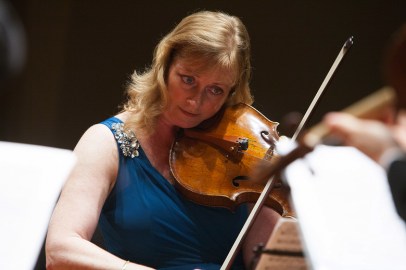
Cynthia Phelps is a regular participant in the Seattle Chamber Music Society’s Summer Festival.
Tonight the 2016 edition of the Seattle Chamber Music Society Summer Festival begins, with James Ehnes and his colleagues fresh from a Beethoven quartet marathon in Seoul. My preview has been posted on the Seattle Times website:
“Chamber music is about being able to trust your colleagues,” says violist Cynthia Phelps. That’s what enables the risk-taking that’s essential for this intimate musical medium, she explains. “And the chance to live and work together during the Summer Festival is a wonderful model for building that trust.”
Filed under: chamber music, James Ehnes, Seattle Chamber Music Society
July 4, 2016 • 12:48 am Comments Off on Happy Fourth of July!
 Arts & Culture Stories from NPR
